Monday, October 3, 2011

It's a trap! No, wait, it's a gift!

I like reading about the creative process and how various people working in various mediums go about making something out of nothing. Here, in an excerpt from an Associated Press article by Frazier Moore published earlier today, Trey Parker and Matt Stone, the creators of South Park, discuss the genesis of each episode:

By some accounts, the world was created in six days.

On the other hand, it takes Matt Stone and Trey Parker seven of them to create a "South Park" episode. But then they get no day of rest before they start on the next episode.

As you're reading this, Matt and Trey and the "South Park" team are back from their midseason break in their 15th year and are under the gun. The episode they started from scratch last Thursday morning will be finished just hours before it's delivered to Comedy Central for premiering Wednesday at 10 p.m. EDT.

How do they do it? And why do it that way?

Not long ago, while in New York to bask in the triumph of their smash Broadway musical, "The Book of Mormon," Matt and Trey took a few minutes to look ahead to the seven episodes of "South Park" facing them this fall.

"Comedy Central would love it if we did the shows ahead of time," Matt said. "But we just don't work as well that way."

"Our best ones," said Trey, "are always the ones where we come in on Thursday with nothing, and we come up with something and we get this energy — 'Ah, that's funny! That's funny!' — and we roll with it. The other way, we over-think things too much."

"I like the process of getting really excited about an idea on Thursday or Friday," Matt said, "and then there's a whole drama to the week: We jump into it, then on Saturday we go, 'Hmmmm. I don't know about this idea.' And you start questioning it."

"But you don't have a choice," Trey interjected.

"You're trapped!" Matt agreed.

Friday, September 30, 2011

Rock Bio #9: Frank Sinatra

Part of a series of brief artist biographies I wrote for Rhino.com in the spring of 2010 ...

Before Michael Jackson, the Beatles, or even Elvis, the biggest pop star in America was Frank Sinatra. In a career that spanned nearly 60 years, the baritone crooner from Hoboken, New Jersey, captivated audiences with a suave, almost conversational style that cut straight to the heart of each standard he made his own.

Francis Albert Sinatra dropped out of high school to chase his dream of being a singer, and in 1939, at age 23, he was hired as the vocalist in Harry James's big band. After six months he left to join Tommy Dorsey's outfit, and together they had more than a dozen top-ten hits, including "I'll Never Smile Again," which was number one on July 20, 1940, the day Billboard published its first chart.

Sinatra stepped out on his own as a performer in 1942 with Cole Porter's "Night and Day," becoming America's first teen idol later that year when he opened for Benny Goodman at New York City's Paramount Theater—young girls went wild. Columbia Records signed him as a solo artist in '43, and although a lengthy musicians' strike prevented Sinatra from recording again until the end of the following year, the label reissued a 1939 recording of "All or Nothing at All" by Harry James and Sinatra that shot to number one on the heels of the singer's newfound superstardom.

Sinatra appeared on popular radio shows like Your Hit Parade, and by 1945 his acting career was on the rise at MGM. He had eight top-ten hits that year, including "Saturday Night (Is the Loneliest Night of the Week)," written by Jule Styne and Sammy Cahn, and he made sure the duo were hired by MGM to write tunes for his first musical, Anchors Aweigh, costarring Gene Kelly. It was a box office smash.

"The Voice" left Columbia Records at the end of '52 and concurrently had no radio, TV, or film work lined up. At 37, Frank Sinatra was unemployed—but not for long. He signed with Capitol Records and was back on the charts soon after with "I'm Walking Behind You," and his film career was at its peak with a plum role in From Here to Eternity (1953), for which Sinatra won the Oscar for Best Supporting Actor.

At Capitol he collaborated with arranger Nelson Riddle on albums like Songs for Young Lovers (1954), which featured standards centered on a romantic theme ("They Can't Take That Away From Me," "I Get a Kick Out of You"); they were, in effect, pop music's first concept albums. Ol' Blue Eyes, as he was affectionately known, also recorded dance LPs—Swing Easy! (1954), Songs for Swingin' Lovers! (1956)—that continued to rule the album charts even as rock 'n' roll was taking over the singles charts.

In late 1960 Sinatra started up his own label, Reprise Records, and put his "Rat Pack" friends Dean Martin and Sammy Davis Jr. on the artist roster. Calling his own shots during this period, Sinatra worked with Count Basie ("Fly Me to the Moon"), Antonio Carlos Jobim ("The Girl From Ipanema"), and even his daughter Nancy on the number-one duet "Somethin' Stupid." He also won the Album of the Year Grammy for 1965's September of My Years on the strength of "It Was a Very Good Year."

The Chairman of the Board closed out the '60s with "My Way," the lyrics of which were written specifically for him by Paul Anka; it quickly became a standard. Sinatra cut back on recording and film roles in the following decades, but in 1980 he created yet another standard out of "Theme From New York, New York," originally performed by Liza Minnelli in Martin Scorsese's 1977 film.

Once compact discs were adopted as the standard format for music in the early '90s, Sinatra's back catalog was lavishly remastered and reissued. He then returned to the studio for Duets (1993) and Duets II (1994), which teamed him up with singers like Bono, Aretha Franklin, and Willie Nelson (though none of them recorded in the same studio as Sinatra). Both discs were hugely successful.

Sinatra retired from performing in 1995, just shy of 80. On May 14, 1998, he passed away, leaving behind a rich legacy as one of the greatest performers of the 20th century.

Saturday, September 17, 2011

everything in its right place

"Evan Connell said once that he knew he was finished with a short story when he found himself going through it and taking out commas and then going through the story again and putting commas back in the same places. I like that way of working on something. I respect that kind of care for what is being done. That's all we have, finally, the words, and they had better be the right ones, with the punctuation in the right places so that they can best say what they are meant to say."

—Raymond Carver, "On Writing," 1981 (from Call If You Need Me: The Uncollected Fiction and Other Prose, 2001)

On the other hand ...

... In the end, "What We Talk About [When We Talk About Love]" [Carver's 1981 short-story collection] was published much as [Carver's editor, Gordon] Lish wanted.

The book received front-page reviews. Critics praised its minimalist style and announced a new school of fiction. Even so, Carver continued to press for stylistic control over his work. He insisted that if Lish wanted to edit his next collection, he would have to keep his hands off. "I can't undergo [that] kind of surgical amputation and transplantation," he wrote Lish in August 1982. "Please help me with this book as a good editor, the best ... not as my ghost," he pleaded two months later.

Gordon Lish (photo credit: Bill Hayward)
Lish reluctantly complied. "So be it," he wrote in December 1982 after giving the manuscript to "Cathedral" only a light edit — although he wrote some acerbic criticisms in the margins. Even then, Carver feared a sneak attack. "I don't need to tell you that it's critical for me that there not be any messing around with titles or text," he warned Lish. Publicly, Carver also began to make a break. He made a point of telling interviewers that he controlled every aspect of his stories, invoking the adage that he knew a story was finished when he went through it once and put the commas in, then went through again and took the commas out.

Lish was angered by Carver's rebellion. He began asking his friends whether he should make his "surrogate work" public. They advised him to keep quiet. Don DeLillo, for example, warned him against taking Carver on. "I appreciate, and am in sympathy with, everything you say in your letter," he wrote to Lish. "But the fact is: there is no exposing Carver.... Even if people knew, from Carver himself, that you are largely responsible for his best work, they would immediately forget it. It is too much to absorb. Too complicated. Makes reading the guy's work an ambiguous thing at best. People wouldn't think less of Carver for having had to lean so heavily on an editor; they'd resent Lish for complicating the reading of the stories.

"In the meantime," he ended, "take good care of your archives."

—from "The Carver Chronicles" by D.T. Max, The New York Times Magazine, August 9, 1998

Wednesday, August 31, 2011

the two faces of America

As Marilyn Nelson explains in the foreword to A Wreath for Emmett Till (2005), her book-length poem is a heroic crown of sonnets, "a sequence of fifteen interlinked sonnets, in which the last one is made up of the first lines of the preceding fourteen."

Till, a 14-year-old Chicago boy, was visiting relatives in Mississippi in the summer of 1955 when he was kidnapped and murdered by two white men for supposedly whistling at a white woman. His mother held an open-casket funeral so the public could see how her child was mutilated by these men, who were charged with the murder but ultimately acquitted after a trial by an all-white jury.

Nevertheless, the battle for civil rights in the Deep South had begun.

Nelson's words pack a punch, especially in the following sonnet:

Trillium, apple blossoms, Queen Anne's lace,
woven with oak twigs, for sincerity ...
Thousands of oak trees around this country
groaned with the weight of men slain for their race,

their murderers acquitted in almost every case.
One night five black men died on the same tree,
with toeless feet, in this Land of the Free.
This country we love has a Janus face:
One mouth speaks with forked tongue, the other reads
the Constitution. My country, 'tis of both
thy nightmare history and thy grand dream,
thy centuries of good and evil deeds,
I sing. Thy fruited plain, thy undergrowth
of mandrake, which flowers white as moonbeams.

Young readers who stick with A Wreath for Emmett Till through Nelson's various twists and turns of phrase will be rewarded with an experience that bears comparison to a fiery gospel sermon delivered by a preacher whose heart is filled with equal parts rage and forgiveness. (Philippe Lardy's artwork is pretty, but the pen is mightier than the brush here.)

Not easily forgotten.

Friday, August 26, 2011

Rock Bio #8: a-ha

Part of a series of brief artist biographies I wrote for Rhino.com in the spring of 2010 ...

To many Americans, a-ha were a one-hit wonder who reached the top of the Billboard Hot 100 in 1985 with the synth-pop megahit "Take On Me," then quickly faded away. But like fellow European acts Simply Red and Jamiroquai, a-ha's popularity around the world continued to grow, dwarfing whatever chart success it enjoyed in the U.S.

Paul Waaktaar-Savoy (guitar), Magne "Mags" Furuholmen (keyboards), and Morten Harket (vocals) began collaborating in 1982 in Oslo, Norway, eventually moving to London to pursue a recording contract, where they signed with Warner Bros. Records. The original version of "Take On Me" was released as a single in the UK in 1984 but failed to chart. It was then rerecorded but failed to chart again, at which point the American arm of Warner Bros. invested in an innovative music video that combined live action and pencil-sketch animation. It became a huge hit on MTV and the song finally charted in the UK, peaking at number two.

The accompanying album, Hunting High and Low (1985), produced one more Top 40 hit in the U.S., "The Sun Always Shines on T.V.," though the song went all the way to number one across the pond. The band's next LP, Scoundrel Days (1986), featured a harder-charging sound on cuts like "Cry Wolf" and "Manhattan Skyline."

In 1987 a-ha recorded the theme song for The Living Daylights, the first James Bond film to star Timothy Dalton; it was another top-five UK hit for the group. Their third album, Stay on These Roads (1988), went platinum in Brazil, and in January 1991, while touring behind East of the Sun, West of the Moon (1990), a-ha played to a crowd of 198,000 at Maracana Stadium in Rio de Janeiro. It was the largest paying concert audience of all time.

After 1993's Memorial Beach, which included "Angel in the Snow," a song Waaktaar-Savoy wrote for his wife as a wedding gift, a-ha went on hiatus, with each member concentrating on solo projects. Then in 1998 they reconvened for the Nobel Peace Prize Concert, performing a new song Waaktaar-Savoy wrote for the occasion called "Summer Moved On." Two years later the track appeared on the platinum-selling Minor Earth Major Sky (2000) and went to number one in 17 countries, a triumphant comeback for the Norwegian trio.

Lifelines (2002) and the live disc How Can I Sleep With Your Voice in My Head (2003) followed in quick succession, and on the 20th anniversary of Hunting High and Low, a-ha released Analogue (2005), featuring guest vocals from Graham Nash. The single "Analogue (All I Want)" became the band's first to crack the UK top ten since "Stay on These Roads."

They continued their upward climb with 2009's Foot of the Mountain, which debuted at number five in the UK. With the '80s revival in full swing and Coldplay naming them as an influence, a-ha returned to their synth-pop roots on Foot of the Mountain while incorporating 21st-century influences like Arcade Fire.

That fall the band announced a farewell world tour for 2010, including dates in the U.S. The title of their final album notwithstanding, the "Ending on a High Note Tour" finds a-ha at the top of the global pop-music mountain.

Monday, August 15, 2011

Summer Movies = Fall Books

The following book recommendations were compiled for the website of the Robert M. Finley Middle School library in Glen Cove, New York, earlier this month. (Yes, I did it for a class project.)

Harry Potter and the Deathly Hallows, Part 2, the final installment of the film series based on J.K. Rowling's best-selling books, opened to rave reviews and blockbuster box office in July. Another popular series begins winding down this year: The Twilight Saga: Breaking Dawn, Part 1, the fourth film derived from Stephenie Meyer's novels about true love and true blood, hits theaters in November, with Part 2 arriving 12 months later. And if you're hungry for a new book-based series to replace those two on the big screen, The Hunger Games, starring Jennifer Lawrence (she plays Mystique in X-Men: First Class) as Katniss Everdeen, opens March 23, 2012.

However, movies adapted from novels aren't the only kind of big-screen entertainment that can spark an interest in the written word. For instance, if this summer's big-screen version of Thor made you curious about the mythological origins of the Marvel Comics superhero, you should check out Norse Mythology A to Z: A Young Reader's Companion, in which author Kathleen N. Daly gives the lowdown on Thor, Loki, Odin, and the Frost Giants as well as the fantastical worlds of Asgard and Jotunheim.

Thor is based on ancient folklore, but X-Men: First Class and Transformers: Dark of the Moon are based on true stories. Well, sort of. The X-Men prequel takes place against the backdrop of the Cuban Missile Crisis, an event that brought the world to the brink of nuclear war in October 1962. Disaster was averted thanks to clearheaded thinking among the leaders of the Soviet Union and the United States, not Professor X and Magneto, but in the end a good story's a good story, right? If you'd like to read more about the real-life decisions that were made to defuse the crisis, pick up a copy of Norman H. Finkelstein's Thirteen Days/Ninety Miles.

Meanwhile, the third Transformers movie puts forth the theory that the U.S. wanted its astronauts to be the first men on the moon in 1969 so they could investigate the crash landing of an Autobot spacecraft. Truth be told, the "space race" was an informal competition between the U.S. and the Soviet Union to be number one in cosmic exploration, and you can read about the many astronauts, cosmonauts, and scientists who made space travel possible in the 1950s and '60s in the graphic novel T-Minus: The Race to the Moon by Jim Ottaviani, Zander Cannon, and Kevin Cannon.

Captain America: The First Avenger is another summer movie that can stake a claim as historical fiction: the bulk of its comic-book-inspired action takes place during World War II. The hero, Steve Rogers, is a scrawny but brave young American who volunteers to become a genetically modified U.S. Army "supersoldier," while in Iain Lawrence's novel B for Buster a 16-year-old who goes by the name Kak lies about his age to enlist in the Canadian Air Force so he can escape an abusive home. As the book's dust jacket describes it, Kak "thinks the night ops over Germany will be like the heroic missions of his favorite comic-book heroes. Good will vanquish evil. But his first time out, in a plane called B for Buster, reveals the ops for what they really are—a harrowing ideal."

If Super 8 inspired you to make your own no-budget horror movies with your friends—minus the spectacular train crash, of course—then Troy Lanier and Clay Nichols's Filmmaking for Teens: Pulling Off Your Shorts is a good place to start in learning the tricks of the trade. You'll also need a good script, which is why Christina Hamlett's Screenwriting for Teens: The 100 Principles of Screenwriting Every Budding Writer Must Know is another essential read.

Finally, in case you were wondering, Bad Teacher, starring Cameron Diaz, is a work of fiction. Any similarity to actual persons, including those who've given you detention or failing grades, is purely coincidental.

For more on books that have been turned into movies, visit any of the following sites:

ChasingtheFrog.com: Movies Based on Books
Mid-Continent Public Library: Based on the Book
Arrowhead Library System: From Books to Movies
Movie Licensing USA: Books to Movies
KidsReads.com: Books Into Movies

Thursday, August 11, 2011

Why We Read

The following book passages and author quotes were compiled for the website of the Robert M. Finley Middle School library in Glen Cove, New York, earlier this month. (Yes, I did it for a class project.)

We ran into the Reardan High School Library.

"Look at all these books," he said.

"There aren't that many," I said. It was a small library in a small high school in a small town.

"There are three thousand four hundred and twelve books here," Gordy said. "I know that because I counted them."

"Okay, now you're officially a freak," I said.

"Yes, it's a small library. It's a tiny one. But if you read one of these books a day, it would still take you almost ten years to finish."

"What's your point?"

"The world, even the smallest parts of it, is filled with things you don't know."

Wow. That was a huge idea. —from The Absolutely True Diary of a Part-Time Indian by Sherman Alexie

For some of us, books are as important as almost anything else on earth. What a miracle it is that out of these small, flat, rigid squares of paper unfolds world after world after world, worlds that sing to you, comfort and quiet or excite you. Books help us understand who we are and how we are to behave. They show us what community and friendship mean; they show us how to live and die. —from Bird by Bird: Some Instructions on Writing and Life by Anne Lamott

The more that you read, the more things you will know. The more that you learn, the more places you'll go. —from I Can Read With My Eyes Shut! by Dr. Seuss

"Outside of a dog, a book is a man's best friend. Inside of a dog, it's too dark to read." —Groucho Marx

"Information is the currency of democracy." —Thomas Jefferson

"Once you learn to read, you will be forever free." —Frederick Douglass

"Reading is to the mind what exercise is to the body." —Joseph Addison

"It is what you read when you don't have to that determines what you will be when you can't help it." —Oscar Wilde

"Until I feared I would lose it, I never loved to read. One does not love breathing." —Harper Lee

"A truly good book teaches me better than to read it. I must soon lay it down, and commence living on its hint. What I began by reading, I must finish by acting." —Henry David Thoreau

"What really knocks me out is a book that, when you're all done reading it, you wish the author that wrote it was a terrific friend of yours and you could call him up on the phone whenever you felt like it." —J.D. Salinger

"We read to know that we are not alone." —C.S. Lewis, as played by Anthony Hopkins in the 1993 film Shadowlands, written by William Nicholson

"You think your pain and your heartbreak are unprecedented in the history of the world, but then you read. It was books that taught me that the things that tormented me most were the very things that connected me with all the people who were alive, or who had ever been alive." —James Baldwin

"My alma mater was books, a good library ... I could spend the rest of my life reading, just satisfying my curiosity." —Malcolm X

"When I look back, I am so impressed again with the life-giving power of literature. If I were a young person today, trying to gain a sense of myself in the world, I would do that again by reading, just as I did when I was young." —Maya Angelou

"Books are mirrors: you only see in them what you already have inside you." —Carlos Ruiz Zafón

"If you don't have time to read, you don't have the time (or the tools) to write. Simple as that." —Stephen King

"No tears in the writer, no tears in the reader. No surprise in the writer, no surprise in the reader." —Robert Frost

"The man who has no imagination has no wings." —Muhammad Ali

"You can't depend on your eyes when your imagination is out of focus." —Mark Twain

"I imagine that yes is the only living thing." —e.e. cummings

"If you're serious about becoming a professional writer, prepare to have some other way of earning a living. Many fine writers don't earn enough to live on. Read widely. Master the tools of writing. I know that spelling, punctuation, and grammar are boring, but they are necessary." —Beverly Cleary

"Read, read, read. Read everything—trash, classics, good and bad, and see how they do it. Just like a carpenter who works as an apprentice and studies the master. Read! You'll absorb it. Then write. If it's good, you'll find out. If it's not, throw it out the window." —William Faulkner

Friday, July 29, 2011

Rock Bio #7: Led Zeppelin

Part of a series of brief artist biographies I wrote for Rhino.com in the spring of 2010 ...

Led Zeppelin "wrote the book and all of us are just trying to write a page," said Paul Stanley of Kiss, in Danny Goldberg's Bumping Into Geniuses: My Life Inside the Rock and Roll Business. "They are the template and the road map that everyone else follows." Anyone who first heard "Stairway to Heaven" as a teenager and dreamed of being the next Jimmy Page would likely agree.

By 1968 Page was the last man standing in England's Yardbirds, after members like Eric Clapton and Jeff Beck had flown the coop. That summer he tried to recruit Terry Reid for a new band, but the singer's schedule was already full. Reid recommended another vocalist, 20-year-old Robert Plant, who then convinced drummer John Bonham, a longtime friend, to join Page's group with him. Bassist and keyboardist John Paul Jones rounded out the lineup.

Fulfilling a contractual obligation, Page's new band played some European dates as the New Yardbirds in September of '68, then switched their name to Led Zeppelin and recorded their eponymous first album in roughly 30 hours. Led Zeppelin (1969) included two Willie Dixon blues standards as well as future rock standards like "Communication Breakdown" and "Dazed and Confused." The band's thunderous approach to rhythm and blues and their interest in mythology—several of their songs contain references to J.R.R. Tolkien works like The Lord of the Rings—helped create the template for heavy metal and hard rock in the 1970s.

Led Zeppelin II was recorded at various studios while the band was on tour in 1969; it hit stores near the end of the year. "Whole Lotta Love" was a top-five hit in the U.S., where Zeppelin was becoming a major concert draw (shows sometimes lasted up to four hours and included 30-minute "Bonzo" drum solos), but the group didn't release singles in the UK or grant many interviews to the press, adding to their overall mystique.

Though 1970's Led Zeppelin III kicked off with the propulsive "Immigrant Song," the album showcased the quartet's acoustic folk influence on tracks like "That's the Way" and "Gallows Pole." Their next release had no title, and Zeppelin refused to edit the eight-minute "Stairway to Heaven" down to a single-friendly size, but 1971's "Led Zeppelin IV," as it's commonly known, still ended up selling 37 million copies over the next four decades, with "Stairway" becoming the most requested song of all time on rock radio stations. The untitled disc also featured instant classics like the riff-heavy "Black Dog" and "Rock and Roll," and the epic folk-rock number "The Battle of Evermore."

By 1973 Led Zeppelin was the biggest band in the world, allowing them to stretch out on that year's Houses of the Holy with playful stabs at reggae ("D'Yer Maker") and funk ("The Crunge"), while 1975's Physical Graffiti was a double album that contained Eastern influences ("Kashmir") alongside touches of country ("Down by the Seaside") and pop ("Houses of the Holy," left off the album of the same name).

The band launched their own Swan Song label through Atlantic Records in 1974, and their concert film The Song Remains the Same was a hit at the box office in '76, but Presence (1976) and In Through the Out Door (1979) arrived in record stores as punk and disco were dominating the musical landscape. On September 25, 1980, John Bonham died of asphyxiation. Led Zeppelin announced their breakup shortly thereafter.

Various one-off reunions have taken place over the past 30 years, including the band's induction into the Rock and Roll Hall of Fame in 1995. With Bonham's son, Jason, on drums, Zeppelin performed on December 10, 2007, as part of a tribute to Atlantic Records founder Ahmet Ertegun, but the band has been silent ever since. Fortunately for fans new and old, Led Zeppelin's timeless music continues to speak for itself.

Wednesday, July 27, 2011

Accept no substitutes.

This blog is not this blog.


Imitation may be the sincerest form of flattery, offending sir or madam, but ID theft feels like a particularly aggressive yet nonverbal way of saying "f**k you," so please come up with another name for your "internationally broadcast scratch paper" (that phrase is mine too—I'm calling retroactive dibs on everything). For instance, I have no qualms with the name Wineberry Koala 69, so think it over and get back to me. You have five seconds. (What do you think this is, a Capitol Hill debt-ceiling negotiation? I don't have that kind of patience.)

Also, in case anyone out there is confused, I've written for Popdose and Popblerd, but not Popdust, PopCrush, PopCrunch, PopSugar, or Pop Candy. Believe me, there have been days when I've felt like a fraud, but I'd still like to think I'm no one's carbon copy.

Monday, July 18, 2011

Welcome to Mulberry Panda 96, your one-stop shop for music-producer sleaze.

Thanks to Blogger's behind-the-scenes "Stats" feature (it hasn't always been there, has it?), I can find out which search-engine queries bring people here. My favorite so far is "'david gates' and 'producer' and 'sleaze.'"

Hey, the man from Bread ain't no sleaze. Or maybe you know something I don't about his business ethics and/or personal life, searcher. I'll allow you that Gates put a particularly innuendo-licious line in "If," but it took Telly Savalas's 1975 cover of the song to coax the sleaze out of its soft-rock shell.

If you're not sure what line I'm talking about, read this excerpt from Lester Bangs's review of The Best of Bread for Rolling Stone (May 24, 1973):

But the real payoff is side one, all those mellow yellow David Gates love ballads. "Make It With You" is the Seventies strawsippin' successor to "I Want to Hold Your Hand." It still melts my heart into a puddle of treacle. And that's because I'm treacle, not Bread; they're honchos!

... And they got plenty of sex in their songs too, don't let nobody tell you they're puds when they hit ya with lines like: "And when my [love for] life is running dry / You come and pour yourself on me." Ahhhhhhhhhhhh!

Now read these posts from last year that I recently rescued from their "draft" prisons (Lester Bangs shows up again, as does a much more juvenile sexual reference):

12/17: authors and other fools
10/10: I like your style, CyborgQX38.
9/24: My face is an open book.
8/2: Before Columbine, there was RoboCop 2.
8/1: Lisa Simpson's (imaginary) wedding day
6/11: Help us, Roger Ebert. You're our only hope.

Friday, July 1, 2011

My consciousness is gone with the wind.

"We still feel that color is hard on the eyes for so long a picture."

That's what Frank S. Nugent had to say about Gone With the Wind, the most successful film of all time (when its gross is adjusted for inflation), in the December 28, 1939, edition of the New York Times.

I'm ashamed to admit it, but I feel the same way about black-and-white movies. They make me sleepy. Is there a psychological diagnosis for this "condition," or am I just too accustomed to the faster pace of modern movies (specifically, everything from Jaws onward)? Then again, as my girlfriend says, "You think the pacing of the dialogue in His Girl Friday [1940] was slow?"

Monday, June 27, 2011

shortcut to movie limbo (or scenic route to movie oblivion?)

"I'd be a great film critic," Alec Baldwin says in the June 24-26 edition of USA Weekend, as part of a two-question interview (pace yourself, you hardworking Sunday supplement!) promoting his role as host of the Turner Classic Movies series The Essentials. "Most film critics make a huge mistake. The movie business is a director's medium. The actors actually have the least amount of responsibility for the film. It's really incumbent on critics to understand who is responsible for what's on screen."

It's true that film actors are generally at the mercy of their directors, not to mention the editors who shape performances in postproduction and sometimes discard them entirely on the cutting-room floor. But it sounds like Baldwin may still be irked that his career as a leading man went south in the '90s along with critics' opinions of box-office failures like The Marrying Man (1991), The Shadow (1994), and Ghosts of Mississippi (1996).

Baldwin started to gain weight around the time of 1997's The Edge, meaning he quickly transitioned from money-losing leading man to the more financially secure status of "character actor" (the talented Russell Crowe, whose metabolism seemed to give up on him after 2008's Body of Lies, appears to be entering this career phase himself, having been cast in a supporting role as Marlon Brando—I mean, Superman's biological dad—in the upcoming Man of Steel). It suits him well—Baldwin had great comic timing even before he entered John Belushi's weight class, having hosted Saturday Night Live 15 times since 1990, but it's certainly helped him pay the bills the past five years—and win a couple Emmys—as Tina Fey's boss on 30 Rock. He's the best thing about that show.

(The actor discussed his time near the top of the Hollywood food chain in a New Yorker profile three years ago. "In Hollywood, the success of [1990's 'The Hunt for Red October'] earned him 'an all-access pass that lasts for five years,' Baldwin recently said. 'You have to capitalize. And, if the movies you make don’t make money in that period, your pass expires.'" I'd never seen a former A-list leading man be that honest about his career before. It made me respect Baldwin even more.)

In 2001, after his big-ticket starring roles had dried up, Baldwin put his money where his mouth is and directed a film based on an old perennial of high school English classes, Stephen Vincent Benet's short story "The Devil and Daniel Webster." It starred Anthony Hopkins as Webster, who defends Baldwin's protagonist in supernatural court against the Devil (Jennifer Love Hewitt, an intriguing choice at the very least) after the struggling writer sells his soul to her and then decides he wants it back.

Sounds somewhat promising, but the film languished in postproduction limbo, appropriately enough, for more than five years after its funding dried up—Baldwin told reporters in 2004 that his investors' checks bounced while the film was being shot—leaving "The Devil and Daniel Webster" unfinished and potential distributors wary of picking up the tab.

Yari Film Group finally bought the film in 2007 and released it that July as Shortcut to Happiness. As proof of how many different hands the movie passed through on its way to (a handful of) theaters, 19 (!) producers are listed on the film's poster, including Baldwin, who chose to use the pseudonym "Harry Kirkpatrick" for his director's credit, having washed his own hands of the project.

So the next time you think Alec Baldwin has phoned in a performance, remember, it's not his fault. Blame it on the Devil if you have to, but even then keep in mind that it wasn't the Devil's idea to cast Jennifer Love Hewitt.

Friday, June 24, 2011

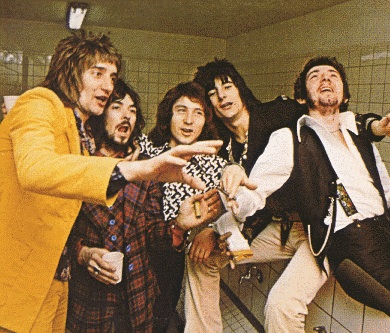
Rock Bio #6: Faces

Part of a series of brief artist biographies I wrote for Rhino.com in the spring of 2010 ...

Ever been to a raucous party that didn't end, it just changed locations? After the Small Faces' frontman, Steve Marriott, announced his resignation by walking offstage during a New Year's Eve performance in 1968, the rest of the group—Ronnie Lane (bass), Ian McLagan (keyboards), and Kenney Jones (drums)—decided to carry on with new members Ron Wood (guitar) and Rod Stewart (vocals), both of whom had recently left the Jeff Beck Group.

Having ditched the Marriott-led configuration's brand of mod pop for a more blues-based rock sound, the Small Faces shortened their name to signal that they were a new band and quickly got down to business, releasing First Step in early 1970. Stewart, meanwhile, had already begun a solo career, releasing his debut album, complete with contributions from Wood and McLagan, just a few months ahead of First Step.

Long Player followed in early '71. Its live covers of Paul McCartney's "Maybe I'm Amazed" and Big Bill Broonzy's "I Feel So Good" emphasized the Faces' growing reputation for sloppy, liquored-up concerts—punk rockers on both sides of the Atlantic took notice in the latter half of the '70s, as did the Replacements in the '80s—and Lane showed off his songwriting talents on "Richmond."

By the time the Faces' third album, A Nod Is as Good as a Wink ... to a Blind Horse, hit record stores at the tail end of '71, Stewart had been crowned a solo star thanks to Every Picture Tells a Story and its number-one hit "Maggie May," which spent five weeks atop the Billboard Hot 100. The Faces' own "Stay With Me" was lifted into the top 20 on the heels of "Maggie May's" success.

Stewart didn't tour separately from the Faces during this period, but because he also played his solo hits in concert, tensions arose between him and the rest of the band, who began to feel (ahem) faceless, mere backing musicians in the eyes of Stewart's newfound "Maggie May" fans. The singer was absent from some of the sessions for the band's next album, Ooh La La (1973), whose second side was dominated by Ronnie Lane compositions, including the wistful title track ("I wish that I knew what I know now / When I was stronger"), which featured Ron Wood's first-ever lead vocal.

After Stewart gave his low opinion of Ooh La La to the press, Lane quit the group and was replaced with ex-Free bassist Tetsu Yamauchi. The Faces carried on for a couple more years, releasing a live album and a few singles, but Stewart's solo career showed no signs of slowing down. As 1975 came to a close, the boys from England called it a day.

Wood replaced Mick Taylor in the Rolling Stones that year, while McLagan and Jones recorded two more Small Faces records with Steve Marriott, fresh from his tenure in Humble Pie. Lane sat out the reunion but kept busy by collaborating on albums with Wood and Pete Townshend before being diagnosed with multiple sclerosis in the late '70s. When the Who's drummer, Keith Moon, died in 1978, Townshend asked Jones to take over.

The Faces reunited in 1986 and '93 for one-off performances, but in September 2009 McLagan, Jones, and Wood played a charity event without Stewart (Lane died in 1997), adding new faces like Simply Red's Mick Hucknall to the mix. Only time will tell if Rod the Mod can be coaxed out of the house for one last pint.

Friday, June 3, 2011

kiss of death

Actress Jane Lynch has apparently aged quite a bit since I last saw her on the small screen, but I respect the fact that she refuses to "glam it up" for awards ceremonies. Good for you, Jane!

Friday, May 27, 2011

Rock Bio #5: Television

Part of a series of brief artist biographies I wrote for Rhino.com in the spring of 2010 ...

When Television took the stage at CBGB on March 31, 1974, it was a new club in Manhattan's Bowery district and they were a new band. But over the next six months, both gained a sizable following in New York music circles. Television's Sunday-night residency at CBGB lit a fire under the nascent genre of punk rock, which became the club's calling card in spite of its initials standing for "Country, Bluegrass, and Blues."

Tom Verlaine and Richard Hell, née Tom Miller and Richard Meyers, met in boarding school in Delaware in the mid-'60s. Verlaine wanted to be a musician, Hell a poet, and by 1967 they were both living in New York City. Verlaine's passion for John Coltrane and the saxophone eventually gave way to the Velvet Underground and electric guitar; Hell couldn't play any instruments, but Verlaine taught him some basics on the bass, and together they formed the Neon Boys with drummer Billy Ficca in 1972. The group wanted to add a rhythm guitarist but couldn't find anyone to their liking (Dee Dee Ramone and Chris Stein, soon to join Blondie, auditioned), and after recording six songs they called it quits.

Finally, in the fall of '73, Verlaine met Richard Lloyd and discovered a guitarist he could spar with onstage. Rebranded as Television (Hell's idea), Lloyd and the ex-Neons began to carve out a name for themselves on the New York club scene, attracting the attention of established stars like David Bowie and Lou Reed. But Hell's lack of experience on the bass was becoming a hindrance to the rest of the band, and in March of '75 he left Television, merging with ex-New York Dolls Johnny Thunders and Jerry Nolan soon after to form the Heartbreakers. He then left that band the following year to create Richard Hell & the Voidoids, whose song "Blank Generation" became one of the defining anthems of '70s punk.

Once Hell was replaced with Fred Smith, who defected from Blondie, the new lineup of Television recorded a single, "Little Johnny Jewel." Elektra Records liked what they heard—the inspiration for Television's sound was equal parts garage rock and free-form jazz—and in 1977 released Marquee Moon, considered by many to be one of the greatest debuts in rock history. By the time the band entered the studio to record it, they knew the album's eight cuts, including classics like "Friction" and "See No Evil," backward and forward. Rumor has it they recorded the ten-minute title track, which features exquisite intertwining guitar work from Verlaine and Lloyd, in one take.

Marquee Moon sold more copies in the UK than in the States, but Television quickly followed it up with Adventure (1978). Though it lacked the high-wire tension of its predecessor, the sophomore effort still produced memorable pop-rock tracks like "Foxhole" and "Glory." But after the album's supporting tour, Television disbanded. Verlaine and Lloyd pursued solo careers in the '80s, and Smith re-upped with Blondie.

In 1992 Television reunited for a third, self-titled album and their most extensive tour to date, but aside from additional concert and festival appearances in 2001 and 2007, the band hasn't recorded again. Nevertheless, the influence of Marquee Moon and Adventure's dynamic musicianship on artists like Lloyd Cole, Matthew Sweet, Echo & the Bunnymen, and even U2 and R.E.M. over the past 30 years has proven immeasurable.

Thursday, May 19, 2011

What a long, strange title it's been.

Many people believe that Hollywood produced more great movies in the 1970s than in any other decade. It certainly allowed some oddball titles to get through the system. Here's a sample:

Who Is Harry Kellerman and Why Is He Saying Those Terrible Things About Me? (1971): Dustin Hoffman plays a famous songwriter in director Ulu Grosbard's comedy-drama. Its title was referenced for the 2010 documentary Who Is Harry Nilsson (And Why Is Everybody Talkin' About Him)?, which is appropriate since Nilsson himself was a songwriter for hire—the Monkees recorded "Cuddly Toy" in 1967—before he found fame as a singer. His first Top 40 hit as a performer was "Everybody's Talkin'," the theme song to Midnight Cowboy (1969), which starred Hoffman. The song was written and originally recorded by Fred Neil, however, and Nilsson's biggest solo hit, 1972's "Without You," was a cover of a Badfinger song.

The Effect of Gamma Rays on Man-in-the-Moon Marigolds (1972): Paul Newman directed his wife, Joanne Woodward, in this family drama based on the Pulitzer Prize-winning play by Paul Zindel, who went on to write young-adult novels with similarly odd titles, such as My Darling, My Hamburger (considered a classic of YA literature), Harry and Hortense at Hormone High, Confessions of a Teenage Baboon, and Pardon Me, You're Stepping on My Eyeball! Alvin Sargent penned the screenplay for Gamma Rays as well as Robert Redford's directorial debut, Ordinary People (1980), which is a movie with an ordinary title, but he also wrote or cowrote films as diverse as Paper Moon (1973), Unfaithful (2002), What About Bob? (1991), and Spider-Man 2 (2004), an accomplishment that isn't ordinary at all.

Love and Pain and the Whole Damn Thing (1973): One of Sargent's lesser-known films (along with 1978's Straight Time, another collaboration between Ulu Grosbard and Dustin Hoffman) is this romantic drama starring Maggie Smith and Timothy Bottoms (The Last Picture Show) and directed by Alan J. Pakula, his follow-up to 1971's Klute. In Peter Bart and Peter Guber's book Shoot Out: Surviving Fame and (Mis)Fortune in Hollywood, Pakula is quoted as saying that the movie's title accurately described how he felt about opening weekend: "I wish I could make movies but never have to release them."


A Hero Ain't Nothin' But a Sandwich (1978): My favorite of the four titles spotlighted here, director Ralph Nelson's drama centers on a 13-year-old heroin addict and is based on a young-adult novel by playwright and author Alice Childress. Her name is the title of a song on Ben Folds Five's 1995 self-titled debut album, but it isn't about her—Anna Goodman, the song's cowriter (along with Folds), named "Alice Childress" after a patient of the same name at the mental institution where she once worked. The film version of A Hero Ain't Nothin' But a Sandwich stars Cicely Tyson, Paul Winfield, and Larry B. Scott, who's still probably best known for his role as Lamar in Revenge of the Nerds.

Wednesday, May 18, 2011

"Boldy" is my new favorite typo.

"Throughout the film's production, [20th Century Fox chairman Bill] Mechanic—especially Mechanic—had taken on the pressure with a wavering composure. He had stood up for Fight Club as boldy as he could, but after this screening, he knew that if this baby didn't fly, there might be a huge career price to pay."

—from chapter 12 of What Just Happened? Bitter Hollywood Tales from the Front Line (2002) by Art Linson, producer of Fight Club, Fast Times at Ridgemont High, and Into the Wild but not Jodie Foster's The Beaver, which is "boldy original," according to People magazine

Monday, May 2, 2011

If you go too fast and furious, Roger Ebert will get lost.

In his April 29 review of Fast Five for the Chicago Sun-Times, Roger Ebert wrote:

The "F&F" titles got confusing with the unrelated "Fast and Furious: Tokyo Drift" and John Singleton's "2 Fast 2 Furious," which is why, I suppose, "Fast Five" drops the "furious." But it isn't technically the fifth "F&F" unless you count the outliers. So I don't know what "Five" refers to. That doesn't bother me.

Maybe the titles did get confusing since only two in the decade-old series employ numbers—it doesn't help that the first and fourth entries essentially have the same title—but if Ebert had checked his facts he wouldn't be so confused. (Perhaps he should have visited Mulberry Panda 96 for a refresher course on the highly profitable street-racing saga.)

The series' second entry, 2 Fast 2 Furious (2003), stars Paul Walker, who was also in the first film, The Fast and the Furious (2001); his costar in the sequel was Tyrese Gibson, who returns in Fast Five. Vin Diesel skipped 2 Fast 2 Furious but showed up in a cameo at the end of 2006's The Fast and the Furious: Tokyo Drift—which didn't feature any other characters from the first two films—then returned to the series full-time, along with Walker, for Fast & Furious in '09.

See, Roger? They're all connected, and Fast Five really is the series' fifth installment, even if it sounds more like the name of a lotto game than a movie. And since it had an $86 million opening weekend, it's a safe bet that "Grandmaster Fast and the Furious Six" will be crashing into a theater near you sometime in 2013.

Friday, April 29, 2011

Rock Bio #4: Bee Gees

Part of a series of brief artist biographies I wrote for Rhino.com in the spring of 2010 ...

Unless you were living under a rock in 1978, the sound of the Bee Gees was inescapable. The brothers Gibb—twins Robin and Maurice and older brother Barry—were all over the radio that year thanks to "How Deep Is Your Love," "Stayin' Alive," and "Night Fever," their number-one singles from the record-breaking Saturday Night Fever soundtrack album. Then there were the smash hits they wrote for other artists, including "If I Can't Have You" (Yvonne Elliman), "Emotion" (Samantha Sang), and "Grease" (Frankie Valli), not to mention the singles they penned with their little brother, Andy, who rocketed to the top of the charts himself with "(Love Is) Thicker Than Water" and "Shadow Dancing."

The Bee Gees may have become the poster boys for the American disco explosion of the late '70s, but their origins were much different. Born in England, the Gibbs started performing together as children in 1955. A few years later their family moved to Brisbane, Australia, where a local DJ started playing their songs on the radio, leading in short order to club gigs, TV appearances, and a debut album in 1965. Emboldened by the Beatles' success in the United States, the Gibb brothers returned to England the following year, where manager Robert Stigwood heard their Australian LP and signed them to a five-year contract with Polydor Records.

In the beginning the Bee Gees' music had a psychedelic, Beatlesque feel; some American DJs and listeners even mistook the group's first hit, "New York Mining Disaster 1941," for a new single from the Fab Four. However, their knack for blue-eyed soul was already evident—their second stateside hit, 1967's "To Love Somebody," was originally written for Otis Redding to sing.

The Bee Gees continued to pick up steam in the U.S. with hits like "I Gotta Get a Message to You" and "I Started a Joke," but a disagreement over which song from 1969's Odessa should be released as a single led Robin to quit the group for a brief period. After the brothers regrouped in late 1970 they scored their first number-one hit in the U.S., "How Can You Mend a Broken Heart," but for the next three years their soft-rock balladry and Moody Blues-style progressive pop failed to generate much interest.

It wasn't until Stigwood introduced the Bee Gees to producer Arif Mardin in 1974 that the second phase of their career began to take shape. Their first collaboration, Mr. Natural, pushed the group in more of an R&B direction than ever before, and on the follow-up, 1975's disco-flavored Main Course, Mardin utilized Barry's now famous falsetto for the very first time on "Nights on Broadway."

Main Course's "Jive Talkin'" went all the way to number one, as did "You Should Be Dancing," from 1976's Children of the World. The disco boom was coming to an end in the States when Saturday Night Fever arrived in movie theaters in December of '77, but the John Travolta film and its iconic soundtrack album, which eventually sold 40 million copies, revived disco's fortunes and then some. When the Bee Gees released their next album, Spirits Having Flown, in early '79, it yielded three more consecutive number-one hits: "Tragedy," "Too Much Heaven," and "Love You Inside Out."

The Bee Gees kept a fairly low profile in the first half of the '80s, contributing new songs to the soundtrack of Saturday Night Fever's sequel, Staying Alive (1983), and writing hits like "Heartbreaker" for Dionne Warwick and the Kenny Rogers-Dolly Parton duet "Islands in the Stream." In 1989 they proved they could still scale the charts themselves when their single "One" landed in the Billboard top ten, a fitting comeback for three brothers with one unforgettable sound.

Tuesday, April 26, 2011

My infatuation with Three Days of the Condor is forever (dot dot dot).

Film critic Juliette Small invites her daughter, Erica, and Erica's friend Katherine to join her for an advance screening of a new Robert Redford movie in chapter 14 of Forever..., Judy Blume's controversial 1975 novel about young love, which I'm reading for a grad-school research paper on young-adult fiction.

After the picture Mrs. Small asked me, personally, what I thought of it.

"Well ..." I told her, "I just love Robert Redford."

"Don't we all ..." Mrs. Small said, "but I mean about the story."

"Oh, the story ... I liked it ..."

"But ..."

"I don't think it could happen that way in real life ..."

"Exactly!" she said. "But you wanted it to, didn't you ... you were hoping it would turn out just that way."

"Yes," I told her.

"You see ... that's the whole point."

"It's going to be a smash," Erica said.

"In spite of my review, you mean?"

"In spite of anybody's review."

"I agree with you, completely," Mrs. Small said.

In 1975 Robert Redford starred in two films, The Great Waldo Pepper and Three Days of the Condor. The former was scripted by William Goldman and directed by George Roy Hill, who had previously collaborated with Redford on 1969's Butch Cassidy and the Sundance Kid, while the latter was helmed by Sydney Pollack, who, prior to Condor, had already directed the California native in three films, including the western Jeremiah Johnson (1972) and the romantic drama The Way We Were (1973), costarring Barbra Streisand.

The Great Waldo Pepper is a period piece in which Redford plays a 1920s stunt pilot, but Three Days of the Condor is a contemporary thriller that asks audiences to believe that a guy as handsome as the Sundance Kid is employed by the CIA as a bookworm rather than a dashing James Bond clone. As Katherine says, "I don't think it could happen that way in real life." But you want it to.

Waldo was released in March of '75; Condor came out in September. When Katherine, the protagonist of Forever..., takes a train from Westfield, New Jersey, into New York City with Erica and her mom to see "a preview of a new Robert Redford picture," it's either late March or early April in the book's narrative. Yes, I'm fully aware of the possibility that Blume isn't talking about any Redford movie in particular—for one thing, I don't know when exactly Forever... was published in '75 (spring, summer, etc.), or if she even had a particular year in mind besides "right now, whenever that is" when she wrote the book, or if copyright issues prevented her from using the title of an actual Redford movie—but a boy can still dream, even when he's no longer a young adult.