Sunday, June 10, 2012

My face is still an open book.

Here's another two years' worth (May 2010-May 2012) of shameless filler gathered from you-know-where.

1. Rand Paul says President Obama's criticism of British Petroleum is "un-American." Yes, a guy from the Tea Party is defending the British.

2. It's a good thing Lost ended when it did, before that BP oil spill started messing with the islanders' ecosystem.

3. South Carolina blogger claims "inappropriate physical relationship" with gubernatorial candidate. Update: Blogger admits to identical relationship with himself, since it's a fact that most of us bloggers have our heads up our ...

4. If North and South Korea were characters on As the World Turns, North Korea would be "the evil twin."

5. Can't all the drunken Cubs fans who stumble around after games be rounded up and used to plug the BP oil well?

6. Before BP polluted it with millions of gallons of crude oil, the Gulf of Mexico was a majestic, unspoiled body of water, not to mention a convenient place to use the bathroom.

7. Each Transformers movie is two and a half hours long. Each Sex and the City movie is also two and a half hours long. The battle of the sexes has reached a cinematic stalemate.

8. ‎"Obama Memorial Day talk canceled by severe storm," reports the Associated Press. It's safe to assume that when the head of BP schedules a talk, God will send locusts.

9. Avatar director James Cameron held a meeting with other deep-sea experts on Tuesday to discuss the BP oil spill. It quickly became the most expensive meeting of all time, but Cameron's PowerPoint presentation was hailed as "pulse-pounding entertainment," "a riveting display of words and rectangles," and "really really really blue, unlike the Gulf of Mexico these days."

10. The FTC has admonished Kellogg's for claiming that Rice Krispies can bolster children's immunity. It's also unhappy about those General Mills ads that promise "immortality" to anyone who eats Count Chocula.

11. In 2008 Owen Wilson costarred with a dog in Marley & Me. This year he's providing the voice of the lead canine in Marmaduke. Next up for the actor: a literal remake of Lasse Hallström's My Life as a Dog, with digitally enhanced squirrel chases and 3-D crotch sniffing.

12. SOS! Jokes about BP oil spill running out much faster than the oil that's still spilling!

13. What veteran White House reporter Helen Thomas meant to say was "The Israelis—and everyone else—should get the hell out of Palestine so someone can clean the place. Some of that dirt's almost as old as me."

14. Two suspects reportedly stole Kanye West's Porsche in Honolulu last Saturday, then paid tribute to his appearance at last year's MTV Video Music Awards by crashing it into a wall.

15. On Wednesday actor and environmentalist Kevin Costner told Congress his strategy for cleaning up the BP oil spill, promising under oath that it doesn't involve him playing another washed-up former athlete.

16. The Annie comic strip is ending today after an 86-year run, according to the Associated Press. Tragically, the mystery of the little orphan's missing pupils remains unsolved.

17. "Good or Bad, Baby Names Have Long-Lasting Effects," say LiveScience.com reporters Hugh Jass and Ivana Tinkle.

18. As the fighting continues in Kyrgyzstan, the Red Cross is asking the international community for sizable donations of blood and vowels.

19. "Sea creatures flee oil spill, gather near shore," reports the Associated Press. We all know what that means—CALL IN THE UNION BUSTERS!

20. BP CEO Tony Hayward to Congress: "I'm sorry." Congressman Joe Barton to Hayward: "No, I'm sorry!" America to Barton: "Either kiss him or SHUT UP."

21. ‎"Saaaaaaailing takes Tony Hayward awaaaaaaay from where everyone hates his guts ..."


22. Sorry, LiveScience.com, but your article "Why Summer Begins Monday" doesn't explain why my Fourth of July hangover started last Tuesday. Wooooooo!

23. Getting back the six hours you wasted standing in line for a new iPhone 4—there's not an app for that.

24. Earlier today the U.S. Supreme Court extended the rights of gun owners, who celebrated by firing their weapons into the air, accidentally killing all nine Supreme Court justices once the bullets fell back to earth.

25. Happy belated birthday to Gary Busey, who turned 66 yesterday! (R.I.P. Gary Busey's brain, which would've turned 66 yesterday.)

26. Why does the U.S. Postal Service sell stamps that are "Forever"? Because with a potential $7 billion loss next year, it may not be.

27. What the government doesn't want you to know about the U.S.-Russia spy swap is that LeBron James was handed over to the other side in exchange for our agents. The LeBron James who signed with the Miami Heat is a robot. But it's a jive-talking robot, so it'll still be worth the billion dollars Miami's already spent.

28. A new Sarah Palin biography due in September will be aimed at 9- to 12-year-olds, according to the AP. This is a brilliant move on the publisher's part: since the former Alaska governor already appeals to adults who read at a grade-school level, the book can easily be repurposed at no extra cost.

29. LeBron's "decision" may have upset Cleveland, but it's still less of a downer than Sophie's "choice."

30. The AP reports that the decade-old Mel Gibson movie What Women Want is being remade in Chinese. So what do women want in 2010? If they're smart, not Mel Gibson.

31. ‎"Glenn Beck says he's been diagnosed with an eye disease that could eventually blind him," reports the AP. You have my deepest sympathy, Mr. Beck. By the way, how did your appointment with the mouth doctor go?

32. In light of recent events, Arizona governor Jan Brewer has announced plans for an ironic weekend getaway to Cancun.

33. I keep seeing headlines about a Clinton wedding. Is Bill getting married again? And does Hillary know?

34. Newsweek has been sold to a 90-year-old billionaire. Boy, ever since Anna Nicole Smith passed away, these rich old guys have really struggled to figure out the best way to lose their fortunes.

35. Congratulations to all gays and lesbians in California, who, if I understand correctly, can now legally marry illegal immigrants in Arizona!

36. I just killed some time by clicking on "Older Posts" at the bottom of this page until I got to my first status update, which was "holding somebody's baby," from September 5, 2007. It's nice to see that even though the Great Recession hadn't yet begun, I was already cutting back on my verb usage.

37. The Wall Street Journal reported last week that Star Wars creator George Lucas is "dedicating the majority of my wealth to improving education," presumably in the hopes that future generations will never write movie dialogue as bad as his.

38. Former Illinois governor Rod Blagojevich has been found guilty of only 1 out of 24 counts of criminal corruption. Wow, great hair really can beat the odds!

39. A new Pew Research Center poll says approximately one in five Americans think President Obama is a Muslim, while a new Cass Research Center poll indicates that nearly four out of five Americans believe turn signals are "optional."

40. ‎"Workplace fatalities decline to historic low," reports The Wall Street Journal. In order to make up the difference, employers are graciously allowing the unemployed to continue dying on the inside.

41. A rejected Canadian Idol contestant from 2008 has been arrested on suspicion of terrorism in Ottawa, according to The New York Times. 'Bout time our neighbor to the north took a stand against aural torture!

42. Glenn Beck says America has "wandered in darkness" too long. But when the alternative is turning on the lights and seeing Glenn Beck, I say: STAY THE COURSE, AMERICA.

43. On tonight's episode of "Is That an Unfortunate Headline in Your Pocket or Are You Just Glad to See Me?" our special guest is TheDailyBeast.com's "Gay Republicans Rising"!

44. Good news! "Craigslist removes adult services section," says the AP. Now I can buy my sex and drugs once again through paid classifieds in the Sunday paper, the way God intended.

45. ‎"A small US church says it will ... burn copies of the Koran on the 9/11 anniversary," reports the BBC. (Please don't let it be a church down south, please don't let it be a church down south ...) "The Dove World Outreach Center in Florida—" (D'oh!)

46. ‎Resident Evil: Afterlife is number one at the box office. In related news, your loud next-door neighbor isn't evil, per se, but if zombies were to eat his brain you probably wouldn't lose any sleep. (In fact you'd sleep much better.)

47. According to the Chicago Sun-Times, British researchers have found that "a good deal on something so mundane as a loaf of bread" can elicit "an emotional response similar to seeing erotic images." Bottom line: in either case you're not getting screwed.

48. I started out bald and chubby and believe it's my duty to complete the circle.

49. The National Center of Health Statistics is reporting that life expectancy for Hispanics in the U.S. is greater than that of whites and blacks. This means that even after Lou Dobbs dies, he'll still be able to hire undocumented Mexican workers.

50. After being trapped underground for two months, previously anonymous Chilean miners are suddenly world famous. Using that same logic, can the cast of Jersey Shore go back to being nobodies if we bury them alive?

51. Mundane Mysteries of the Universe #1: No matter what time of day you go to the grocery store, an inventory cart will be blocking access to the yogurt.

52. Former president George W. Bush says in his new memoir that he thought about leaving Dick Cheney off the Republican ticket in 2004, but once he saw the vice-president choke a man to death using only his mind and pure evil, he quickly reconsidered.

53. On this day in 1884, the Washington Monument was completed after 36 years of erectile dysfunction.

54. On Monday morning I saw Chicago mayoral candidate Rahm Emanuel jaywalk across State Street. Just think of the crimes and misdemeanors he could commit if he's elected! Mr. Emanuel, if you promise to uphold the local tradition of adding dead people to voter rolls in order to swing presidential elections, then you have my vote, sir.

55. Mundane Mysteries of the Universe #2: Sweatpants are usually appreciated the most by people who hate working up a sweat.

56. Yo, New York City! If you're so busy never sleeping, how come you couldn't find time for shoveling?


57. Senator Joe Lieberman announced today that he will retire at the end of his term in 2012. In other news, God announced that tomorrow is December 31, 2012.

58. ‎"Supreme Court Justice Clarence Thomas has amended his financial-disclosure forms after a liberal group, Common Cause, said he was failing to report the employment of his wife, conservative activist Virginia Thomas," reports The Wall Street Journal. Then again, after her embarrassing phone call to Anita Hill last fall, maybe Thomas is trying to deny his wife's entire existence, not just her employment.

59. Congratulations to Black Swan, the closest the Academy got this year to nominating a black film!

60. On my way back from Oak Park this morning in the blizzard, walking through 18-inch snowdrifts on unshoveled sidewalks, I noticed a guy in winter jogging gear huffing and puffing his way down Halsted Street. This is the kind of thing that's missing from apocalyptic weather-disaster movies like The Day After Tomorrow and 2012: the guy who goes about his everyday routines while cars are being swallowed up by massive cracks in the earth, occasionally spitting out one-liners like "One more reason why I don't drive, people ..." (In conclusion, don't cancel your yoga class just because it's Judgment Day.)

61. President Obama met with Steve Jobs, Mark Zuckerberg, and Google's Eric Schmidt in California yesterday, reportedly to beg for "a cushy desk job" once they officially take over the world this summer.

62. Mel Gibson pledging his support for Charlie Sheen is a little like brain cancer defending the moral character of heart disease.

63. If you're the president of the United States, you're halfway through your first term, and spring is right around the corner, then it must be time to blow some shit up in the Middle East. (You make me blue, déja vu.)

64. The Wall Street Journal reports that Detroit's population plunged 25 percent in the past decade. The cause? Black flight, preceded by decades of white flight. The solution? Skyrockets in flight, which scientists predict will lead to afternoon delight and enough pregnancies to repopulate the Motor City by January.

65. "Flotsam from Japan's tsunami to hit US West Coast," reports the AP. Ugh! Flotsam never tours the midwest. Jetsam had better make an appearance at Lollapalooza or I'm going to be seriously upset, you guys.

66. The best part about a government shutdown? All the "classic" reruns on C-SPAN, of course. Be sure to catch the 1957 epic "Strom Thurmond's 24-Hour Segregationist Filibuster" starting at midnight, followed by the deepest sleep you've experienced in a long, long time starting at 12:05.

67. "Benicio Del Toro expecting child with Kim Stewart," reports the AP. Meanwhile, Reuters takes a judgmental tone: "Benicio Del Toro impregnates Rod Stewart's daughter." But that's nothing compared to the Arizona Tattler's headline: "Suspected illegal immigrant caught stealing movie roles and celebrity sex from hard-working Americans."

‎68. "Gwyneth Paltrow turns love of food into a book," says the AP, which is ironic since I've recently turned mild depression into a love of food!

69. Today is Record Store Day. Visit one of your 1.7 remaining local music retailers so the bearded, black-frame-eyeglasses-wearing cliché behind the counter can demonstrate his complete lack of people skills as he looks down on your taste in music, thereby causing you to exit the store without buying anything and defeating the purpose of the entire day. Enjoy!

70. ‎"Schwarzenegger to star in proposed new 'Terminator,'" reports Reuters. In this fifth installment of the series, the Terminator travels back in time to 2012 and runs for president, but in spite of his thick Austrian accent, robotic walk, and ability to withstand assassination attempts by deflecting bullets with his face, no one ever questions where he was born. Not even once. Isn't science fiction crazy?!

71. "Coffee, Sex Increase Aneurysm Risk," according to U.S. News & World Report. When used in tandem they also increase the chance of third-degree burns on sensitive areas, so proceed with caution.

72. "Al-Qaida likely to elevate No. 2," says the AP, "or name no one." Or Brett Favre's agent will make a last-minute offer. Stay tuned ...

73. Fifty years ago today President Kennedy told Congress that he hoped to put a man on the moon by the end of the decade. He also hoped to put Marilyn Monroe on his lower torso by the end of the week. Guess what? He accomplished both. God bless America.

74. First Mayor Daley stepped down. Then Oprah. Do you see where I'm headed with this, Chicago Cubs? The difference is, those two went out on top. To do the same you'd have to play your final game at the North Pole. But you're used to brutal Chicago winters, so I'm sure you'll dress accordingly.

75. Barack Obama? Mitt Romney? I'm suspicious of any presidential candidate whose name forces my tongue to use its brain. Say, that reminds me—whatever happened to John Edwards? Now, there's a name you could trust.

76. Earlier today Apple introduced iCloud. An hour later God sued Apple for trespassing and issued the following statement: "Heaven isn't as crowded as people think, but I'll be damned if Steve Jobs is going to make me responsible for housing ten billion pirated Lil Wayne MP3s."

77. ‎"Natalie Portman gives birth to baby boy," says Reuters, but my sources claim she used a pregnancy double for 75 percent of the labor.

78. On Saturday my youngest niece was upset because she didn't have as many pennies and nickels as her big sister. "I want more money," she quietly whimpered. I tried to console her by saying that even though we'd all like more money, we shouldn't concern ourselves with how much other people have. What I'm saying is, I lied to a four-year-old.

79. "Spelling mistakes 'cost millions' in lost online sales," says the BBC. So true. Last year I spent a small fortune trying to beat Noxzema at its own game, but in the end only a handful of genocidal dictators were interested in my new product, Bobby C's All-Natural Racial Cleanser.

80. I was nominated for Best Supporting Actor at the 2005 Delusional Academy Awards for my five-minute performance in Common Senses, but somehow I still lost to George Clooney in Syriana. Man, he's good!

81. In 1972 Robert De Niro sold his soul to the devil. In return he won two Oscars and was hailed as the best actor of his generation. But if the new trailer for New Year's Eve is any indication, when the clock strikes midnight this New Year's Eve the devil will be coming around to collect.


82. Sir Paul, it was a thrill to hear "Band on the Run" and "Ob-la-di, Ob-la-da" echoing from Wrigley Field last night as I walked home from the grocery store down the street, but you were almost upstaged inside the store by two men belting "Let 'Em In." Good call, Paul—I wouldn't have let 'em in either, but if you're looking for a good deal on Chicago-style meth after tonight's show, I'm sure they can accommodate you.

83. "Costly Drone Is Poised to Replace U-2," says The New York Times, proving that even the nation's best newspaper can't resist taking a shot at Coldplay.

84. The Wall Street Journal says New York attorney general Eric Schneiderman is cracking down on bank fraud, so if he has any skeletons in his closet he'd better confess now, or else he could end up just like his predecessor, Elliot Spitzer—in other words, the host of a talk show on CNN. Oh, the humanity!

85. To set itself apart from other talent-competition shows, Fox's The X Factor will reportedly take a cue from the network's parent company and its innovative approach to fact gathering. For example, after a bad performance celebrity judge Simon Cowell is likely to remark, "Don't deny you're a dreadful singer. You said so yourself in a voice mail to your mum just the other day."

86. It's no wonder so many people are terrified of public speaking.

87. Whenever you find yourself saying, "Same shit, different day," be thankful you're not saying, "Different shit, same day," because there's only so much shit a person can take in one day.

88. "Ex-NJ Gov. McGreevey finds niche mentoring inmates," says the AP. So don't fret, ex-Illinois governor Rod Blagojevich—help is on the way.

89. In his new book, Retromania, music critic Simon Reynolds argues that popular culture is recycling its past faster than ever. Does that mean the current stock-market roller coaster is merely a display of affectionate nostalgia for the fall of '08? (Everybody wang chung tonight, everybody foreclose tomorrow.)

90. On Sunday the news ticker outside ABC7's State Street studio in Chicago read: "In describing the affect of Hurricane Irene, Mayor Bloomberg says NYC 'dodged a bullet.'" What kind of affect did it have, exactly? An overconfident swagger? A fake British accent? A cigarette holder in one hand, a Pomeranian in the other? Tell me more, local news ...

91. Whenever you pass by a local restaurant advertising a "world-famous" menu item, it's important to remember that the world is a much smaller place than it used to be.

92. Did Pat Robertson name his TV show The 700 Club because only 700-year-olds are feeble-minded enough to believe whatever he says? (Current club members: Robertson, Mickey Rooney; Hall of Fame inductee: Methuselah; Hall of Shame nonbeliever: Yoda.)

93. Former teen idol and current Tea Party "birther" Pat Boone recently told the San Francisco Chronicle that President Obama is "spending millions of dollars so that we do not have his records." But where can average Americans sign up to pay millions to ensure that nobody has Boone's 1950s pop records? I've heard that paying the president's "Buffett tax" will protect our borders from Parrotheads, but will it also keep out Boone's vanilla covers of "Tutti Frutti" and "Long Tall Sally"?

94. Whenever people say, "I wasn't born yesterday," they're not lying, but if I had made that statement on September 26, 1975, I would've looked like a fool. Luckily, I was asleep most of that day. Also, I didn't know how to speak English yet. (In case you're wondering, I still use those excuses as an adult, but they rarely pan out.)

95. Apropos of nothing, I didn't care for the Sharon Stone movie Silver.


96. "Whoopi Goldberg says potato chips are her weakness," according to the AP. Robert Cass says this is not news.

97. "Formerly Imprisoned Politician Explains Prison Sex," reports The Atlantic Wire, and you can read all about it in his new book, Everything You Always Wanted to Know About Prison Sex or Anything Else That Can Help Me Reduce These 500 Hours of Community Service (But Were Afraid to Ask).

98. Hank Williams Jr. has apologized for comparing President Obama to Adolf Hitler, stating on his website, "You obviously can't believe everything you read in Famous Vegetarians Monthly. I'm canceling my subscription today."

99. Yo' bank's fiscal arrogance so fat, when it occupy Wall Street it occupy Wall Street.

100. Sean Combs, a.k.a. Puff Daddy, Puffy, P. Diddy, and Diddy, is the latest victim of identity theft, according to the Chicago Sun-Times. "I'm just glad I still have a half-dozen identities left," said the hip-hop producer, record executive, actor, fashion designer, perfume maker, and restaurant owner. "Besides, it's not like anyone was begging to hear me rap again."

101. The villain of the new Ben Stiller-Eddie Murphy movie Tower Heist is modeled after Bernie Madoff, while the sitcom 2 Broke Girls and the recently canceled update of Charlie's Angels feature lead characters whose convict dads are Madoff types. Conclusion: the notorious Ponzi schemer stole from the rich so that Hollywood could give us poor excuses for entertainment.


102. "Various '7 billionth' babies celebrated worldwide," says the AP. In other news, Arnold Schwarzenegger has put his recently rebooted acting career on hold, citing a desire to spend more time with his families.

103. I bet Herman Cain's best pickup line in the '90s was "The only topping you need is me, baby."

104. If you're obsessive-compulsive and you live in Saluda, North Carolina, remember to vote for Lynn Cass for city council, and don't stop voting until you're confident you made the right choice multiple times. (By the way, are you sure you locked the front door this morning?)

105. "Studio executives concede it's growing harder to lure fans into [movie] theaters given all the portable games, devices and other electronics people have to fill up their entertainment time," says the Associated Press. So how come those people always end up sitting behind or beside me in the theater?

106. "Herman Cain Tells Supporters 'It Ain't Over Till It's Over, and It Ain't Over,'" reports ABC News. Meanwhile, in Florence, Italy, the Fat Lady has accused Herman Cain of sexual harassment.

107. All these unwatched episodes of A&E's Hoarders, TLC's Hoarding: Buried Alive, and OWN's Extreme Clutter seemed to pile up on my DVR so quickly ...

108. Dear Expanding Waistline: Why do you insist on pushing me out of the spotlight? Concerned, Fading Youth

109. TONY CURTIS: "You probably remember me from 'Some Like It Hot.'"

MADONNA (distracted): "Uh-huh. Yeah, I love that song. The Power Station's great."

MICK JAGGER (under his breath): "Bloody Yanks ..."


110. In the movie Limitless Bradley Cooper's character becomes the smartest man in the world through the magic of pharmaceuticals; he's able to speak many languages fluently, including French, and by the end of the film it's clear that he will run for president someday soon. In real life Republican presidential candidate Newt Gingrich has criticized fellow candidate Mitt Romney for being able to speak a little bit of French. The lesson? Only in the movies can intelligence and an interest in foreign cultures be considered assets in a presidential campaign. (U-S-A! U-S-A! U-S-A!)

111. Jon Huntsman has dropped out of the presidential race, leading millions of Americans to ask, "Which one was he again?"

112. "Do one thing every day that scares you" isn't an Eleanor Roosevelt quote I want to see on a billboard as I'm barreling down the highway with dozens of other drivers in their own two-ton death machines. How about "We are afraid to care too much, for fear that the other person does not care at all" instead? That way, when another driver carelessly cuts me off I won't care too much when I flip him off.

113. In February 2002 I sat next to a young novelist named Jonathan on a four-hour flight from Atlanta to L.A. Three years later he published Extremely Loud & Incredibly Close. Well, excuuuuse me for being friendly!

114. Mundane Mysteries of the Universe #3: Tonight CBS airs the 200th episode of NCIS, the highest-rated scripted show on network television for three years running—and a profitable hit in syndication to boot—yet its star, Mark Harmon, still can't afford a decent haircut.

115. The Chicago Tribune reports that the FBI ran a background check on Steve Jobs in 1991. Interview subjects told the agency that Apple's cofounder had a "tendency to distort reality in order to achieve his goals" but that they would still recommend him for a potential advisory role in the Bush administration. Republicans, this is the "can't lose" presidential candidate you've been waiting for! And before you say, "Didn't Jobs die four months ago?" don't forget how far the Democrats got in 1988 with Michael Dukakis.

116. Pet Airways is running out of money, says The New York Times, so if its planes are forced to dump their cargo midflight, it will literally be raining cats and dogs. (Thank you, thank you. I'm here all week. Enjoy the buffet.)

117. "Grammy embrace of Chris Brown draws criticism," reports the AP. Why? Was it a rough embrace? Hey, what goes around comes around ..."

118. Governor Chris Christie has defended his controversial veto of New Jersey's gay marriage bill, telling reporters, "Just look at some of the 'traditional' marriages our state has produced: Kardashian and Humphries. Tony and Carmela. Toxic waste and groundwater. And now you want me to make that drug legal in the gay community? Get the f**k outta heeere ..."

119. Due to a heated argument between songwriters Burt Bacharach and Hal David, one of their most famous songs originally had a much darker opening: "Why do birds suddenly appear / Every time you are near / Just like me they long to be / Swooping down from on high, sinking their long talons into your doughy flesh, and disposing of you like the vermin you truly are ..."


120. A Little League coach in Chicago's Oak Lawn suburb has been suspended for calling Whitney Houston the N-word on Facebook, but claims he doesn't remember adding the slur to his online post criticizing the singer's posthumous status as a role model. "I do stand behind everything I said except the 'n'-word," he told the Chicago Sun-Times. "I regret using that adjective." Most people already know that racism is stupid, but now we know for a fact that it's stuck at a third-grade reading level.

121. To celebrate the era of silent film depicted in Best Picture nominees The Artist and Hugo, please watch the Oscar telecast on "mute" tonight. And in accordance with the average life expectancy of that era and the current moral philosophy of Rick Santorum, please die already if you're older than 54.

122. Actor Michael Douglas is featured in a new public service announcement for the FBI, while active-duty Navy SEALs are starring in the number one movie in the country. On that topsy-turvy note I'd like to announce that I'm People magazine's new Sexiest Man Alive. Sure, some will say "Who?" and others will scream "How?!" but aren't both of those words just one letter away from "HOT!" I rest my case.

123. After debuting his namesake car at the Daytona 500 on Monday, Republican presidential candidate Rick Santorum told NASCAR fans, "If the highlight of your week involves waiting for something to crash and burn, you ain't seen nothin' yet!"

124. "After losses, Santorum reaches out to women," says ABC News, and if you know the man's politics, ladies, then you know how he feels about your choice in the matter.

125. Do not feed the birds. Do not feed them doorknobs, or Fisher-Price Little People, or chubby chess pawns. Just don't.


126. "Julie Taymor claims there was a 'Spider-Man' plot," says the AP. Unfortunately, no one who saw the Broadway musical during previews last winter could find it.

127. "Limbaugh says his apology to student was sincere," according to the AP. "The problem," the popular talk-radio host explained, "is that the apology came out of my mouth, which is completely full of shit."

L.A. gas station, May 11, 1979
128. The AP is reporting that President Obama has declared oil a "fuel of the past." Yesss! I love nostalgia! Time to party like it's 1979, people, by which I mean there'll be an incredibly long line to get into my retro-themed Petrolapalooza bash, so be sure to RSVP ASAP. Say, who's up for an old-fashioned gasoline fight?

129. As presidential candidate Rick Santorum explains on his official website, "Pornography is toxic to marriages and relationships." He added, "Not to mention the long-term job prospects of Republican congressmen who otherwise could've campaigned for me this year, doggone it. That's why, in a rare display of bipartisan cooperation, former Democratic congressman Anthony Weiner has agreed to confiscate the hard-core porn collections of all current GOP senators and representatives. It's a shining example of what my old friend Mark Foley used to call reaching around the aisle. Thank you for your continued support, and from now on, whenever you start to think about sex, think about me instead. That should do the trick."

130. Now that Dick Cheney's had a heart transplant, it'd be great to see him adopt the tenets of a 12-step program and go door to door making amends to all the families whose sons and daughters died in the Iraq war ("I'm so sorry about last decade. I was drunk with power practically every second of the day"). Then again, how do we know Cheney didn't receive Kim Jong-il's heart?

131. "Ashton Kutcher to Play Steve Jobs in Indie Film," according to TV Guide. That's why, in an attempt to restore balance to the universe, I'm going to write a Lifetime movie in which Kutcher will be played by Stephen Hawking.

132. Last night on Late Show With David Letterman recently fired Current TV anchor Keith Olbermann compared himself to "a $10 million chandelier," supposedly because only a fool would spend that much money on something that's always in danger of crashing to the ground.

133. "Apple's 'iPad' is the only tablet people know," reports the AP. When reached for comment, God replied, "I sold the one that says 'Thou shalt have no other gods before me' on eBay a couple months ago for $500. Guess what I bought with that money? So, yeah, I give up."

134. Fox has announced that it will air fewer episodes of Cops next season, so if you're still jonesing for your 15 minutes of fame, aspiring criminals, you'd better start thinking of innovative ways to stand out. May I suggest underwater drunk driving or a domestic dispute with a nonhuman spouse? Make me proud!

135. "Now, there's an example of 'social media' that can actually turn a profit," says my girlfriend.


136. According to Cynopsis, a TV-industry e-mail bulletin I've received for the past ten years, the next season of E!'s Keeping Up With the Kardashians "will catch viewers up on what each Kardashian family member is doing, including the revelation that patriarch Bruce [Jenner] feels he is taken for granted." My heart goes out to the former Olympic athlete, but has he ever stopped to think how his plastic surgeon feels?

137. The best thing about being a librarian in training is that I can now walk into any library in the world and completely ignore those signs that say "Please Do Not Reshelve Books. This Means You, Robert Cass."

138. "Tornadoes, severe storms threaten country's midsection," says Yahoo! News. Meanwhile, dark beer and an irrational fear of sit-ups continue to jeopardize mine.

139. Psst! Secret Service! The next time you want to get "serviced" at taxpayers' expense, you need to make sure the service in question remains a secret.

140. One of my sneakers has a hole in its sole, so whenever I take a step it squeaks. Yesterday as I walked down the street I could've sworn the birds in the trees were more vocal than usual. I felt bad for teasing them with a fake mating call, but on the other hand, WHO DO THEY THINK THEY ARE OBJECTIFYING MY SHOE LIKE THAT?

141. The toilet on the right is so advanced it'd be insulted if you kept it in a boring old bathroom. It's like, "Is your name Dorothy? 'Cause mine ain't Toto." (That's right—this toilet is so advanced it knows sarcasm!) And it's all, "Once your lady friends see me parked in the living room, partially obscuring your smoggy view of Laurel Canyon, they'll know you're one fella who isn't afraid of intimacy. Or nosy neighbors, obviously." Order yours today.

‎142. "Newt Gingrich hints he may quit [presidential] race," reports Yahoo! News. The former Speaker of the House has also revealed that he just woke up from a three-month nap.

143. A former aide to John Edwards says the ex-senator "doubted he fathered mistress' baby," according to the AP. Until the baby's first words turned out to be "Vidal Sassoon," that is ...

144. A live recording of one of Louis Armstrong's last performances is "now a CD," says the AP, ensuring that future generations of music lovers will never hear it.

145. According to TheWeek.com, a new study hypothesizes that left-handed people have made up only 10 percent of the world's population for the past 5,000 years because evolution favors cooperation over competition, an area in which lefties have an advantage, especially in sports. But what about those lefties who've never been good at sports? Hi, I'm Robert Cass, here to tell all my fellow throws-like-a-girl southpaws how they can contribute to mankind's progress. It's simple: BE UNCOOPERATIVE. Remember, nobody likes a wet blanket until they find themselves on fire, so just say no—to everything and everybody. Sooner or later, history will prove us right. I mean, left. You get the idea ...

146. "Invisible man casts shadow over US-China talks," says the Associated Press. In related news, after receiving complaints from invisible men around the world who claim they've never once cast a shadow, citing photographic evidence obtained in women's locker rooms and tanning salons, the AP promptly fired its science fiction fact checker.

147. If the movies Major Payne and Max Payne had a sequel baby they hoped would be successful yet more even-tempered than either of them, would they name it "General Payne"? If they decided to adopt an infant girl from China instead, would she be christened "Min Payne"?

148. "Two charged with trying to extort Stevie Wonder," says the AP. Reportedly unaware of the musical legend's personal history, the duo bragged to friends, "We're going to rob him blind," immediately dooming their plan to failure.

149. The Masterpiece, Bobby Brown's first new album since 1997, comes out June 5, but starting today at his official website fans can stream the lead single, "I Pray (It's Not Too Late to Change That Title)," and an exclusive bonus track, "Never Gonna Live This Down."

150. Yahoo! CEO Scott Thompson resigned on Sunday after being accused of falsifying his academic credentials, the inconsistencies in his resumé having been discovered by shareholders during a Google search. For those keeping score, that's a vote of no confidence for the company's chief executive and a vote of total confidence for its competition.

151. Chen Guangcheng, the human rights activist who escaped from house arrest in China last month, arrived in the U.S. on Saturday, reportedly to study at New York University. But since Chen is a blind lawyer, and since the comic book superhero Daredevil is a blind lawyer by day, and since Marvel Studios is looking to reboot its Daredevil movie franchise nearly a decade after Ben Affleck played the character, and since China is now the second-largest market for movies, right behind the U.S., and since Hollywood is increasingly dependent on the Asian superpower for box office revenue and production capital—Marvel will shoot part of "Iron Man 3" in China this summer and cofinance the film with a Beijing company—can't our government just admit that Chen is in New York for a costume fitting? His country's Communist leaders should have no problem with Daredevil's all-red outfit, though for diplomacy's sake Marvel might want to reconsider those horns.

152. This morning I received an e-mail from the Chicago Tribune inviting me to "Celebrate Reading & Writing ... at the Midwests Largest Literary Festival." But since I prefer to celebrate those things in the company of apostrophes, I probably won't go.

153. "Court orders woman to stay away from Jeff Goldblum," says the AP, and if you've ever seen his performance in a 1996 movie called Mad Dog Time, you're likely to agree with that verdict. (Jeff, I kid. Love ya, babe. Brunch? Call me.)

154. In his continuing efforts to make Hell less of a one-size-fits-all destination, the Devil is asking current sinners-slash-future residents to fill out a brief questionnaire. It turns out my "personalized" eternal damnation will involve the constant aggravation of walking into cobwebs.

Friday, May 25, 2012

noise

From my towering pile of ever-yellowing newspaper articles:

"'There is good data showing that noise potentiates anger, aggression if the person has already been provoked and/or witnessed' aggressive behavior, reported psychology professor Gary Evans of Cornell University. 'There is evidence that noise by itself suppresses altruism.'

"In non-scientific terms, that means that if Guy A is not the most stable fellow around, he might behave very poorly with a garden hoe if Guy B next door shoots one more exploding bottle rocket at Guy A's house." —Ross Werland, Chicago Tribune, June 8, 2003

Last year on Netflix my girlfriend and I watched Noise, a movie I'd been curious about ever since I saw an ad for it in another Chicago newspaper, the Reader, in '08. The film, written and directed by Henry Bean, has its moments, but didn't provide the catharsis I was hoping for, probably because there are no scenes featuring Noise's protagonist, played by Tim Robbins, confronting ignorant neighbors or obnoxious moviegoers. However, if you live in New York City and wish you could strangle every car alarm in town with your bare hands, Noise just might be the escapist fantasy you've been waiting for.*


* Sorry, The Avengers, but all you did was create more noise, and besides, you've made enough money already.

Thursday, May 17, 2012

Norse god/rock god

In the parallel dimension where Kurt Cobain is still writing and recording music, his drastic shift away from the classic grunge look on Nirvana's most recent tour has baffled fans.

Friday, April 6, 2012

look-alikes

Musician Evan Dando and actor Viggo Mortensen apparently shop at the same clothing stores once frequented by Pablo Picasso. Viggo also seemed to be co-opting Evan's early-'90s look on the cover of The New York Times Style Magazine last fall. Or was it Mike Nesmith's late-'60s look?


Here we see Tahiti 80 bassist Pedro Resende paying tribute to the late Peter Falk, but I must've missed the episode of Columbo in which Falk sported a hot pink biker cap.


Best Supporting Actor nominee Jonah Hill (Moneyball) used to look like Seinfeld and Jurassic Park supporting actor Wayne Knight ...


... but then he slimmed down. (So did Knight.) Now he looks more like Josh Lucas—who looks like Matthew McConaughey, Lucas's costar in The Lincoln Lawyer, if you ask me. My girlfriend doesn't see the resemblance between those two hunk-tors, though, so she probably won't see the resemblance between Hill and Lucas, which is admittedly more of a stretch, but I stand by my eyesight.


Finally, before Ben Folds was a famous rock star, and before Ed Helms was a star on screens both big (The Hangover) and small (The Office), they were rocking the same haircut.

Thursday, March 15, 2012

Even beasts need a daily dose of vitamin "C."

It's March, which means it's time to celebrate mental illness brought about by college athletics. But it's also time for another update from my friend and fellow improviser Michael on the state of the English language in signs and packaging created by people who probably didn't grow up speaking English. (In case you're wondering, there's no political subtext here—I won't be moving to Arizona anytime soon.)

Last December Michael moved from Chicago to Los Angeles, where a bag of "dehydrated crush hot chili" was all set to transform into the Antichrist on December 16, 2010, but it looks like nothing happened. Maybe the manufacturer (who's maybe Mayan) meant to write "12/21/2012" instead? Stay tuned.


As for the following product's power to fight off scurvy, Michael said, "I guess the use of quotation marks permits advertising a negligible amount." Indeed!

Monday, March 5, 2012

Are they black enough for you?

"In pushing past the accepted borders of soul music, it is possible that [Thom] Bell, [Isaac] Hayes, Gamble and Huff, and all the others were moved at least in part by their own upward mobility. It could also be that their fascination with sophisticated symphonic soul reflected what longtime R&B record producer Ahmet Ertegun characterized as African Americans' musical orientation towards the future—'what's next.' For these musicians, 'what's next' may have meant exploring the freedom to move beyond stultifying racial categorizations that consigned them to a particular kind of R&B—raw, straightforward, and unadorned. Stevie Wonder certainly made music that spoke to the dreams and disappointments of African Americans, and yet he categorically rejected the label 'black musician.' 'That's putting me in a particular box,' he insisted, 'and saying ... stay ... right ... where ... you ... are!' Over the years, Philly producers Kenneth Gamble and Leon Huff have positioned themselves differently when questioned about the 'blackness' of their music. In early 1973, Gamble argued that black artists no longer had to go through a 'whitening process' because the black market was now large enough to sustain them. (Certainly [Philadelphia International Records, Gamble and Huff's label] produced any number of socially relevant songs geared to black listeners.) He also said that he and his partner 'never thought along the lines of a black music thing,' and on yet other occasions that they thought 'green.' But the critical disparagement of PIR's sweet soul (mostly at the hands of white critics of rock music) infuriated the two producers. Huff went so far as to complain that these critics 'cannot really hear black music' and find it difficult 'respecting black cats without patronizing us.'"

—Alice Echols, Hot Stuff: Disco and the Remaking of American Culture, 2010 (pg. 25-26)

Friday, February 24, 2012

Rock Bio #14: Genesis

The last in a series of brief artist biographies I wrote for Rhino.com in the spring of 2010 ...

When Peter Gabriel left for a solo career in 1975, Genesis was presumed to be on its last legs. But, true to its name, the prog-rock band was reborn, becoming an adult-contemporary pop juggernaut after promoting Phil Collins from drummer to lead singer.

Peter Gabriel (vocals), Mike Rutherford (bass), Tony Banks (keyboards), Anthony Phillips (guitar), and Chris Stewart (drums) met at boarding school in Surrey, England, and formed Genesis as teenagers in 1967. After a few psychedelic, Bee Gees-style pop singles, the group recorded their first album, 1969's From Genesis to Revelation, replacing Stewart with John Silver and then John Mayhew before reconvening for 1970's Trespass.

Genesis's sophomore album provided a glimpse of their future as progressive-rock stylists, including experiments with song structure and length ("The Knife" is nine minutes long) and complex instrumentation. Mayhew and Phillips then departed, making way for former child actor Phil Collins on drums and, shortly thereafter, Steve Hackett on guitar.

Their lineup now solidified, Genesis started gaining recognition as a popular live act. Gabriel wore makeup and various costumes onstage as the group's concerts evolved into elaborate theatrical affairs, quietly ushering in the era of music videos. In 1972 came Foxtrot, which closed with the 23-minute epic "Supper's Ready," and by the time Selling England by the Pound hit record stores in '73, Genesis was achieving momentum on FM radio in the United States.

The Lamb Lies Down on Broadway (1974) was the band's most ambitious offering yet, a double-LP concept album about a Puerto Rican boy in New York City; the accompanying tour, in which the entire album was re-created each night, featured laser-light effects and spoken narration by Gabriel. Lamb was a sizable hit, but Gabriel's dominance over the project created a rift between him and the rest of the band. In May of '75 he announced he was leaving Genesis.

Collins took over as lead vocalist, but it wasn't until after Hackett left in '77 that Genesis shifted from progressive rock to a more mainstream pop sound, scoring their first U.S. Top 40 hit in 1978 with the gently melodic "Follow You Follow Me," from And Then There Were Three.

The '80s found the remaining trio of Collins, Rutherford, and Banks churning out one hit after another as Genesis—1980's "Misunderstanding," 1983's "That's All," and five top-five smashes from 1986's Invisible Touch (the title track and "Land of Confusion," among others)—with additional hits coming from Rutherford's side project, Mike & the Mechanics ("All I Need Is a Miracle," "The Living Years"), and Collins's solo albums and movie-soundtrack contributions—he scored seven number-one singles that decade, including "One More Night," "Against All Odds," and "Two Hearts," making him one of the biggest pop stars of the Reagan era.

Collins recorded one more album with Genesis—1991's We Can't Dance, which generated five more Top 40 singles—before leaving amicably in '96 to pursue other opportunities. Rutherford and Banks continued with a new vocalist, Ray Wilson, for 1997's Calling All Stations, but it's the last studio album to date from the group.

The 1971-'75 lineup of Collins, Rutherford, Banks, Gabriel, and Hackett reunited in 1999 to record a new version of The Lamb Lies Down on Broadway's "The Carpet Crawlers" for a greatest-hits compilation, and in 2007 the Invisible Touch-era trio embarked on a 40th-anniversary tour. Genesis was inducted into the Rock and Roll Hall of Fame in 2010, a fitting honor for a band that took the word "progressive" to heart and never stopped moving forward.

Friday, February 10, 2012

Dwayne Johnson's solid sequel choices

Journey 2: The Mysterious Island, starring Dwayne Johnson, opens in theaters today. In case you're wondering why you don't remember a previous Johnson movie called Journey, this one's a sequel to Journey to the Center of the Earth (2008), which starred Brendan Fraser, not Johnson (both films are loosely based on Jules Verne novels). And it's not the first time this athletic actor has grabbed the baton after the initial lap.

Johnson, a former WWE wrestler who went by the name of "the Rock"—and who's taken the John Cougar Mellencamp route on the big screen, beginning his film career with his wrestling moniker, transitioning to Dwayne "the Rock" Johnson, and now using just his first and last name—once costarred in a movie with Fraser, though they didn't share any screen time. But Johnson's supporting role in The Mummy Returns (2001) was so well received, at least by the studio heads that took calls from his agent, that he was given his own spin-off, The Scorpion King, in 2002.

Since then Johnson has made a smart habit of taking supporting parts in sequels or already successful franchises, including Be Cool (2005), the film adaptation of Elmore Leonard's follow-up to Get Shorty, and Fast Five (2011), the fifth iteration of The Fast and the Furious. (Inexplicably, 2010's Faster wasn't a sequel to anything.) He also showed up at the end of Tyler Perry's Why Did I Get Married Too? (2010), and this summer he'll play a live-action action figure in G.I. Joe: Retaliation, a retooling of the series that began three years ago with G.I. Joe: The Rise of Cobra.

Because Johnson himself was already an established brand when he began making movies a decade ago—with a nickname like "the Rock," how could he not inspire confidence in studio executives eager to extend the life of their "tentpole" action franchises?—it makes sense that he would want to hitch his fortunes to movies with built-in name recognition. Johnson also appeared in the remakes of Walking Tall and Escape to Witch Mountain, which was renamed Race to Witch Mountain; the 2005 adaptation of the popular video game Doom; and the Steve Carell-Anne Hathaway update of the TV series Get Smart (2008). A cameo in Reno 911! Miami continued the trend.

In The Rundown (2003), one Johnson movie that isn't a sequel or a remake, Arnold Schwarzenegger makes an uncredited appearance walking past the muscular star in a crowded club. It's a symbolic passing of the torch from one action hero to another ("Have fun," the Terminator says). Johnson still hasn't reached the same box office heights as Schwarzenegger in his prime, but by signing up for ensemble parts in Fast and/or Furious and G.I. Joe sequels and picking up where Brendan Fraser left off on his Journey, Johnson is showing Hollywood that he does have the same business acumen as Schwarzenegger.

Besides, if this acting thing doesn't work out, he can always run for office.

Friday, February 3, 2012

Walter Stovall

My uncle's name has shown up a few times recently in the list of search terms that have brought people to this blog. Until now, though, his name had only appeared in a 2008 post about my grandparents; that's because my grandfather's full name was George Walter Stovall.

Walter wrote two novels in the late '70s after spending nine years as a reporter and editor for the Associated Press alongside colleagues like Nicholas Pileggi (Wiseguy) and Thomas Harris (The Silence of the Lambs). (I also discovered last year that Walter has a decades-old connection to American Splendor writer Harvey Pekar.) Both novels are out of print, but with any luck the rapid rise of e-book technology will make them available once again.

Walter's debut, Presidential Emergency—it was originally called "A Grasshopper's Tale," I believe, but the publisher, Dutton, wanted a more commercial title—came out in 1978 and was hailed as "a riveting thriller" by The New York Times Book Review. In the following excerpt Thack Forbes, an adviser to U.S. president Joseph Hamilton, has been handed a letter by the vice president, Lawrence Melville, in which the commander in chief appears to confess his future plans to a judge.

It took Forbes several minutes to read the letter. Many of the words were nearly illegible, so cramped was the handwriting. He was amazed that so much could be crowded onto a single page.

Forbes stared at it. He noticed that it hadn't been folded. He was appalled at the self-pity, the grandiose delusions, the bizarre conceptions of history. He felt hurt, as if he had read a letter to another man from a woman he was secretly in love with.

He read the letter again quickly. A fist behind his navel squeezed shut.

For the first time in many years Forbes was surprised.

"What should we do, Thack?" Melville's voice was subdued. He looked earnestly at Forbes.

Forbes walked to the desk and took another cigarette. He lit it with his gold presidential lighter. He realized he was smoking more than usual.

"The obvious thing is to get to Roundtree," said Forbes. "Have a talk with him. It's clear Hamilton respects him. I didn't know they were so close, but it seems they are." He described his earlier conversation with Roundtree, adding the details of his unusual introduction to Vest. Melville and Hibbitt listened tolerantly; their expressions conveyed that they found the story interesting but not really consequential. Hibbitt cut him short by saying that Vest had a reputation for eccentric behavior.

"Roundtree has tried to talk to him," Melville put in quickly. "I was told this by a good source, a very good source. My source said Roundtree didn't think it did any good." He was on his feet; he picked up a glass swan and examined it; the swans were his favorites. "According to my source, Roundtree said Hamilton thinks only of the treaty and doesn't seem to comprehend the gravity of ... the other contingency."

"Maybe there's nothing to it," said Forbes. "Maybe he was just rambling on. Maybe it's just carelessness. He's capable of talking very carelessly, believe me."

"Good God, man!" Melville exploded. "Can't you see what we're faced with? We're talking about the possibility of the president of the United States defecting to Red China!"

In 1980 Wyndham published Walter's second novel, The Minus Pool, a tale of high-stakes gambling on a global scale. Kirkus Reviews called it "lively nonsense" but, more importantly, "a lot of fun."

Katz scowled. Then he put his hands together and touched his chin. "Let's get down to business, Mr. Leitstein, if you don't mind," he said somewhat irascibly. "We wasted quite a bit of time with your colleague McManus. We don't intend to waste any more. You have something we need. We have something you want."

The waitress brought his brandy. He tilted the balloon and sniffed it and took a sip. He had first tasted Armagnac in Havana before the war. There had been a bar where they knew he was an ex-fighter; he stopped in whenever it was raining and the track was sloppy at Oriental Park. One of the regulars, whose name he never caught, was a big, loud American with a mustache and a sunburn; the guy got a load on every afternoon and talked about boxing and whores—Kansas City whores, not Havana whores. Everybody seemed engrossed by the guy's monologues; everybody except Nathan Leitstein, who disregarded noisy drunks; and the fact that even one customer wasn't paying attention to him drove the guy to talk at the top of his lungs. One day the guy cornered him at the bar and mumbled in his face that it would be a noble and glorious thing if they stepped outside and found out who had the best left hook. Without looking up, he placed his thick-knuckled left hand on the bar, palm down so the guy could see, and said quietly, "Thanks, pal, but amateurs don't always get up healthy from left hooks." The guy looked as if he were about to say, this isn't the way it was supposed to happen; then his face constricted in pain like a sudden toothache and he walked unsteadily out. The bartender, who had been watching, poured him a drink from a round, flat bottle. "Algo especial, Señor Leitstein," he said with a modest smile of relief, "Armagnac. Salud," and added, shaking his head, "Ernesto es un buche y pluma." He never saw the guy again.

He took another sip and considered Katz's gambit. He guessed that Katz and the others had heard that their $115 million would not be welcome at the Commercial and Claims Bank. He thought of his return call to Jerusalem; the retired general had been called out of the country, he was told, and could not be reached; he had left the message with the woman who answered.

"Okay, pal. Let's start with what I got that you need."

Friday, January 27, 2012

Rock Bio #13: The Stooges

Part of a series of brief artist biographies I wrote for Rhino.com in the spring of 2010 ...

Although singer Jim Osterberg, better known as Iggy Pop, set out to create a new form of blues music in the late 1960s, what he and his fellow Stooges ended up with were the seeds of punk rock.

Iggy (he was once in a band called the Iguanas, hence the nickname) formed the Stooges in 1967 in Ann Arbor, Michigan, with brothers Ron and Scott Asheton (guitar and drums, respectively) and their friend Dave Alexander (bass). They played chaotic, unpredictable live shows in which Iggy was liable to dive into the crowd, cut his chest with shards of glass, or challenge bikers to a fight, while Ron Asheton employed household items like a blender and a vacuum cleaner to build an impenetrable wall of noise.

Signed to Elektra Records, the Stooges' self-titled debut album (1969) was produced by John Cale, who'd recently left the Velvet Underground, another seminal influence on future punk rockers. The Stooges contains classics like "No Fun," later covered by the Sex Pistols, and "I Wanna Be Your Dog," but it sold poorly and didn't quite capture the band's go-for-broke live spirit.

The follow-up, Fun House (1970), added Steve Mackay on saxophone and came the closest of the Stooges' studio albums to duplicating their sound in concert. Like The Stooges, it didn't sell many copies, but its reputation grew exponentially over the years: Henry Rollins called Fun House the best rock record he's ever heard, and in 2007 Q magazine named it the Loudest Album of All Time.

After Fun House Alexander was fired for being too drunk to play at a festival gig in Michigan in August 1970. James Williamson was brought in to replace him, but the Stooges were soon dropped from Elektra's roster, and the band broke up. Luckily, they had a fan in David Bowie, who was on his way to superstardom in England and used his influence to get Iggy a recording contract with Columbia Records.

With Williamson by his side on guitar, Iggy traveled to London to record Raw Power (1973). They originally intended to use British musicians as their rhythm section but decided to invite the Asheton brothers back into the fold, moving Ron from guitar to bass. Produced by Iggy and remixed by Bowie, Raw Power (credited to "Iggy & the Stooges") ended up being another protopunk touchstone thanks to hard-hitting cuts like "Search and Destroy." Sales were anemic, however, and Columbia soon dropped the band. Suffering from various drug addictions, the Stooges broke up for good in early '74.

Iggy continued working with Bowie and Williamson as a solo artist throughout the latter half of the '70s, and the Ashetons briefly played together in a band called the New Order (not to be confused with the English synth-pop group of the same name). In 1975 Alexander died of pancreatitis-related symptoms at the age of 27.

Twenty-five years later Ron and Scott Asheton teamed up with J Mascis (Dinosaur Jr.) and Mike Watt (the Minutemen) to perform some of the Stooges' songs in concert. Iggy then asked the Ashetons to contribute to his solo album Skull Ring in 2003, leading to a full-fledged Stooges reunion that year at the Coachella festival, with Watt sitting in for Alexander. The Stooges toured off and on for the next three years before recording their fourth studio album, The Weirdness (2007), with Watt and producer Steve Albini (Nirvana, the Pixies).

Ron Asheton died of a heart attack on January 6, 2009, at which point James Williamson returned as the Stooges' guitarist. Scarred but smarter, the band was inducted into the Rock and Roll Hall of Fame in 2010.

Tuesday, January 24, 2012

I'm extremely loud around people I'm incredibly close with.

The Oscar nominations were announced this morning. Congratulations to all the inevitable losers!

Yes, being nominated for an award is nice (I mean, I guess it is—nominate me for one and I'll confirm my hypothesis for you), but winning an award is better. Here's the third-place winner of Oak Park Public Library's 24-hour filmmaking competition for teenagers, a project I spearheaded last fall during an internship.

JUMP.
(Created by Keenan Benshop, Scott Daniel, and Jonah Lazarus.)
The rules for the competition were as follows: (1) films had to be scripted, shot, and edited in 24 hours; (2) completed films could not exceed four minutes in length; (3) using Maurice Sendak's Where the Wild Things Are as inspiration, participants were required to incorporate the theme of "impulse," demonstrate the action of "leading," and use water as a prop in their narratives. Below is the entry that came in second.

THE PRICE
(Created by Emma LaSaine and Kendra Murphy.)


And here's the film that took home the figurative gold! (Winners received gift certificates to Oak Park's Lake Theatre cinema.)

ROSIE THE HEAD
(Created by Mary Alexander, Felipe Bascuñán, and Christian Kuta-Dankwa.)

Monday, January 2, 2012

George Clooney as George Washington via Abe Vigoda


I can't be the only one who sees Fish in this photo from the December 11, 2011, issue of The New York Times Magazine, right?

Friday, December 30, 2011

Rock Bio #12: Big Star

Part of a series of brief artist biographies I wrote for Rhino.com in the spring of 2010 ...

Everyone who bought the Velvet Underground's first album in the 1960s ended up forming a band, while everyone who bought Big Star's first album in the '70s became a rock critic—or so the saying goes. Though they were beloved by critics, Big Star also influenced a new generation of bands in the '80s and beyond, from the Replacements, who sang "I never travel far / Without a little Big Star" on 1987's "Alex Chilton," to R.E.M., the Lemonheads, Teenage Fanclub, and Wilco.

The group got its start in Memphis, Tennessee, in 1971 when 20-year-old singer and guitarist Alex Chilton, having abandoned his role as teenage frontman for the Box Tops two years earlier, joined Ice Water, a trio consisting of Chris Bell (guitar and vocals), Andy Hummel (bass), and Jody Stephens (drums). Inspired by the Byrds and the Beatles, Chilton and Bell started writing songs together, and during a break in rehearsal one day at Ardent Studios, the new band decided to name themselves after the grocery store across the street.

When Big Star's debut album, #1 Record, was released in the spring of '72, critics raved; Rolling Stone's Bud Scoppa called it "exceptionally good" and praised the guitar work and harmonies on songs like "The Ballad of El Goodo" and "Feel." Unfortunately, a convoluted distribution arrangement between Ardent's in-house label and Stax Records prevented the album from reaching many listeners: when readers of those rave reviews went to buy #1 Record, it was nowhere to be found. The band's tongue-in-cheek name and their album's wishful title suddenly seemed like cruel jokes.

When a disillusioned Bell quit the band in late '72, Big Star appeared to be finished, but the following spring Ardent held a convention for rock journalists, and Chilton, Hummel, and Stephens agreed to perform. The enthusiastic response from Lester Bangs and other writers convinced them to give it another go.

Thanks to Chilton's love of Memphis soul, Radio City (1974) has a grittier sound than its predecessor, exemplified by the funky "O My Soul" and blues-tinged "Mod Lang." It also features "September Gurls," one of the defining anthems of power pop. Once again, however, Stax was unable to get the album into record buyers' hands.

Hummel bowed out and headed back to college, while Chilton and Stephens returned to Ardent Studios in the fall of '74 and recorded what eventually came to be known as Third, or Sister Lovers. By the time it received a belated release on the PVC label in 1978, Big Star was no more, but the resulting album was a masterpiece, filled with fragile love songs ("Nightime"), furious rockers ("You Can't Have Me"), and bleak ballads ("Holocaust").

On December 27, 1978, Chris Bell died in a car accident at the age of 27. He only released one solo single before his death, the achingly majestic "I Am the Cosmos," the title of which was used for Rykodisc's 1992 compilation of his post-Big Star recordings (Rhino Handmade reissued I Am the Cosmos in 2009 as a deluxe two-disc package).

Chilton went on to have an eclectic solo career, and Stephens was hired as director of A&R at a revived Ardent Records. In 1993 two students at the University of Missouri asked Big Star to reunite for a concert; to Stephens's surprise, Chilton said yes. With Hummel enjoying a career as an aerospace engineer, Stephens recruited Big Star disciples Jon Auer (guitar) and Ken Stringfellow (bass) of the Posies to fill out the lineup.

Big Star 2.0's performance was captured on CD as Columbia: Live at Missouri University 4/25/93, and the group continued to perform one-off reunion concerts throughout the '90s and the following decade, culminating in the first new Big Star album in 30 years, 2005's In Space. It was followed in 2009 by Rhino's four-disc retrospective Keep an Eye on the Sky.

Chilton died of a heart attack on March 17, 2010, three days before Big Star was scheduled to play at the South by Southwest festival in Austin, Texas. The concert was then refashioned as a memorial to the iconoclastic musician, with R.E.M.'s Mike Mills, the Lemonheads' Evan Dando, the Watson Twins, and even Andy Hummel paying tribute in song.

Thursday, December 22, 2011

kinda sorta book reviews for tweens and teens (i.e., stuff I read in my YA classes this year)

The Cay by Theodore Taylor (1969). Delacorte Press; 137 pages; adventure; ages 8-14; ISBN: 0-380-01003-8.

Phillip Enright is an 11-year-old American living on the Dutch-occupied island of Curaçao during World War II. His father works for a local oil refinery, a target of German submarines that also happen to be torpedoing ships off the coast, and his mother decides that the island is no longer safe—she decides to take her son back home to Virginia. But tragedy strikes shortly after they depart when their ship is torpedoed as well; Phillip is hit in the back of the head with a piece of timber and blacks out during the evacuation, and when he wakes up he's on a raft with Timothy, a shipmate who rescued him from certain death in the water.

Timothy was born in the West Indies. He grew up with nothing, and doesn't know his own birthday. He and Phillip have nothing in common, but he will protect Phillip at any cost, and they must work together to stay alive, especially once they land on a small island, or cay, located in a forgotten part of the Caribbean that Timothy refers to as "the Devil's Mouth." A fast-paced, suspenseful story that provides poignant lessons on racial tolerance and the ties that bind all men together, The Cay almost dares you not to finish it in one sitting. It's a mesmerizing reading experience from start to finish.

Winner of a 1970 Lewis Carroll Shelf Award and the Jane Addams Children's Book Award that same year, though the latter was revoked five years later due to controversy surrounding the author's portrayal of Timothy, who speaks in a Creole dialect. For further reading, check out Taylor's 1993 sequel of sorts, Timothy of the Cay.

Iggie's House by Judy Blume (1970). Atheneum Books for Young Readers/Simon & Schuster; 117 pages; realistic fiction; ages 8 and up; ISBN: 978-0-689-84291-7.

Eleven-year-old Winnie's best friend from down the street, Iggie, has recently moved to Tokyo with her family. As Judy Blume's first novel begins, a new family is moving into Iggie's house—a black family, making them the first nonwhites in the neighborhood. Winnie's excited to make new friends with the Garber family's three children, Glenn, Herbie, and Tina, and show them she's not like other white kids, but her parents are less enthused, mainly because they can see the trouble around the bend that Winnie can't. And once neighborhood busybody Dorothy Landon starts up her own unwelcoming committee, tempers begin to flare on both sides of the issue.

Blume's YA debut shows her in full control of her talent, which blossomed even further as the '70s rolled on. She creates memorable characters like hotheaded Herbie, who confronts Winnie on her ill-advised "great white savior" role and in general speaks his mind like a grade-school prototype of TV's George Jefferson (who was still a few years away from seeing the televised light of day), and shows readers how Winnie's actions are similar to Mrs. Landon's. Iggie's House powerfully reflects the "white flight" racial tensions of its time but ends on a quiet note, gently reminding readers both young and old that modest victories are sometimes the only ones you get.

For further reading, check out everything Judy Blume has ever written. You'll be glad you did. And to see a Glogster-hosted advertising poster I created for Iggie's House, click here.*

Are You There God? It's Me, Margaret by Judy Blume (1970). Atheneum Books for Young Readers/Simon & Schuster; 149 pages; realistic fiction; ages 9-14; ISBN: 0-689-84158-2.

The suburb of Farbrook, New Jersey, is ex-New Yorker Margaret Simon's new home as she enters sixth grade. She quickly becomes friends with Gretchen, Janie, and Nancy, who invite her into a secret club for girls only; they create Boy Books, listing who they like the most (Philip Leroy is always number one), but mostly they talk about exercises to increase their "bust" and promise to tell each other when they get their periods. Margaret also talks to God about anything and everything, but because her father is Jewish and her mother is Christian, they haven't pressured her to choose between the two. The same can't be said for her overbearing Christian grandparents, but at least Margaret's Jewish grandmother isn't the kind to make her choose sides.

In a way Judy Blume picks up where she left off with her previous novel, Iggie's House, expanding her scope in Are You There God? It's Me, Margaret to incorporate preteen girls' concerns and curiosity about their changing bodies as well as issues of religious faith and tolerance. Blume switches from the third-person narration of Iggie's House to first-person narration in this book, causing the reader to feel Margaret's frustration right alongside her as she questions her body, her beliefs, and everything in between. I especially like how Blume portrays grandparents in her books: Margaret's Jewish grandmother treats her like a person, not a child, similar to the grandmother of Katherine, the protagonist in Blume's 1975 novel Forever.... (Please wait a few years before you tackle that book, tween readers. Having said that, I'm completely positive you won't wait to find out why you should wait.)

For further reading, check out It's Not the End of the World, Blume's 1972 novel about a girl whose parents don't have the same loving bond as Margaret's.

Then Again, Maybe I Won't by Judy Blume (1971). Yearling/Random House; 164 pages; realistic fiction; ages 9-14; ISBN: 0-440-48659-9.

A year after Are You There God? It's Me, Margaret Judy Blume published the flip-side male version. Similar to Margaret, Tony Miglione moves from a small house in Jersey City to a big one in (fictional) Rosemont, New York, after his dad, an electrician and part-time inventor, strikes it rich with a prototype for an electrical cartridge. The seventh grader enjoys certain aspects of the 'burbs, like his next-door neighbor Joel's older sister, Lisa, who undresses in front of her bedroom window but doesn't know Tony can see her from his bedroom (or does she?).

On the other hand, he hates that his mom suddenly only seems to care about impressing the Migliones' wealthy neighbors, and he really hates that their new housekeeper has banished his grandmother from the kitchen, depriving her of her main source of happiness. Tony also has to contend with Joel, who's "nice" around adults but shoplifts whenever he can in front of his new friend, which literally ties Tony's stomach in knots.

I first read Then Again, Maybe I Won't when I was in second or third grade. At that time I had no idea what a wet dream was, and I still don't think I knew by fourth grade, but age nine seems like a good entry point for new readers of Blume's classic book. Unlike Margaret and her friends, Tony doesn't talk with other boys about the changes their bodies are going through, including the erections he gets from out of nowhere during school, but his dad does try to have "the talk" with him, and much awkwardness ensues. Then Again, Maybe I Won't proved that Judy Blume could write just as incisively about the young male mind as she could about girls like Margaret and Winnie.

For further reading, check out The Catcher in the Rye by J.D. Salinger (1951), featuring another male protagonist who's wary of "phonies." (Recommended for older tweens.)

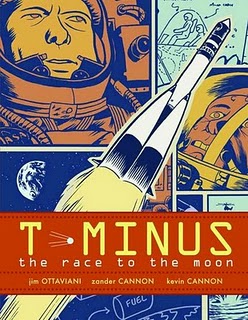
T-Minus: The Race to the Moon by Jim Ottaviani, Zander Cannon, and Kevin Cannon (2009). Aladdin/Simon & Schuster; 124 pages; historical fiction; ages 9-13; ISBN: 978-1-4169-4960-2.

A graphic novel covering the historic race between the United States and Soviet Union to put a man on the moon, T-Minus gives equal coverage to both superpowers, culminating in the events of July 20, 1969.

Along the way readers are introduced to the men and women who made it happen, including lesser-known figures like German rocket scientist Wernher von Braun, who designed the Saturn V rocket that carried Neil Armstrong and company into outer space; Sergei Korolev, the "chief designer" of the Soviet space program; NASA engineers Caldwell "C.C." Johnson and Max Faget; and "computers," otherwise known in the USSR as Russian women who were hired for their mathematical expertise.

Jim Ottaviani, the writer of T-Minus, and Zander Cannon and Kevin Cannon, who illustrated it (and aren't related, it turns out), stuff a large amount of historical and technological information into T-Minus's 100-plus pages, so much so that at times the pace flagged because I got bogged down in explanations of acronyms such as TLI ("Trans-Lunar Injection") and GUIDO ("Guidance Officer"). If you've recently developed a casual interest in the history of space exploration, T-Minus probably isn't the place to start, but its authors show a deep respect for the attention spans of their intended tween audience, which is to be commended.

For further reading, check out Laika by Nick Abadzis (2007). And to see a Glogster-hosted advertising poster I created for T-Minus, click here.*

No Girls Allowed by Susan Hughes (2008). Illustrated by Willow Dawson. Kids Can Press; 80 pages; history; ages 9-12; ISBN: 978-1-55453-177-6.

Susan Hughes's graphic novel, subtitled "Tales of Daring Women Dressed as Men for Love, Freedom and Adventure," is made up of seven stories based on historical fact (more or less) that stretch from 1500 BCE to the American Civil War. Readers learn about Hatshepsut's rise to power as an Egyptian pharaoh despite men only being allowed to hold that title; Mulan's selfless enrollment in the Chinese army, an action she took to save the life of her elderly father; Ellen Craft's bold plan to escape her life as a slave in the American south in the 1840s with her husband, William, also a slave; and four other females who sacrificed their identities but never their souls in order to carve out better lives for themselves.

Hughes crams a lot of history and exposition into her seven tales, sometimes with a heavy hand that also ends stories abruptly, but Willow Dawson's clean black-and-white drawings help convey the characters' fears, frustrations, and triumphs quickly and effectively. "Allowed the freedom to reach out and try, they could achieve their goals," Hughes writes in No Girls Allowed's afterword. "Unfortunately, they had to do it while living a lie." Luckily, their shining examples of courage and independence blazed the trail for countless other women in the years to come.

For further reading about risk-taking females, check out T-Minus author Jim Ottaviani's Dignifying Science: Stories About Women Scientists (1999).

Lafcadio, the Lion Who Shot Back by Shel Silverstein (1963). HarperCollins; 112 pages; humor; ages 9-12; ISBN: 0-06-025675-3.

An African jungle lion decides one day that he isn't going to run from the rifle-carrying hunters who are chasing him and his friends. He tries to make nice with one of them, but when the hunter tries to shoot him, the lion eats the hunter and takes his rifle. Eventually he learns how to pull the trigger with his tail and becomes an expert marksman, attracting the attention of a circus owner who names the lion Lafcadio and brings him to America. Lafcadio becomes rich and famous showing off his skills in front of circus crowds, but when he returns to the jungle years later he questions his place in the world.

Shel Silverstein narrates Lafcadio, the Lion Who Shot Back as "Uncle Shelby," a self-described "very handsome and very intelligent and very kind" man who helps Lafcadio when he arrives in America. The author fills his story with whimsical conceits, such as a suit made of marshmallows and a lion who can sign six autographs at once using his tail, teeth, and four paws, but Lafcadio and his lion friends do eat the hunters who want to shoot them, and those hunters do shoot and kill the lions who don't run away fast enough. Silverstein's book also ends on a down note, with Lafcadio facing an identity crisis—"And he didn't really know where he was going, but he did know he was going somewhere, because you really have to go somewhere, don't you?"—that will likely ring true with tween readers who feel stuck at the border between childhood and adolescence.

Older tweens may also be interested in reading Brian K. Vaughan's graphic novel Pride of Baghdad (2006), illustrated by Niko Henrichon.

Roberto Clemente: Pride of the Pittsburgh Pirates by Jonah Winter (2005). Illustrated by Raúl Colón. Atheneum Books for Young Readers/Simon & Schuster; 40 pages; biography; ages 7-11; ISBN: 0-689-85643-1.

Jonah Winter’s biography of Roberto Clemente, who played baseball for the Pittsburgh Pirates for the duration of his 18 seasons in the major leagues, is a compelling portrait of a man who worked relentlessly at the sport he loved (“’If you don’t try as hard as you can,’ he said, / ‘you are wasting your life’”), using his earnings to give back to the people of his native Puerto Rico before his untimely death in a plane crash on December 31, 1972.

Winter gives his text the appearance of poetry by putting a space between every two lines, thus implying that Clemente was poetry in motion, a hitter, runner, and fielder without equal. Meanwhile, illustrator Raúl Colón alternates soft, cool watercolors with black-and-white pencil etchings, but the latter are only used when showing Clemente in his Pirates uniform, far from home and fighting to be seen as more than just a color. Fans quickly warmed to him, but “the newspaper writers did not,” Winter writes; “when Roberto got angry, / the mainly white newsmen called him a Latino ‘hothead.’”

This hint of a temper is the only negative trait Winter allows his hero, and it’s viewed merely as a byproduct of his quest to become so good at his profession that he could no longer be ignored by the world at large. Winter's message to young readers in Roberto Clemente is that success isn’t guaranteed for anyone in America, but if your work ethic is solid and you keep striving to be the best, you can ultimately prove your doubters wrong.

For further reading, check out Jonah Winter's picture books ¡Béisbol! Latino Baseball Pioneers and Legends and Fair Ball! 14 Great Stars from Baseball’s Negro Leagues, as well as the Colón-illustrated Play Ball!, New York Yankees catcher Jorge Posada's account of his childhood in Puerto Rico.

The Absolutely True Diary of a Part-Time Indian by Sherman Alexie (2007). Illustrated by Ellen Forney. Little, Brown and Company; 230 pages; realistic fiction; ages 12 and up; ISBN: 978-0-316-01369-7.

Arnold Spirit Jr. is an awkward but creative 14-year-old Spokane Indian who lives on a reservation with his parents and grandmother. On the first day of ninth grade at the "rez" school, he discovers his mother's maiden name in his "new" geometry textbook. Infuriated, he throws the book at his teacher, breaking the man's nose, but when the teacher comes to Arnold's house to talk to him about the incident, he encourages Arnold to do whatever he can to get off the reservation, before it kills his spirit. Arnold decides to enroll at the all-white high school in nearby Reardan, angering many Indians, especially his newly former best friend, Rowdy, who feels abandoned but can only express himself with his fists. But over the course of the school year, as he experiences one family tragedy after another amidst personal triumphs on the school's basketball court, Arnold comes to terms with his status as a part-time Indian.

Sherman Alexie's semiautobiographical novel is bursting with brash humor and unexpected tragedy (apparently seven of his relatives died in a single school year when he was around Arnold's age). It also doesn't pull any punches in discussing extreme poverty among Indians or the rampant alcoholism that's a direct cause—and effect—of that poverty. Ellen Forney's line drawings enhance Alexie's prose, so much so that it's hard to imagine the book without them. The Absolutely True Diary of a Part-Time Indian lives up to the critical hype.

Winner of the 2007 National Book Award for Young People's Literature. For further reading, check out The Skin I'm In by Sharon G. Flake or American Born Chinese by Gene Luen Yang (see below). And to see a Glogster-hosted advertising poster I created for Part-Time Indian, click here.*

The Skin I'm In by Sharon G. Flake (1998). Jump at the Sun/Hyperion; 171 pages; realistic fiction; ages 11 and up; ISBN: 978-142310385-1.

Seventh grader Maleeka Madison is picked on because of the darkness of her skin. When a new language-arts teacher named Miss Saunders arrives at her inner-city middle school as part of a corporate program that puts advertising executives in classrooms for a year, Maleeka finds herself in the presence of a caring mentor, though she doesn't know it at first. In fact she resists Miss Saunders's attention and concern almost every step of the way, partly because the new teacher has a large white birthmark on her black face, making her, in Maleeka's mind, as much of a target for negative comments as Maleeka herself. The protagonist must also deal with an aggressive classmate named Charlese, who lets Maleeka wear her fashionable clothes in exchange for doing Charlese's homework every night.

Author Sharon G. Flake makes the point of providing hints as to how a "bad girl" like Charlese came to be: we see that her home life consists of no parents and an older sister who throws parties that last entire weekends. We also learn why John-John, one of Maleeka's worst verbal tormentors, began disliking her in the first place. The Skin I'm In wraps up its various plot threads a little too neatly (did Maleeka really have to find romance with the cutest boy in school?), but Flake energizes her story as a whole by telling it in Maleeka's urban-teen vernacular ("I ain't no squealer. Never was, never will be."), and her account of a near-rape that Maleeka narrowly escapes is told with vivid, heart-rending suspense.

Winner of the Coretta Scott King Book Awards' John Steptoe New Talent Award in 1999. For further reading, check out The First Part Last by Angela Johnson (see below).

American Born Chinese by Gene Luen Yang (2006). First Second; 235 pages; drama/fable; ages 12 and up; ISBN: 1-59643-208-X.

Three stories converge in an unexpected fashion in this graphic novel centering on identity crisis and self-respect. The reader is first introduced to the Monkey King, a character from epic Chinese literature who emerges from a large rock and uses Taoist teachings to gain supernatural powers. But when he attends a party in heaven and isn't given what he considers proper respect for his godlike status, he beats up all the other deities; his punishment is 500 years' imprisonment trapped under a mountain. The second story revolves around Jin Wang, a Taiwanese-American middle schooler who's recently moved from San Francisco to a new town and new school and just wants to fit in, while the third story begins as a sitcom parody entitled "Everyone Ruvs Chin-Kee," in which handsome white teenager Danny is visited—and humiliated—by Chin-Kee, his cousin from China who embodies every outdated Chinese stereotype in existence.

Yang's bold color palette signals an assured sense of identity that generally eludes Jin Wang, Danny, and the Monkey King as they struggle to break free from their roots ("It's easy to become anything you wish," a mysterious Chinese herbalist tells a young Jin Wang, "so long as you're willing to forfeit your soul"). Yang is an inventive storyteller, playing around with readers' preconceived notions of story structure in order to catch them off guard when he delivers his plot twists, and his story ends on a sweetly reconciliatory note. American Born Chinese teaches an important lesson about tolerance—of other people, of your own race, and of yourself—while also throwing in some pee and fart jokes for reluctant male readers.

A 2006 National Book Award finalist in the category of Young People's Literature; also, winner of the 2007 Eisner Award for Best Graphic Album (New). For more fantastical—not to mention fantastic—tales by Gene Luen Yang, check out The Eternal Smile: Three Stories, coauthored with Derek Kirk Kim (2009).

The First Part Last by Angela Johnson (2003). Simon & Schuster Books for Young Readers; 144 pages; realistic fiction; ages 12 and up; ISBN: 978-1-4424-0343-7.

Bobby is 16, a good student who's planning to attend college. He's also a single father. Feather is the baby's name, and Nia is the mother, and we find out why she's no longer around as Angela Johnson's narrative unfolds, crisscrossing back and forth in time as it covers various events that have occurred in Bobby's life. Nia and he are presented with the option of giving Feather up for adoption, but once their lives are changed forever, Bobby decides to bring Feather home—to his mom's home, that is, and despite being a loving, attentive grandmother, she has no intention of taking care of Feather whenever her son is too tired or too busy with schoolwork to do it himself.

The "tough love" reticence Bobby's mother displays as she adamantly refuses to let him deflect any of his parental responsibilities onto her, is my favorite aspect of The First Part Last. It's nice to see a pregnancy-centered "problem" novel for tweens and teens that's told from the father's perspective—one who doesn't leave the hard work to the mother—but the revelation of why Nia isn't around tips the story into soap-opera territory, and the conclusion pours on the schmaltz. Still, the novel's good qualities outweigh the bad.

Winner of the 2004 Michael L. Printz Award and 2004 Coretta Scott King Award. For further reading, check out Angela Johnson's Heaven (1998), another Coretta Scott King Award winner, in which Bobby makes his first appearance.

The Death of Superman by Dan Jurgens, Jerry Ordway, Louise Simonson, and Roger Stern (1993). Illustrated by Jon Bogdanove, Tom Grummett, Jackson Guice, Dan Jurgens, et al. DC Comics; 168 pages; sci-fi/fantasy; ages 8-13; ISBN: 1-56389-097-6.

This graphic novel delivers on its promise: the seemingly immortal Man of Steel is killed at the hands of Doomsday, an otherworldly creature more powerful than any foe he's faced before. Doomsday is a killing machine, pure and simple, whose agenda consists of nothing more than total annihilation of everything that lies in his path.

Because The Death of Superman is a compilation of seven comic-book issues that spanned five different DC Comics titles (Superman, Superman: The Man of Steel, The Adventures of Superman, Action Comics, and Justice League America) at the tail end of 1992, there's a bit of repetition in the storytelling to fill in readers who may not have picked up previous issues. Every few pages it seems like a new character is questioning the origins of Doomsday, just as Superman constantly questions his ability to defeat the creature. The action-packed Doomsday story line, which becomes increasingly bloody as it nears its climax, starts on an unpromising note with a subplot involving creatures who live below the streets of Metropolis, but once Superman is interviewed on a local daytime talk show and states that "violence is the price we pay to accomplish a greater good," The Death of Superman begins to take off.

For further reading, check out World Without a Superman and The Return of Superman, which completed the saga in 1993.

Weetzie Bat by Francesca Lia Block (1989). HarperCollins; 109 pages; magical realism; ages 12 and up; ISBN: 978-0-06-073625-5.

Weetzie grew up in Los Angeles and is nostalgic for a Hollywood she never knew, yet it's one we all unconsciously know, the golden age of stars like Bogart and Monroe. Weetzie is in her early 20s and a little lost when she meets Dirk, who becomes her new best friend. Dirk's gay, and Weetzie helps him in his search for an ideal boyfriend. Together they find Duck, while Weetzie falls for the one and only Secret Agent Lover Man. The two couples then move in together, but author Francesca Lia Block doesn't provide them with "happily ever after" until she's thrown a wrench or two into the works, plus a baby, a disease, and a death or two.

If you're in the right frame of mind, Weetzie Bat is a fun read that operates mostly on dream logic as it blends elements of 1980s L.A. with 1950s La-La Land. Tweens and teens discovering the book today can learn a little about the AIDS epidemic that permanently changed the American landscape in the '80s for both homosexuals and heterosexuals, though Block's then-progressive scenario of a woman and her two gay male friends raising a baby together may seem quaint to today's younger audiences. Thank God for that ...

For further reading, check out subsequent entries in Block's "Dangerous Angels" series: Witch Baby, Cherokee Bat and the Goat Guys, Missing Angel Juan, and Baby Be-Bop.

Coolies by Yin (2001). Illustrated by Chris Soentpiet. Philomel/Penguin Putnam Books for Young Readers; 40 pages; history; ages 7-10; ISBN: 0-399-23227-3.

Shek and his younger brother, Wong, leave famine-devastated China for America in the mid-1800s to find work building the First Continental Railroad along the western portion of the country. Their goal is to send money home so their remaining family members won't starve. On top of back-breaking work and discrimination from white railroad foremen, who condescendingly call the Chinese "coolies," or slaves, Shek, Wong, and their fellow immigrants discover they're being paid less than non-Chinese laborers. They go on strike, but Shek reminds them that as long as they don't work, they can't send money back to their families in China.

Yin tells her story with a framing device involving a tween boy and his grandmother, who regales him with the history of her great-grandfather and his brother—Shek and Wong, respectively. Soentpiet's drawings employ wide-screen, sun-kissed vistas that add cinematic flair to Yin's heartfelt, human prose. "Call us what you will," Shek says upon the completion of the First Transcontinental, "it is our hands that helped build the railroad."

For further reading, check out Ten Mile Day and the Building of the Transcontinental Railroad, written and illustrated by Mary Ann Fraser (1993).

Debbie Harry Sings in French by Megan Brothers (2008). Henry Holt and Company; 234 pages; realistic fiction; ages 13 and up; ISBN: 978-0-8050-8080-3.

This coming-of-age novel centers on Johnny, a 1990s Florida teen whose dad dies in a car crash the week of his 13th birthday. His mom, too depressed to do much of anything over the next couple years, leaves chores like shopping for groceries and paying the bills to Johnny; he starts drinking to deal with the pressure. After she recovers and takes charge of the household again, Johnny accidentally overdoses on Ecstasy one night at a club. He goes into rehab, but following his own recovery, his mom sends him to South Carolina to live with his uncle Sam, whereupon he meets and falls for Maria, a “bad girl” who shares his love of 1970s punk rock (Blondie, Patti Smith, the Ramones) and helps Johnny explore his latent interest in transvestism.

Debbie Harry Sings in French received a starred review from Publishers Weekly for its “brisk pace and ... strong-willed, empathetic narrator,” although, like Kirkus Reviews, it took issue with Brothers’s plot, which the latter found “problematic,” especially in the early chapters set in Tampa. I’m sure a movie adaptation would cut the bulk of those chapters, but I enjoyed how Brothers presented a single-parent household in which the only child, out of sheer necessity, takes on the responsibilities of the incapacitated parent. Booklist’s Jennifer Hubert noted that “the prose occasionally slides into cliché,” but I’d argue it’s the supporting characters who sometimes run the risk of being stereotypes: Lucas, the hip, wise Jamaican record store owner, skirts the edge of “Magical Negro” status, and Bug, Johnny’s female cousin, acts more like a precocious second grader than an 11-year-old on the cusp of adolescence.

For further reading, check out Parrotfish by Ellen Wittlinger (2007).

Twelve Rounds to Glory: The Story of Muhammad Ali by Charles R. Smith Jr. (2007). Illustrated by Bryan Collier. Candlewick Press; 80 pages; biography; ages 9-14; ISBN: 978-0-7636-1692-2.

Charles R. Smith Jr.'s picture-book biography of the legendary boxer is written as a series of poems, simultaneously emulating and paying tribute to its subject, whose famous pre-fight poems—"Float like a butterfly, sting like a bee / His hands can't hit what his eyes can't see"—influenced the braggadocio of early rap music. Warmly illustrated by Bryan Collier, Twelve Rounds to Glory takes young readers through Ali's entire career, from his heavyweight-championship knockout of Sonny Liston in 1964 to his refusal to fight in the Vietnam War three years later, and continuing on to his popular and professional comeback in '74, when he beat his seven-years-younger opponent, George Foreman, to regain the heavyweight title. The book ends with a brief mention of Parkinson's disease, which Ali was diagnosed with in 1984.

Smith doesn't ignore the often ugly insults Ali slung at his opponents before fights, the worst of them reserved for Joe Frazier: "cutting even deeper / into his heart by dropping a bomb, / by insulting his blackness when you called him Uncle Tom." But for the most part this is a sunny-side-of-the-street biography, in which Ali's four marriages and eight children, two of which were born out of wedlock, are treated as a show of generosity on Ali's part, i.e., he had too much love for just one family! Smith's poetry shines brightest when he recounts Ali's various title bouts, including the 1974 "Rumble in the Jungle" versus Foreman in Zaire: "'IS THAT ALL YOU GOT? / IS THAT ALL YOU GOT?' / absorbing brick after brick, / taking shot after shot, / infuriating the Bull, / making his eyes see blood-red, / moving shots to the body / up top to the head."

Winner of Honor Book recognition from the Coretta Scott King Book Awards in 2008. For more of Smith's poetry, check out the basketball-themed Hoop Kings (2004). And to see a book trailer I created for Twelve Rounds to Glory, click here.

In His Own Write by John Lennon (1964). Simon & Schuster; 79 pages; humor; ages 10 and up; ISBN: 0-684-86807-5.

The Beatles stormed America in 1964 after conquering their native UK, so it made sense that any of the band's side projects would generate at least some interest from fans and the general public. Hence In His Own Write, singer-guitarist John Lennon's debut collection of stories, poems, and drawings, some of which were generated during his school days in Liverpool, or "Liddypool," as he refers to his hometown in a short story of the same name. "The writing Beatle," as one particular version of the book's cover touts, enjoys playing around with pronunciations and spellings, as evidenced by titles like "The Fingletoad Resort of Teddiviscious" and "On Safairy With Whide Hunter" ("written in conjugal" with Paul McCartney). He also isn't afraid to explore dark territory, a la Roald Dahl: in "The Fat Growth of Eric Hearble," the title character loses his job "teaching spastics to dance" and is called a "cripple" because of the scabby growth on his head that has conversations with him, and in "Randolf's Party" the protagonist is killed by his friends at his own "Chrisbus" gathering.

I was somewhat surprised to find In His Own Write in the Young Adult section of the Oak Park Public Library, but because Lennon's stories and poems are almost exclusively short and nonsensical, I can see the appeal for younger readers. However, because of Lennon's inventive spellings and heavy use of English slang, some of which may have gone out of fashion about the same time the Beatles broke up 41 years ago, In His Own Write can be a frustrating read. Beatles fans of all ages are encouraged to give it a go all the same: famous Lennon song lyrics like "Yellow mother custard dripping from a dead dog's eye" aren't far removed from poem lyrics such as "I wandered hairy as a dog / To get a goobites sleep" ("I Wandered").

For further reading, check out Lennon's second collection of this and that, A Spaniard in the Works, published the following year. And to see a book trailer I created for In His Own Write, click here.

* Glogster is a temperamental beast. At a certain point I had to give up on making all of the text I created completely visible at all times. What you see is what I got.