"12 Years a Slave is two hours of ecstasy!" says Robert Cass of WhoU.com.
"I mean, not that slavery is anything to be ecstatic about. That's not what I'm saying, so please don't think that. Look, for what it's worth, some of my best friends are slaves— I mean, black! Jesus Christ, did I really just say 'slaves' instead of 'blacks'? Goddammit, I meant to say 'black people' just then, not 'blacks'! I'm ... whew, deep breath ... Sorry, everybody. And sorry about taking the Lord's name in vain there. That wasn't cool either. Okay, let me start over: '12 Years a Slave' is two hours of—"
USER ERROR: MAXIMUM AMOUNT OF SPACE FOR HACK-CRITIC ADVERTISING BLURB EXCEEDED BY, LIKE, A CRAZY HUGE AMOUNT. SERIOUSLY, DUDE.
"You know what, I'll just pick a different movie. How about 'Gravity is out of this world! Until the final scene, that is, which takes place on Earth.'
"What, you consider that a 'spoiler'? If I'd told you that George Clooney dies halfway through the movie, that would be a spoiler, but I didn't, so ...
"Oh, I guess I did.
"Maybe I should've been a pharmeutical rep instead."
Showing posts with label George Clooney. Show all posts
Thursday, October 24, 2013
Monday, January 2, 2012
George Clooney as George Washington via Abe Vigoda
I can't be the only one who sees Fish in this photo from the December 11, 2011, issue of The New York Times Magazine, right?
Wednesday, June 9, 2010
It's not the stars that are falling, it's the skies that hold them in place.
Maybe I'll be proven wrong, but after seeing another TV ad for Jonah Hex last night, I feel like it faces an uphill battle:
1. It's a western. It's also an action movie with big guns and explosions, and it's got supernatural horror-movie elements, but mostly it's a western, and that genre hasn't produced many successful films in the past 40 years (or, if you'd like a less sweeping generalization, since Clint Eastwood's Unforgiven in 1992).
2. It stars Josh Brolin, who's a handsome guy, but as Jonah Hex the right side of his face is disfigured after he's cattle-branded by bad guy John Malkovich, who probably took this role to pay for some renovations on his Tuscan villa.
3. It's based on a comic book. Normally that'd be a good thing, at least as far as Hollywood bean counters are concerned, but Jonah Hex is a DC title that already seemed old and unhip when I was reading comic books in the '80s.
Jonah Hex opens June 18, the same day as Toy Story 3. That sequel should do very well with family audiences, but it's also being targeted at college students who were toddlers when the first Toy Story opened in 1995. Disney and Pixar even screened the first two-thirds of the film for college kids earlier this year, whetting their appetites for the final third in theaters this summer.
This Friday sees the debut of The Karate Kid, a remake of the hit film from the '80s, and The A-Team, an adaptation of the hit TV show from the '80s. Neither one looks promising to me, though I'd guess the former will fare better than the latter because it'll appeal to family audiences before they jump ship for Toy Story 3 the following weekend.
Richard Corliss has a good article on Time magazine's website about the fact that most of Hollywood's big films so far this summer haven't been as big as predicted. He chalks it up partly to the predictors raising box office expectations too high, but he also points out that ticket prices have increased once again. I paid for my girlfriend and I to see Splice on her birthday last Sunday afternoon—not our first choice, but it'd gotten good reviews (which I now disagree with)—and it cost $19. What happened to matinee prices?
One of the most interesting points of Corliss's article is about the number of movie tickets that are actually sold these days:
The five years from 2005 to 2009 showed remarkably consistent ticket sales, all in the range of 1.39 billion to 1.42 billion, according to movie-stats blog the Numbers. Indeed, in 2009 moviegoers bought no more tickets (1.42 billion) than they did in 1997; the 62% increase in box office revenue, from $6.51 billion to $10.65 billion, was entirely due to the gradual hike in prices. But the bust could be real: if current trends hold, the number of admissions this year will be 1.27 billion, the lowest since 1996. Historical note: None of the recent years comes anywhere near the 4 billion tickets sold in 1946, back before TV gave Americans a free, at-home option for watching entertainment. That's three times the tickets, when the U.S. population was half what it is today.

1. It's a western. It's also an action movie with big guns and explosions, and it's got supernatural horror-movie elements, but mostly it's a western, and that genre hasn't produced many successful films in the past 40 years (or, if you'd like a less sweeping generalization, since Clint Eastwood's Unforgiven in 1992).
2. It stars Josh Brolin, who's a handsome guy, but as Jonah Hex the right side of his face is disfigured after he's cattle-branded by bad guy John Malkovich, who probably took this role to pay for some renovations on his Tuscan villa.
3. It's based on a comic book. Normally that'd be a good thing, at least as far as Hollywood bean counters are concerned, but Jonah Hex is a DC title that already seemed old and unhip when I was reading comic books in the '80s.
Jonah Hex opens June 18, the same day as Toy Story 3. That sequel should do very well with family audiences, but it's also being targeted at college students who were toddlers when the first Toy Story opened in 1995. Disney and Pixar even screened the first two-thirds of the film for college kids earlier this year, whetting their appetites for the final third in theaters this summer. This Friday sees the debut of The Karate Kid, a remake of the hit film from the '80s, and The A-Team, an adaptation of the hit TV show from the '80s. Neither one looks promising to me, though I'd guess the former will fare better than the latter because it'll appeal to family audiences before they jump ship for Toy Story 3 the following weekend.
Richard Corliss has a good article on Time magazine's website about the fact that most of Hollywood's big films so far this summer haven't been as big as predicted. He chalks it up partly to the predictors raising box office expectations too high, but he also points out that ticket prices have increased once again. I paid for my girlfriend and I to see Splice on her birthday last Sunday afternoon—not our first choice, but it'd gotten good reviews (which I now disagree with)—and it cost $19. What happened to matinee prices?
One of the most interesting points of Corliss's article is about the number of movie tickets that are actually sold these days:
The five years from 2005 to 2009 showed remarkably consistent ticket sales, all in the range of 1.39 billion to 1.42 billion, according to movie-stats blog the Numbers. Indeed, in 2009 moviegoers bought no more tickets (1.42 billion) than they did in 1997; the 62% increase in box office revenue, from $6.51 billion to $10.65 billion, was entirely due to the gradual hike in prices. But the bust could be real: if current trends hold, the number of admissions this year will be 1.27 billion, the lowest since 1996. Historical note: None of the recent years comes anywhere near the 4 billion tickets sold in 1946, back before TV gave Americans a free, at-home option for watching entertainment. That's three times the tickets, when the U.S. population was half what it is today.

Seeing those figures reminded me of an Associated Press clipping I'd saved from the fall of 2007, when the Farrelly brothers' remake of Elaine May's The Heartbreak Kid was released. Reporter David Germain wrote:
“The Heartbreak Kid” [opened in] 3,229 theaters, about 1,000 more than “There’s Something About Mary,” which still managed to pack in far more viewers [in 1998]. Based on today’s higher ticket prices, “There’s Something About Mary” pulled in nearly 3 million people over opening weekend, compared to just over 2 million for “The Heartbreak Kid.”
Two million ticket buyers translated to $14 million over the weekend of October 5, 2007. By comparison, the number-one show on TV, American Idol, averaged 24.7 million viewers per episode this season.
Just as movie attendance ain't what it used to be before TV came along, network TV ratings have taken a hit over the past quarter-century thanks to cable TV, VCRs, home video-game systems, DVD players, the Internet, and DVRs. Dallas averaged 34.5 million viewers in its 1980-'81 season, which began with the episode that answered the question "Who shot J.R.?"; that alone attracted 83 million viewers, the highest rating for any non-finale episode in history.
Eighteen years later, the top-rated show was ER, with 17.8 million viewers on average. As many media watchers have reported (over and over and over) this year, American Idol's ratings have dropped every year since 2006, but 24.7 million viewers a week is still better than 17.8 million a decade ago.
When ER finished its 1998-'99 season with that number, George Clooney had recently departed the show after five seasons. He'd honored the contract he signed in 1994, but he was also interested in pursuing movie roles, and today he's one of the most popular and respected movie stars around (the Ocean's Eleven franchise, Michael Clayton, Up in the Air).
It can easily be argued that when Clooney was on ER he was much more visible and popular than he'll ever be on a movie screen, yet movie stars are still held in higher esteem than TV stars, and whenever a TV star generates a lot of buzz, like Katherine Heigl on Grey's Anatomy or Steve Carell on The Office five years ago, the question becomes "When are they going to make the leap to movies?," as if big-screen work legitimizes small-screen actors.
Screen size does have something to do with it, of course. I believe it was Clooney who once said in an interview that when he was on ER people would casually approach him on the street and say hello, but once he'd left the show and was doing movies, fans would keep their distance. His reasoning was that when you're a TV star you're invited into viewers' homes each week, and because TV is "the small screen," you're thought of as a regular person. But when a star is on "the big screen," he or she stands 20 feet tall and is gazed upon by an entire room of people, much like congregants in a church.
TV stars are friends, but movie stars are gods. (Speaking of which, Friends's Matthew "Chandler" Perry is one of many TV stars who will forever be known by the name of the character they played on the hit series that made them famous.) And that's how the stars will continue to be aligned, no matter how few people are buying movie tickets or turning on their televisions.
“The Heartbreak Kid” [opened in] 3,229 theaters, about 1,000 more than “There’s Something About Mary,” which still managed to pack in far more viewers [in 1998]. Based on today’s higher ticket prices, “There’s Something About Mary” pulled in nearly 3 million people over opening weekend, compared to just over 2 million for “The Heartbreak Kid.”
Two million ticket buyers translated to $14 million over the weekend of October 5, 2007. By comparison, the number-one show on TV, American Idol, averaged 24.7 million viewers per episode this season.
Just as movie attendance ain't what it used to be before TV came along, network TV ratings have taken a hit over the past quarter-century thanks to cable TV, VCRs, home video-game systems, DVD players, the Internet, and DVRs. Dallas averaged 34.5 million viewers in its 1980-'81 season, which began with the episode that answered the question "Who shot J.R.?"; that alone attracted 83 million viewers, the highest rating for any non-finale episode in history.
Eighteen years later, the top-rated show was ER, with 17.8 million viewers on average. As many media watchers have reported (over and over and over) this year, American Idol's ratings have dropped every year since 2006, but 24.7 million viewers a week is still better than 17.8 million a decade ago.
When ER finished its 1998-'99 season with that number, George Clooney had recently departed the show after five seasons. He'd honored the contract he signed in 1994, but he was also interested in pursuing movie roles, and today he's one of the most popular and respected movie stars around (the Ocean's Eleven franchise, Michael Clayton, Up in the Air).It can easily be argued that when Clooney was on ER he was much more visible and popular than he'll ever be on a movie screen, yet movie stars are still held in higher esteem than TV stars, and whenever a TV star generates a lot of buzz, like Katherine Heigl on Grey's Anatomy or Steve Carell on The Office five years ago, the question becomes "When are they going to make the leap to movies?," as if big-screen work legitimizes small-screen actors.
Screen size does have something to do with it, of course. I believe it was Clooney who once said in an interview that when he was on ER people would casually approach him on the street and say hello, but once he'd left the show and was doing movies, fans would keep their distance. His reasoning was that when you're a TV star you're invited into viewers' homes each week, and because TV is "the small screen," you're thought of as a regular person. But when a star is on "the big screen," he or she stands 20 feet tall and is gazed upon by an entire room of people, much like congregants in a church.
TV stars are friends, but movie stars are gods. (Speaking of which, Friends's Matthew "Chandler" Perry is one of many TV stars who will forever be known by the name of the character they played on the hit series that made them famous.) And that's how the stars will continue to be aligned, no matter how few people are buying movie tickets or turning on their televisions.
Thursday, August 27, 2009
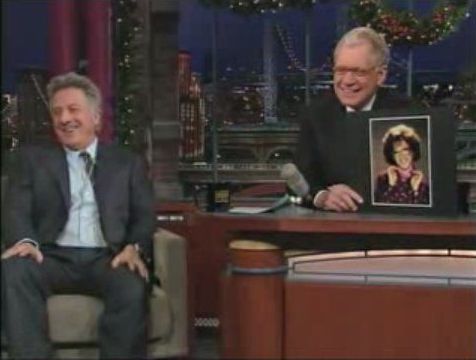
the day Dustin Hoffman met George Clooney's uncle
On Tuesday night I watched Sydney Pollack's Tootsie (1982) at Butler Field in Chicago's Grant Park. It was the final film in this summer's Chicago Outdoor Film Festival—in July I saw Billy Wilder's Sunset Boulevard—and the first time I'd seen my favorite of Pollack's movies on a big screen. The appreciative audience surrounding me didn't hurt.
Yesterday* I discovered the following Late Show With David Letterman clip, from December 22 of last year, on YouTube:
ACCEPT NO SUBSTITUTES EXCEPT THIS ONE
* Almost 14 years later I discovered that the original clip had been pulled from YouTube. The link above, which I can't embed on Blogger the normal way because of the time stamp, will have to do.
Subscribe to:
Posts (Atom)