Showing posts with label Moonlighting. Show all posts

Wednesday, December 5, 2018

L is for "loss" (financially speaking, anyway).

"I've never learned from success," he says. "'Get Lucky' allowed me to get a record deal for the new Chic album, but I couldn't tell you how to make that song again. Things just line up right." He frowns. "As a producer, I help an artist make a record that I'd want to hear as a fan. But I had no idea 'Get Lucky' would be so huge. It's always up and down. The way you know you're good is if there are more ups than downs ... Let me play you something." He finds a YouTube video for a creamy Al Jarreau ballad from 1986 called "Across the Midnight Sky." "L Is for Lover is the album," he says. "It's the best thing I ever made that didn't sell." He plays air guitar along with himself. "The theme from Moonlighting was on it, but Al and I thought it wasn't cool enough. So we took it off the album. That becomes a hit, and the album sank. Shows what I know."

—from "The Deep Hidden Meaning of Nile Rodgers" by David Marchese, New York magazine, July 27, 2015
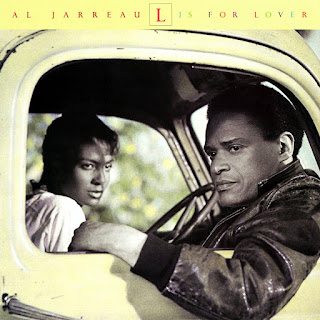
To my non-golden ears, every song on L Is for Lover, which has a flawless side one and is my favorite of Jarreau's albums, could've appeared on Moonlighting and fit the general atmosphere of the show—except for "Across the Midnight Sky," which sounds like something Robert Guillaume might've pressured the producers of Benson into letting him perform on a "Benson and the rest of the governor's staff go to Las Vegas for some reason" type of episode late in that series's run.

I wonder why Rodgers and Jarreau thought Moonlighting's theme song "wasn't cool enough." Rodgers also says on YouTube, in the comments under the posting of "Across the Midnight Sky" that's mentioned in the New York article, "I love this cut and this album. It's one of my greatest works. It would have been a smash had we not given 'Moonlighting' to Irving Azoff for a TV soundtrack album that was a huge hit and 'Moonlighting' was the single. I've made many dumb moves in my career. That was a huge one."

But L Is for Lover came out in September of '86, whereas the Moonlighting soundtrack album wasn't released until after the '86-'87 season had ended; my Billboard Top 40 Hits book lists Jarreau's theme-song single as entering the Top 40 on July 4, so I would imagine the album followed soon after. That version of the theme song wasn't used in the show's opening credits until the fall of '87, so maybe the inclusion of Moonlighting's theme on L Is for Lover wasn't possible once ABC or Azoff, then the president of MCA Records, decided that the updated version should be held back to promote the soundtrack, released on MCA.

As with a lot of Moonlighting-related minutiae, the truth is probably buried in a 30-year-old filing cabinet somewhere in Culver City.

(In some countries the B-side of the Moonlighting theme's single was "Golden Girl," a track from L Is for Lover. Were any customers fooled into thinking that Jarreau had also recorded the theme song to NBC's The Golden Girls, which tied Moonlighting in 1987 with 14 Emmy nominations?)

Sunday, March 6, 2016

"Ambush Bug" was a gateway drug.

Nearly a decade before Deadpool appeared for the first time in a Marvel comic book, DC introduced the similarly self-aware Ambush Bug in the December 1982 issue of DC Comics Presents. Two and a half years later he was given his own "mini-series" of four issues, the last of which I've had in a shoebox for decades now.

ABC's Moonlighting debuted a couple months before the first issue of Ambush Bug was published, but, as far as I can remember, its main characters, Maddie Hayes (Cybill Shepherd) and David Addison (Bruce Willis), didn't break the fourth wall or comment on the fact that they were characters on a TV show until the second season, starting in the fall of '85. It was during that second season that I saw reruns of The Monkees, on MTV, for the first time, another series with plenty of "meta" moments.

My ten-year-old self couldn't get enough of that style of humor. Looking back, Ambush Bug may have been the entry point. (I'd watched Looney Tunes characters break the fourth wall years earlier in those cartoons, but I can't say with any certainty that I got the joke.)


As Ambush Bug prepares to face off against the villain Scabbard, a note appears in an otherwise empty panel on the page: it's from Ambush Bug creator Keith Giffen's wife, Ana, informing the comic book's editor, Julius Schwartz, that Keith has a 24-hour virus; their son Kyle drew the following page in order not to miss DC's deadline. (She adds, "P.S. Kyle would like his original page back as soon as possible, so he can sell it at the NY con.")


One page later Scabbard realizes he's in the wrong comic book—he's supposed to be wreaking havoc in Thriller (although, according to Wikipedia, that comic book's run ended in November of '84 after 12 issues)—so he exits, leaving Ambush Bug with dead air to fill.


Unlike Deadpool, Ambush Bug will probably never headline a movie of his own, but his influence on comic-book comedy, not to mention my own appreciation for the silly, the stupid, and the sublime, is worth noting.

Friday, December 7, 2007

why my favorite TV show died

A radio station in Charleston, South Carolina, claimed that Moonlighting, my favorite show when I was younger, never recovered after the writers' strike that delayed the beginning of the 1988 fall season. Or so my friend Beau told me, as his wife, Kristen, had told him. But those Charleston DJs were only half right. Here's what I wrote to Beau and Kristen ...

Moonlighting was hurt by a lot of things. As one person who worked on the show said, the show's slow demise came about because "Cybill Shepherd got pregnant and Bruce Willis got rich." Shepherd got pregnant in early '87, during the show's third season, although her pregnancy wasn't worked into the show until that fall, during the fourth season. Glenn Gordon Caron, the show's creator, said he couldn't see any way around the pregnancyavoiding the issue would've prevented Shepherd from being shot below chest level, and that would've made scenes with her very static and confined to desks or tables.

Long story short, the first part of the fourth season involved Maddie in Chicago staying with her parents while trying to figure out whether she should go back to David and the detective agency and let him know she was pregnant (the audience, not to mention David, didn't know if it was his baby or third-season guest star Mark Harmon's). Because Maddie was in Chicago, David solved cases with Herbert Viola, a.k.a. "Booger" from Revenge of the Nerds. Not as much fun as Maddie and David solving crimes together, but by that point they'd "done it," which took all of the sexual tension away. It's a slippery slope once the romantic leads on a TV show get together, of course, and unlike Cheers, Moonlighting didn't have a bunch of supporting characters to fall back on in case viewers got sick of the main characters bickering back and forth. All you had were Herbert and Ms. DiPesto, who were funny in small doses, yet they ended up having two episodes to themselves during the fourth season while Shepherd and Willis were indisposed. Two whole episodes—and only 14 were produced that season.

The fourth season was cut short due to the writers' strike, but during the previous season
Moonlighting had only produced 15 episodes, and the one before that produced just 18. It was supposed to deliver 22 episodes a season just like any other show, but it never did, partly due to Glenn Gordon Caron being such a perfectionist and delivering script rewrites at the last minute. (I've read that production on his current show, NBC's Medium, is somewhat disorganized, but he's managed to produce 22 episodes per season so far, as he did for the one and only season of his 1999-2000 CBS series, Now and Again.)

I do like Ms. DiPesto and Herbert Viola more now that I'm older. But when I was in grade school I just wanted to see Maddie and David flirt and watch Bruce Willis be cool and funny. He hasn't been all that funny since Moonlighting, and he wasn't even that funny during the last two seasons. He looked a bit bored, to be honest.

By the way, I lied when I said "long story short." 

Willis was in those early fourth-season episodes much more than Shepherd, and he was reportedly angry that he had to carry the show while shooting Die Hard at the same time. By the tail end of the season Maddie had returned to Los Angeles, but she got married to a stranger on a train on her way back from Chicago, which made almost every fan groan (the grade-school ones anyway). She called it off the day of the "official" wedding, realizing she still loved David, and then the season ended one episode later, with the quickie annulment of Maddie's quickie marriage and a comment on the writers' strike in the last segment. Like other Moonlighting episodes, this one had ended up a few minutes short, so an extra scene was filmed with Maddie and David talking to the audience about how the writers were on strike and they didn't know how to fill the extra time. They ended up making Herbert dance to "Wooly Bully."

When the show returned in December of '88 along with other network shows, Maddie had a miscarriage, which made more fans groan, but at least that concluded the show's soap-opera aspects for the most part. Then it was back to Maddie and David solving crimes together, which I was happy to see when I was in seventh grade, but once I got older I realized it was ridiculous—as Willis said in an interview after the show ended, there was no way those two would've continued to work together after having gone through such a long, stormy affair.

Moonlighting was put on hiatus by ABC in February of '89 because its ratings had fallen so far (those ratings probably wouldn't look so bad today, though, compared to what a normal low-ranking network show generates in 2007); it returned two months later, but on Sundays at 8 instead of Tuesdays at 9. The fifth season consisted of 13 episodes, and the last six were cranked out quickly in order to get Moonlighting up to the bare minimum needed for syndication on a cable network—Lifetime showed it in the early '90s, and Bravo aired it earlier this decade, but it never reached regular syndication like, say, Magnum, P.I. or NYPD Blue, which produced more episodes per season over longer runs.

So yeah, the writers' strike didn't help Moonlighting get its momentum back, but it was already in serious trouble before that.


Thursday, March 8, 2007

Let's watch some TV!

After she read (well, half-read) my post about PAX/the i/Ion and Charlie's Angels, my friend Mary mentioned that her dad liked Kate Jackson's character on Charlie's Angels the most and that he usually liked "the smart one" on those kinds of shows. I've noticed in my, uh, research that in the few episodes featuring Kate that Ion has shown so far, she's not used as cheesecake the way Jaclyn and Cheryl (and presumably Farrah) are. (Notice who's not bearing any cleavage in the picture above?) They're the ones required to get into bikinis and other skimpy outfits. Fine by me, but what kind of message were you trying to send to little girls who watched the show, Aaron Spelling? That the hottest girls usually aren't the brightest? That's not ni— ... actually, in my experience that's often been true ... but it's still not a nice thing to imply!


Even 30 years later, at last year's Emmy Awards ceremony, the necklines for each Angel hadn't really changed:


One last picture before we move on:


Even Kate's hands are covered up! Good grief, Charlie Brown ...


Wait—we're not moving on yet. There's one other aspect of Charlie's Angels that strikes me as funny: the Angels are detectives who go undercover all the time, yet they always use their real names when they're on assignment. Or maybe I just haven't paid close enough attention to the episodes where Kate goes undercover. It's possible that she uses undercover aliases while Jaclyn and Farrah/Cheryl are clearly too dumb to remember any name other than their own. Did Shelley Hack take on the mantle of "smart Angel" when Kate left? Or did the Angels lose some collective IQ points for the '79-'80 season? Tanya Roberts certainly didn't play the smart Angel in the '80-'81 season.

Okay, now we're moving on ...

As my mom said recently, "Tina Fey sure does show off her cleavage a lot on
30 Rock." That's the advantage of being the star of a show you created, I guess—even if you're more of a Kate in real life, you can pretend to be somewhat of a Jaclyn on the small screen.

In the credits of tonight's episode of 30 Rock I noticed Anna Chlumsky's name. Remember her? The little girl in My Girl? And My Girl 2? And Gold Diggers: The Secret of Bear Mountain? (I don't blame you if you don't remember that one. Anna and Christina Ricci played literal gold diggers in the movie. But don't fret—in the sequel I'm currently writing, they play conniving, money-grubbing hoo-ers.) Anna's a grown-ass woman now! On 30 Rock she played "the other Liz." I didn't recognize her at all. Then again, why would I? Gold Diggers came out in '95, and that's the last time I remember seeing her.

I wonder who wrote that "Blue Oyster Cult/cowbell" sketch on Saturday Night Live back in 2000? Or who originally pitched it, at the very least? The sketch has its own lengthy Wikipedia entry, but no writer is mentioned. Whoever you are, you deserve some public recognition.

Today I saw a rerun of Married ... With Children on FX in which Marcy, the Bundys' neighbor, was trying to keep a college radio station on the air. I only saw the last ten minutes, but the only Bundy seen in those ten minutes was Bud. Was this one of those episodes where Ed O'Neill and Katey Sagal and Christina Applegate got to take some time off? I remember Moonlighting, my favorite show in grade school, featuring one episode a season in which Maddie Hayes and David Addison would bookend an episode but disappear for the rest of it so that Agnes DiPesto and/or Herbert Viola could solve a mystery on their own. I didn't care for those episodes as a child. (SORTA FUN FACT! The fourth season of Moonlighting only produced 14 episodes, 8 less than the average for prime-time network dramas. Agnes and Herbert got two episodes to themselves that season, and one of them wasn't even bookended by David and Maddie. Actually, neither episode featured Maddie at all, seeing as how Cybill Shepherd was either pregnant or on maternity leave throughout much of that shortened season.)

Okay, back to Married ... With Children, the only sitcom in TV history whose studio audience always seemed to be on the verge of running onto the set and gangbanging Christina Applegate. According to TV.com, the episode I saw today was set up as a potential spin-off for the two college-DJ characters who were prominently featured. I don't know if a pilot was ever produced, but no spin-off ever made it to air, although one Married spin-off did last seven episodes in the spring of '91: Top of the Heap, starring Joseph Bologna and Matt LeBlanc. And I'd completely forgotten about the spin-off of Top of the Heap that aired for seven episodes the following year: Vinnie & Bobby, also starring LeBlanc (and a young, already vocally irritating Joey Lauren Adams), but not Bologna. Thanks for the reminder, IMDB!

Sorry—back to today's episode! Wait, more tangential information—Keri Russell from Felicity was in the episode as a girl who had dated Bud. She was supposed to be a total babe, and she is a good-looking woman, but Keri also seems to be smart, and what did Aaron Spelling teach us? Sorry, Keri, but it's just not working out.

Why did I even bring up this episode? Oh yeah, here's why—the college radio station that was in danger of getting yanked from the air was 106.2 FM on the dial. WHAT?! Pardon me, but aren't the majority of college stations somewhere around 88 to 92 on the left of the dial? No one's going to give prime radio real estate like a 106 frequency to a college station. Married ... With Children writers, use your brains! Oh wait ... are you writers also really hot women? Never mind then. My apologies. But may I give you a word of advice? Stay far away from your show's studio audience.