Last week I was leaving the grocery store when a woman approached me and asked if I'd like to buy a copy of StreetWise, the local magazine sold by homeless and at-risk vendors. She said she was trying to get off the street and that selling StreetWise allowed her to not have to panhandle anymore.
I've been volunteering as a proofreader at StreetWise since March. I tried mentioning this to the woman for the sake of small talk, i.e. "Here's something we have in common," but she just looked past me and said, "Uh-huh." As I handed her my two dollars and she gave me a copy of the latest issue, I tried again, thinking maybe I should point to my name on the masthead on the inside cover. "Okay," she said. She wasn't listening.
It's hard being a proofreader. People pretend you don't exist, but the "problem" isn't just going to go away, no matter how many of us you don't employ.
Wednesday, September 9, 2009


Tuesday, September 1, 2009
Which movie currently in theaters is a sequel to a remake and a remake of a sequel?
The correct answer is Rob Zombie's Halloween II.
What will you think of next, Hollywood?
 "Halloween 3D," as it turns out, because even though Halloween II opened in third place last weekend, far behind The Final Destination (another horror sequel, with the "The" in the title implying that this is the last installment in the series—for now, anyway), Hollywood can't have enough sequels or 3-D movies or "reboots" in theaters.
I have a feeling "Halloween 3D" won't be a remake of 1982's Halloween III: Season of the Witch, a sequel that ditched the Michael Myers character from the first two films to tell a story about a Halloween-mask manufacturer's sinister plan to kill millions of children with its black-magic-enhanced product. Halloween III wasn't well received by moviegoers or critics at the time, so my script for "Halloween 3A: Season of the Witch 2" never came to pass, with our heroes from the first Witch racing to prevent Donovan's 1966 song "Season of the Witch" from appearing in any more movies or TV shows. It's a fine song, but, you know, enough already.
What will you think of next, Hollywood?
 "Halloween 3D," as it turns out, because even though Halloween II opened in third place last weekend, far behind The Final Destination (another horror sequel, with the "The" in the title implying that this is the last installment in the series—for now, anyway), Hollywood can't have enough sequels or 3-D movies or "reboots" in theaters.
I have a feeling "Halloween 3D" won't be a remake of 1982's Halloween III: Season of the Witch, a sequel that ditched the Michael Myers character from the first two films to tell a story about a Halloween-mask manufacturer's sinister plan to kill millions of children with its black-magic-enhanced product. Halloween III wasn't well received by moviegoers or critics at the time, so my script for "Halloween 3A: Season of the Witch 2" never came to pass, with our heroes from the first Witch racing to prevent Donovan's 1966 song "Season of the Witch" from appearing in any more movies or TV shows. It's a fine song, but, you know, enough already.
Thursday, August 27, 2009
the day Dustin Hoffman met George Clooney's uncle
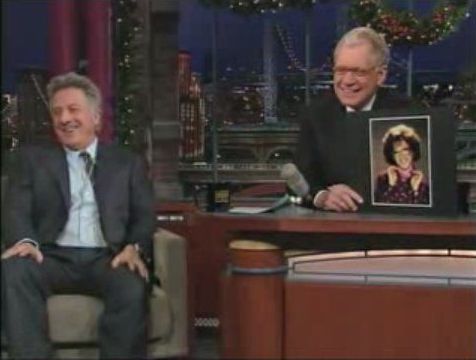
Yesterday* I discovered the following Late Show With David Letterman clip, from December 22 of last year, on YouTube:
ACCEPT NO SUBSTITUTES EXCEPT THIS ONE
* Almost 14 years later I discovered that the original clip had been pulled from YouTube. The link above, which I can't embed on Blogger the normal way because of the time stamp, will have to do.
Thursday, August 20, 2009
sassy cannibals spawning, preaching, living, and loving
 Gospel According to Harry is a 1994 art film by Polish filmmaker Lech Majewski that debuted on DVD last year courtesy of Kino Video. The back of the DVD box says, "Years before the Lord of the Rings trilogy catapulted him to international superstardom, Viggo Mortensen (Eastern Promises, A History of Violence) played Wes, a young husband locked in co-dependent discontent with his beautiul and needy wife Karen (Jennifer Rubin — The Doors)."
Once you watch the film, though, Wes comes across as much more needy than Karen, praying to God that she'll return to him after she moves out. In the early scenes he's portrayed as an anger-prone layabout who refuses to buy life or health insurance, so it's not too hard to side with Karen when she leaves. And once she returns, he quickly takes her for granted again. Is she considered needy simply because she needs love?
The Gospel DVD contains audio commentary by Majewski, who doesn't acknowledge Rubin when she first appears on-screen, but once Mortensen shows up a minute or two later, he has plenty to say about the actor and the experience of working with him.
I snagged my copy of Gospel last year at the Chicago Reader, where I used to work. More recently I came into possession of a DVD of C.H.U.D. (1984) and a VHS copy of Piranha II: The Spawning (1981), which delivers the kind of quality you'd expect from the title, even though the Jaws rip-off was directed by Oscar winner James Cameron. (The video box uses a comma in the title instead of a colon. It's the idiosyncrasies I love the most.)
 Avatar, which is set for release this December, will be Cameron's first feature film since 1997's Titanic, and it appears to have elements in common with Aliens (1986), the second sequel he directed for which he had nothing to do with the original film. (He did direct 1984's The Terminator and its first sequel, 1991's Terminator 2: Judgment Day, but not the subsequent two installments.) Similarly, Piranha II has elements in common with Cameron's The Abyss (1989) and Titanic—namely, scenes where characters explore ships that have sunk to the bottom of the ocean.
I watched my found copies of Piranha II and C.H.U.D. back to back last Saturday. I got a kick out of the fact that the killer flying piranha and the Cannibalistic Humanoid Underground Dwellers weren't the real bad guys in either film—the good ol' U.S. government was the true source of all evil. (Sorry to ruin it for you.) In Piranha II a military experiment in the Caribbean has gone awry, and in C.H.U.D. the Nuclear Regulatory Commission has been storing toxic waste below the streets of New York City, turning homeless "mole people" who live in the subway tunnels into CHUDs.
I also watched a Reader-appropriated copy of My Sassy Girl (2008), an American remake of a Korean romantic comedy, starring Elisha Cuthbert of 24 and Jesse Bradford of the upcoming I Hope They Serve Beer in Hell, which, judging by the trailer, will be shown in hell on a constant loop for eons to come.
In one scene Cuthbert's character, Jordan, whose "sassiness" extends into the realms of complete self-absorption, binge drinking, irrational anger, mind games, and borderline mental illness, demands that the stationmaster at a New York City Subway stop broadcast an announcement over the station's loudspeakers to Charlie (Bradford), who's on the platform below. The stationmaster begins to make the announcement when Jordan interrupts her to ask, "What kind of diction is that? How could anyone possibly understand you?"
The stationmaster is black. Jordan is white. But it's not a racial insult, alright? This is a bad romantic comedy, after all, where everyone gets along with everyone else unless they're fighting about love. It is a class thing, though, because Jordan is the daughter of a rich doctor and the stationmaster works nights in a loud, smelly pit just to keep food on the table.
 The stationmaster sarcastically informs Jordan that she doesn't have to make the announcement at all, at which point Jordan barges into her booth and says, "I would rather if you're going to do something nice for someone that you do it properly—and well." C'mon, be a friend, lady!
The stationmaster replies, "This PA system is 50 years old. If the queen of England made the announcement, you wouldn't understand it." Jordan volleys back with "The queen of England wouldn't step foot in this shithole." But the queen of Sassy would, and she's not happy with what she sees, not to mention the customer service she gets when she makes "nice" requests.
The microphone is left on during this exchange, and director Yann Samuell cuts to the reactions of the people on the platform below. A few look confused, but most of them are heard laughing, with white faces dominating the screen. It's a racially charged scene, if unintentionally so.
Jordan then delivers a drippy personal message over the PA to Charlie, who, instead of cringing and covering his face with his coat, races to the stationmaster's booth to find her. Right before he gets there, Jordan shows her gratitude to the stationmaster by calling her a "rat-faced woman," her voice still ringing out over the PA system.
This scene doesn't take place at the end of the film, when desperate moves are often made by characters in rom-coms to ensure that they end up with the boy or girl of their dreams. It's just another instance of Ms. Sassy wanting what she wants right now and expecting someone to give it to her.
Gospel According to Harry director Lech Majewski might charitably describe Jordan as "needy," but if by the end of My Sassy Girl you're ready for the "rat-faced woman" to turn into a human-size rat and team up with a CHUD to devour her, you're not alone.
Sunday, August 16, 2009
the unfunny father of humor
Every month the management staff of my apartment building slips a bulletin under each tenant's door to let us know about holiday celebrations, shopping excursions for the senior citizens, "movie night," and other community events originating in the building. The bulletin is often padded out with "this date in history" trivia that's always worth reading, including the following factoid:
Aug. 16—The Original Funny Man. By many accounts, English comic actor Joseph (or Josias) Miller of London's Drury Lane Theatre was a popular favorite, known for his boisterous wit. When he died on this date in 1738, leaving his family in poverty, his friend John Mottley decided to collect all the jokes attributed to Miller and publish them. The proceeds from the book were to go to Miller's family. Joe Miller's Jests, first published in 1739, was 70 pages long, contained 247 jokes, and represented the first published professional humor. After numerous revisions and expansions, it contained more than 1,500 jokes that some experts cite as the foundation of all modern movie, television, radio and stage humor. Some are reluctant to give Miller all the credit, however; they say Miller wasn't a true comedian at all, but that he was always credited with everyone else's wit. According to one historian, Miller's friends gave him credit for jokes because he was actually quite grave and humorless.
Tuesday, August 11, 2009
America's first daddy-daughter anchor team
There once was a little girl named Sophie, who became the world's youngest news anchor at the tender age of two. Though she was just one half of WGCM's latest anchor team—the other half being her dad, Michael—it was still a lot of pressure for someone who couldn't read yet or even pronounce the last letter of "anchor."
Luckily, Sophie was up to the challenges that lay ahead.

Luckily, Sophie was up to the challenges that lay ahead.

For one thing, she was mighty cute, which always helps on TV. She was also a natural when it came to "happy chat," an essential part of any local newcast. Sophie loved to talk about puppies and trees and twinkling little stars and the sounds barnyard animals make, not to mention her grandparents and her mommy and daddy and her big sister, Olivia, who was four. Olivia was Sophie's biggest influence when it came to being informative, inquisitive, and mighty cute.
Plus, Sophie had an advantage that older news anchors would never have: she could make any piece of bad news seem okay just by smiling or laughing.
Has the economy got you down? Just let WGCM cut to a tight close-up of Sophie telling you the numbers she knows.
Tired of hearing how high school literacy rates keep dropping? Listen to Sophie as she recites her ABCs in her own unique fashion.
Infuriated by stories about crime and punishment being followed by silly "lighter side" items about water-skiing squirrels? Well, at the very least, Sophie is much more adorable than a squirrel, especially when she's splish-splashing in the tub with her rubber ducky.
When she heard that people were accusing WGCM of putting her on the air as some sort of stunt to boost their ratings—"a shameless attempt to trivialize serious issues," said one newspaper columnist—Sophie laughed. Then she cried. She didn't know what "stunts" or "ratings" or "issues" were.
Plus, Sophie had an advantage that older news anchors would never have: she could make any piece of bad news seem okay just by smiling or laughing.
Has the economy got you down? Just let WGCM cut to a tight close-up of Sophie telling you the numbers she knows.
Tired of hearing how high school literacy rates keep dropping? Listen to Sophie as she recites her ABCs in her own unique fashion.
Infuriated by stories about crime and punishment being followed by silly "lighter side" items about water-skiing squirrels? Well, at the very least, Sophie is much more adorable than a squirrel, especially when she's splish-splashing in the tub with her rubber ducky.
When she heard that people were accusing WGCM of putting her on the air as some sort of stunt to boost their ratings—"a shameless attempt to trivialize serious issues," said one newspaper columnist—Sophie laughed. Then she cried. She didn't know what "stunts" or "ratings" or "issues" were.
Sophie was confused!
Were people mad at her? What did she do wrong? She didn't want anyone to be mad—ever—especially not at her. (Besides, she had no idea she was editorializing when she said "I lahhv you" at the end of certain stories. She was just expressing herself.)
Sophie knew what she had to do. After just one six o'clock newscast, she retired from journalism. But in a surprising turn of events (some in the TV news business would even call it "shocking"), a story in the local newspaper implied that she was forced out—not by WGCM, but by her fellow anchor.
Michael defended his actions in a written statement: "I don't know why, but I forgot for a minute that Sophie has to take a bath and go night-night by eight o'clock. I wouldn't be able to look her in the eye again if I kept her up for the eleven o'clock news every night. Besides, she'd probably be pretty crankypants at that hour."
And so a brilliant career ended almost as soon as it began, but that was okay. There would be plenty of opportunities for Sophie to shine in the years ahead, just like her big sister, who was well on her way to becoming a prima ballerina.

Were people mad at her? What did she do wrong? She didn't want anyone to be mad—ever—especially not at her. (Besides, she had no idea she was editorializing when she said "I lahhv you" at the end of certain stories. She was just expressing herself.)
Sophie knew what she had to do. After just one six o'clock newscast, she retired from journalism. But in a surprising turn of events (some in the TV news business would even call it "shocking"), a story in the local newspaper implied that she was forced out—not by WGCM, but by her fellow anchor.
Michael defended his actions in a written statement: "I don't know why, but I forgot for a minute that Sophie has to take a bath and go night-night by eight o'clock. I wouldn't be able to look her in the eye again if I kept her up for the eleven o'clock news every night. Besides, she'd probably be pretty crankypants at that hour."
Sophie's mom, Heather, responded in a phone interview: "I finally find time to take a short nap while Michael's watching Sophie, and the next thing you know I'm watching her—on TV!"
And so a brilliant career ended almost as soon as it began, but that was okay. There would be plenty of opportunities for Sophie to shine in the years ahead, just like her big sister, who was well on her way to becoming a prima ballerina.

In fact, Olivia gave Sophie the best compliment of all: "You are the bestest little sister and local news anchor in the whole wide world, and I love you very very much, even if you never win a local Emmy."
That made Sophie very very happy. And then she went night-night.
[The writer would like to make the following correction to the third paragraph: Olivia is four and a half. The writer regrets the error and any inconvenience it may have caused.]
That made Sophie very very happy. And then she went night-night.
[The writer would like to make the following correction to the third paragraph: Olivia is four and a half. The writer regrets the error and any inconvenience it may have caused.]
Saturday, August 8, 2009
Saturday, August 1, 2009
"51 Going on 15"
I run my own business. I make my own hours. I'm my own boss and my own man.
There's this coffee shop down the street from where I live. I go there when I need to get out of the house for a few hours. Or sometimes I'll stay the entire day. It's great—I'll buy one cup of coffee and stay for eight hours. And sometimes on the weekends I'll come in for a few hours and not order anything at all. Nobody says anything. It's mostly college girls behind the counter, so they're not gonna say anything. Sometimes I put on my sunglasses when I'm there so I can check them out without them knowing. The one with the black hair—I'd definitely fuck her.
The woman who runs the place is this tiny Chinese lady, or Vietnamese or Korean or something. I told her I own my own business, so we have that between us. You can tell she's impressed.
Get this—lately I've been taking my shoes off and propping them up on the couch in the back. I swear to God, nobody says anything. It's great.
There was this one time when a guy behind the counter told me to watch my language when my Mac started fucking up. But that prick was a fucking asshole. Trying to prove himself or something, show me who's boss. Yeah, you're a big man, mister minimum wage plus tips. I go through computers like some people go through underwear. Guess who can't afford a new computer every six months? You, motherfucker. Maybe if you kept your mouth shut, you'd get more tips. What do you think?
When he told me to stop saying "fuck," I left. I didn't have to take that shit. I'm my own man. So I went home.
My wife was out of town again. The house can be kind of lonely without her. When the cat died back in January she was out of town, so she blames me for it. I never liked that cat. But he kept me company.
I make a lot of calls. Not everyone calls me back.
There's this coffee shop down the street from where I live. I go there when I need to get out of the house for a few hours. Or sometimes I'll stay the entire day. It's great—I'll buy one cup of coffee and stay for eight hours. And sometimes on the weekends I'll come in for a few hours and not order anything at all. Nobody says anything. It's mostly college girls behind the counter, so they're not gonna say anything. Sometimes I put on my sunglasses when I'm there so I can check them out without them knowing. The one with the black hair—I'd definitely fuck her.
The woman who runs the place is this tiny Chinese lady, or Vietnamese or Korean or something. I told her I own my own business, so we have that between us. You can tell she's impressed.
Get this—lately I've been taking my shoes off and propping them up on the couch in the back. I swear to God, nobody says anything. It's great.
There was this one time when a guy behind the counter told me to watch my language when my Mac started fucking up. But that prick was a fucking asshole. Trying to prove himself or something, show me who's boss. Yeah, you're a big man, mister minimum wage plus tips. I go through computers like some people go through underwear. Guess who can't afford a new computer every six months? You, motherfucker. Maybe if you kept your mouth shut, you'd get more tips. What do you think?
When he told me to stop saying "fuck," I left. I didn't have to take that shit. I'm my own man. So I went home.
My wife was out of town again. The house can be kind of lonely without her. When the cat died back in January she was out of town, so she blames me for it. I never liked that cat. But he kept me company.
I make a lot of calls. Not everyone calls me back.
Wednesday, July 29, 2009
Wipe your feet on me. I deserve it.
Back in February I wrote about an alt-weekly called Doormat that used to be published in Charleston, South Carolina. I had run across an issue from the fall of '94 while I was home for Christmas and going through a box of stuff at my parents' house. I was struck by comments in two different columns about technology circa 1994, specifically how the Internet was starting to become a household word. But when I went online to find out what became of Doormat, I found nothing.
The other day I received an e-mail from the writer of one of those columns, whose writing I'd called "mediocre." The column in question was mediocre—I assumed he was still in college when he wrote it—but could I have done any better in my early 20s? No.
I used to think some of the columns in the Red and Black student paper at my alma mater, the University of Georgia, were pointless exercises in whining about how hard the library is to use when you've waited until the last second to start a research paper, but I know what it's like to be under the pressure of a deadline, and sometimes you come up empty. And even now, at 33, I don't always make my point clear when I write.
The Doormat writer contacted me because he wasn't sure what my point was in writing about his former labor of love. Was I saying I was glad it no longer existed or that it deserved its comeuppance in the digital age since it was wary of new technology? Not at all.
"Or, here in 2009, were you acknowledging that the ever-expanding horizon of modern communications is foreign and undesirable to you," he asked, "and in so doing, were you identifying with our 1994 desire to eschew innovation, in favor of the more comfortable status quo?" Yes and no.
My last paragraph in that February 6 entry was weak, no doubt about it:
But technology seems to have changed so rapidly since '94 that I'd imagine there's a ten-year-old somewhere in the world right now saying, "Now I can program the DVR with my phone? I just learned how to program the DVR period." Then again, probably not—I'm just old. The upside is that I'm thankful it's not November 1994 anymore.
I meant to go back and expand on that paragraph or just fix it in general, but I forgot, which is unfortunate—it's not smart to call someone's writing from their 20s mediocre and then churn out some unfinished mediocrity of my own in my 30s.
In November of '94 I was a freshman in college at the North Carolina School of the Arts. It was a terrible school year for several different reasons, and I ended up transferring to UGA the next fall. That's why I'm glad it's not November of '94 anymore. I should've just said that, but I was trying to avoid whining. Don't get me wrong—I'm great at it—but the first year of this blog is full of self-absorbed bitching and moaning, and I want to avoid that now whenever I can.
I worked for an alt-weekly for five and a half years here in Chicago before being laid off in January. Every newspaper in the world has been hurt badly by profit-draining websites like Craigslist and consumers who now expect news to be free on the Internet. They still read newspapers online, but they don't want to pay for the content in print, and if people don't pick up a paper, advertisers won't want to waste their time placing ads there. Back in 1994, of course, the Internet didn't pose any kind of threat to newspapers.
 For the first eight-or-so years after college I didn't feel older, but technology mercilessly dated my memories. How'd we go from blank tapes to "burned" CDs in that amount of time? Technology seems to have advanced so much since the late '90s, when no one I knew owned a cell phone. Now some people have no idea what it feels like to have both hands free while walking down the street.
But maybe in the summer of '69 my parents were still getting used to the idea of commercial air travel right as Neil Armstrong became the first man to walk on the moon. Life just speeds up at a certain age even as it simultaneously slows down: we settle into careers, we begin long-term romantic relationships, we raise children. And if we blink, a year has gone by without much having changed, or so it seems.
New technology can make certain things in life more convenient—the remote control, the laptop computer, the cell phone—while making us lazier at the same time and more scattered in our thoughts, e.g., writing e-mail or typing out text messages while watching TV. So yes, I somewhat miss the status quo of 1994, when I was a pretty smart guy because I knew how to program a VCR and make a decent mix tape for a girl. But I also enjoy having an iPod and being able to access the Internet at a coffee shop and improve my writing through a blog that people can see and critique and make me think about the words and thoughts I'm casting out into the world.
After all, if it weren't for new technology, the guy from Doormat never would've found my mediocre blog entry.
The other day I received an e-mail from the writer of one of those columns, whose writing I'd called "mediocre." The column in question was mediocre—I assumed he was still in college when he wrote it—but could I have done any better in my early 20s? No.
I used to think some of the columns in the Red and Black student paper at my alma mater, the University of Georgia, were pointless exercises in whining about how hard the library is to use when you've waited until the last second to start a research paper, but I know what it's like to be under the pressure of a deadline, and sometimes you come up empty. And even now, at 33, I don't always make my point clear when I write.
The Doormat writer contacted me because he wasn't sure what my point was in writing about his former labor of love. Was I saying I was glad it no longer existed or that it deserved its comeuppance in the digital age since it was wary of new technology? Not at all.
"Or, here in 2009, were you acknowledging that the ever-expanding horizon of modern communications is foreign and undesirable to you," he asked, "and in so doing, were you identifying with our 1994 desire to eschew innovation, in favor of the more comfortable status quo?" Yes and no.
My last paragraph in that February 6 entry was weak, no doubt about it:
But technology seems to have changed so rapidly since '94 that I'd imagine there's a ten-year-old somewhere in the world right now saying, "Now I can program the DVR with my phone? I just learned how to program the DVR period." Then again, probably not—I'm just old. The upside is that I'm thankful it's not November 1994 anymore.
I meant to go back and expand on that paragraph or just fix it in general, but I forgot, which is unfortunate—it's not smart to call someone's writing from their 20s mediocre and then churn out some unfinished mediocrity of my own in my 30s.
In November of '94 I was a freshman in college at the North Carolina School of the Arts. It was a terrible school year for several different reasons, and I ended up transferring to UGA the next fall. That's why I'm glad it's not November of '94 anymore. I should've just said that, but I was trying to avoid whining. Don't get me wrong—I'm great at it—but the first year of this blog is full of self-absorbed bitching and moaning, and I want to avoid that now whenever I can.
I worked for an alt-weekly for five and a half years here in Chicago before being laid off in January. Every newspaper in the world has been hurt badly by profit-draining websites like Craigslist and consumers who now expect news to be free on the Internet. They still read newspapers online, but they don't want to pay for the content in print, and if people don't pick up a paper, advertisers won't want to waste their time placing ads there. Back in 1994, of course, the Internet didn't pose any kind of threat to newspapers.
 For the first eight-or-so years after college I didn't feel older, but technology mercilessly dated my memories. How'd we go from blank tapes to "burned" CDs in that amount of time? Technology seems to have advanced so much since the late '90s, when no one I knew owned a cell phone. Now some people have no idea what it feels like to have both hands free while walking down the street.
But maybe in the summer of '69 my parents were still getting used to the idea of commercial air travel right as Neil Armstrong became the first man to walk on the moon. Life just speeds up at a certain age even as it simultaneously slows down: we settle into careers, we begin long-term romantic relationships, we raise children. And if we blink, a year has gone by without much having changed, or so it seems.
New technology can make certain things in life more convenient—the remote control, the laptop computer, the cell phone—while making us lazier at the same time and more scattered in our thoughts, e.g., writing e-mail or typing out text messages while watching TV. So yes, I somewhat miss the status quo of 1994, when I was a pretty smart guy because I knew how to program a VCR and make a decent mix tape for a girl. But I also enjoy having an iPod and being able to access the Internet at a coffee shop and improve my writing through a blog that people can see and critique and make me think about the words and thoughts I'm casting out into the world.
After all, if it weren't for new technology, the guy from Doormat never would've found my mediocre blog entry.
Thursday, July 23, 2009
Entertainment Tonight, substance tomorrow
Last summer I saw Entertainment Tonight for the first time in years. I'd been wondering for a while who their new Leo is.
 See, back in the first half of 1998, as Titanic kept going and going at the box office, Entertainment Tonight somehow found a way to do a story about its male star, Leonardo DiCaprio, every single weeknight. It was quite a feat. By May, as Titanic was finally giving way to the summer-movie onslaught, ET had to resort to starting out a story about UPN's new show The Love Boat: The Next Wave with "They may not have Leo on this boat, but...."
Over the next ten years DiCaprio stayed out of the spotlight and mainly starred in movies directed by Martin Scorsese, not Titanic-sized films. What was poor ET to do? Last August I found out: Brangelina!
Brad Pitt, Angelina Jolie, and their 17 kids are always good for a story. Did Brad get a new haircut? Is Angelina pregnant again? Or is one of her adopted kids adopting a kid of his or her own? It's an ET first!
Later that month, however, I passed by Entertainment Tonight This Weekend on a Saturday and saw a story about the top summer romance movies. Number one was no surprise: Titanic.
Tonight I tuned into Entertainment Tonight for the first time since last August. It's now been almost a month since Michael Jackson died, and he's still the top story. When will he no longer be the top story? Once Leonardo DiCaprio gets Brad Pitt pregnant, of course.
 See, back in the first half of 1998, as Titanic kept going and going at the box office, Entertainment Tonight somehow found a way to do a story about its male star, Leonardo DiCaprio, every single weeknight. It was quite a feat. By May, as Titanic was finally giving way to the summer-movie onslaught, ET had to resort to starting out a story about UPN's new show The Love Boat: The Next Wave with "They may not have Leo on this boat, but...."
Over the next ten years DiCaprio stayed out of the spotlight and mainly starred in movies directed by Martin Scorsese, not Titanic-sized films. What was poor ET to do? Last August I found out: Brangelina!
Brad Pitt, Angelina Jolie, and their 17 kids are always good for a story. Did Brad get a new haircut? Is Angelina pregnant again? Or is one of her adopted kids adopting a kid of his or her own? It's an ET first!
Later that month, however, I passed by Entertainment Tonight This Weekend on a Saturday and saw a story about the top summer romance movies. Number one was no surprise: Titanic.
Tonight I tuned into Entertainment Tonight for the first time since last August. It's now been almost a month since Michael Jackson died, and he's still the top story. When will he no longer be the top story? Once Leonardo DiCaprio gets Brad Pitt pregnant, of course.
Tuesday, July 21, 2009
Some things are meant to be ignored.
The fortysomething man in the coffee shop with the rock-musician hair and the sandals and the purple T-shirt and the skin tone that suggests a natural tan mixed with natural dirt and dust gets up to go to the bathroom. The sign on the door says "Please knock before entering." He either sees it and chooses to ignore it or doesn't see it at all.
He comes out a few minutes later. A sign on the door inside the bathroom says "Please turn out the light. Thank you!" He either sees it and chooses to ignore it or doesn't see it at all. But he's been here before.
A few minutes later he goes back to the bathroom, this time with a newspaper. The man doesn't read signs asking him to be polite and perform simple tasks in places that aren't his own home, but he does require reading material when performing other everyday tasks.
Before he reaches the bathroom door he does some twists: spine goes left, arms go right, spine goes right, arms go left. He steps toward the door again, then lifts his knees up to his chest one at a time. I see all this, but I pretend to ignore it, as if I didn't see it at all.
A few minutes later he comes out of the bathroom. The newspaper does not. He's left the light on once again. Maybe newspapers are afraid of the dark. Maybe he's the only one who knows this.
The man goes outside and paces around while talking on his cell phone for 20 minutes. In that time I use the bathroom. I turn off the light as I exit. The man with the long hair comes back to the bathroom a third time. No knock before he walks in, no flipping off the light as he leaves. He goes back outside to make another phone call. But now he's left with a burning question: How did the newspaper get up and turn off the light while he was making his phone call?
Some questions are better left unanswered.
As I make my way out of the coffee shop, I notice the man has taken up two entire tables with briefcases, papers, and a computer. He's set up shop. Until he goes home, he is home.
I leave the coffee shop and wait for the light to change so I can cross the street. Even though he isn't planning to cross the street, the man strolls up beside me and says into his phone, "Is this the home of 'Make My Day' Kay?"
Some things are meant to be ignored.
He comes out a few minutes later. A sign on the door inside the bathroom says "Please turn out the light. Thank you!" He either sees it and chooses to ignore it or doesn't see it at all. But he's been here before.
A few minutes later he goes back to the bathroom, this time with a newspaper. The man doesn't read signs asking him to be polite and perform simple tasks in places that aren't his own home, but he does require reading material when performing other everyday tasks.
Before he reaches the bathroom door he does some twists: spine goes left, arms go right, spine goes right, arms go left. He steps toward the door again, then lifts his knees up to his chest one at a time. I see all this, but I pretend to ignore it, as if I didn't see it at all.
A few minutes later he comes out of the bathroom. The newspaper does not. He's left the light on once again. Maybe newspapers are afraid of the dark. Maybe he's the only one who knows this.
The man goes outside and paces around while talking on his cell phone for 20 minutes. In that time I use the bathroom. I turn off the light as I exit. The man with the long hair comes back to the bathroom a third time. No knock before he walks in, no flipping off the light as he leaves. He goes back outside to make another phone call. But now he's left with a burning question: How did the newspaper get up and turn off the light while he was making his phone call?
Some questions are better left unanswered.
As I make my way out of the coffee shop, I notice the man has taken up two entire tables with briefcases, papers, and a computer. He's set up shop. Until he goes home, he is home.
I leave the coffee shop and wait for the light to change so I can cross the street. Even though he isn't planning to cross the street, the man strolls up beside me and says into his phone, "Is this the home of 'Make My Day' Kay?"
Some things are meant to be ignored.
Saturday, July 11, 2009
We are a fat, tattooed nation.
And as I discovered last Monday at the Warren Dunes in Sawyer, Michigan, sometimes we are both. Lots of pain, and still lots of gain.
Monday, July 6, 2009
the boomerang of satire
Last October a Republican women's group in California distributed a newsletter that featured an illustration of then-Senator Barack Obama on a food stamp; the presidential candidate was surrounded by a watermelon, ribs, a bucket of KFC, and the Kool-Aid Man. When Diane Fedele, the group's president, was asked by the Riverside Press-Enterprise about the stereotype-laden imagery, she replied, "It was just food to me. It didn't mean anything else."
Of course it didn't.
Fedele resigned shortly thereafter, but the humdinger is that the illustration was created five months earlier by an anti-right-wing blogger. "This article was complete satire and I wanted to let anyone reading this know that this was not a slight on Obama at all," he wrote in an update to his original May 26 entry. "It was a satirical look at some of the Fox News watching right-wingers out there that are afraid of a government that sponsors welfare type programs. It was intended to poke fun at the unrealistic fears and agenda of racism that a fringe element of Republicans strongly embrace."
If you don't get the joke, the joke's on you. But if you don't carefully construct the joke you're creating in the first place, the joke's on you as well.
All I know is that I really like watermelon. And it's summer now, so I win.
Of course it didn't.
Fedele resigned shortly thereafter, but the humdinger is that the illustration was created five months earlier by an anti-right-wing blogger. "This article was complete satire and I wanted to let anyone reading this know that this was not a slight on Obama at all," he wrote in an update to his original May 26 entry. "It was a satirical look at some of the Fox News watching right-wingers out there that are afraid of a government that sponsors welfare type programs. It was intended to poke fun at the unrealistic fears and agenda of racism that a fringe element of Republicans strongly embrace."
If you don't get the joke, the joke's on you. But if you don't carefully construct the joke you're creating in the first place, the joke's on you as well.
All I know is that I really like watermelon. And it's summer now, so I win.
Saturday, July 4, 2009
MAXWELL makes MUSIC for the HEARING IMPAIRED!
Neo-soul singer Maxwell will release his first new album since 2001's Now on Tuesday. It's called BLACKsummers'night, and it's part of a trilogy—next year will see the release of blackSUMMERS'night, with blacksummers'NIGHT set for 2011.


How are fans supposed to differentiate between the titles of the three albums? By shouting whatever word is in caps? Sure, the trilogy's name looks good when it's lined up this way ...
BLACKsummers'night
blackSUMMERS'night
blacksummers'NIGHT
... but help us out with some "Part I," "II," "III" suffixes, Maxwell. And please explain to your punctuation-obsessive fans how one night can belong to so many black summers.
BLACKsummers'night
blackSUMMERS'night
blacksummers'NIGHT
... but help us out with some "Part I," "II," "III" suffixes, Maxwell. And please explain to your punctuation-obsessive fans how one night can belong to so many black summers.
Saturday, June 27, 2009
Michael Jackson
Last night my girlfriend and I walked past a man on his cell phone who said, "I heard he was dead but they hadn't confirmed it yet. After the autopsy they'll confirm it." He was talking about Michael Jackson, but there wasn't any hint of sarcasm in his voice. There wasn't any hint of craziness in his voice, either, so what exactly did he mean?
One of my favorite man-on-the-street quotes so far about Jackson's death was in an Associated Press story on Thursday, the day he died. "It's like when Kennedy was assassinated. I will always remember being in Times Square when Michael Jackson died," the 36-year-old New Yorker said. One thing this man can't remember, of course, is where he was when President Kennedy died—because he wasn't born yet! Jackson himself was barely five years old in November of '63.
The self-appointed King of Pop's 1979 album Off the Wall is one of my favorites, but his untimely death shouldn't be compared to the assassination of a president. Elvis's death, maybe, but not Kennedy's.
Of course, Kennedy was a democratically elected president. Elvis and Michael, on the other hand—they were kings.

One of my favorite man-on-the-street quotes so far about Jackson's death was in an Associated Press story on Thursday, the day he died. "It's like when Kennedy was assassinated. I will always remember being in Times Square when Michael Jackson died," the 36-year-old New Yorker said. One thing this man can't remember, of course, is where he was when President Kennedy died—because he wasn't born yet! Jackson himself was barely five years old in November of '63.
The self-appointed King of Pop's 1979 album Off the Wall is one of my favorites, but his untimely death shouldn't be compared to the assassination of a president. Elvis's death, maybe, but not Kennedy's.
Of course, Kennedy was a democratically elected president. Elvis and Michael, on the other hand—they were kings.

Thursday, June 25, 2009
Life is a verb, in case y'all didn't know.
On Monday, at the National Conference on Volunteers and Service in San Francisco, guest speaker Matthew McConaughey discussed his mantra, which sprang from a line of dialogue in one of his first movies, Richard Linklater's Dazed and Confused (1993).
 "For me, it was a few words that became a sort of a personal mission statement: 'j.k. livin,'" he said. "Where the J is for 'just,' the K is for 'keep,' and there's no G on 'livin,' because life is a verb."
Actually, there's no G because that's the first letter in "good," an adjective that can't be applied to most of the performances McConaughey gives these days. And if he wants to talk about volunteering and giving back, he needs to give me back the 85 minutes I spent watching his performance in Surfer, Dude last December.
In fact, I'd like to propose community-service punishment for movie stars who waste our time on bad performances. Granted, I got to see Surfer, Dude for free because I reviewed it for Popdose, but surely Cameron Diaz should have to pick up trash off the side of the road for 88 hours to make up for the 88 grueling minutes of The Sweetest Thing (2002). But since McConaughey continues to entertain me with the things he says off-camera, I'd only make him complete 42 hours of service, which he could earn by enlightening underprivileged youths about life and how it's not a noun.
 "For me, it was a few words that became a sort of a personal mission statement: 'j.k. livin,'" he said. "Where the J is for 'just,' the K is for 'keep,' and there's no G on 'livin,' because life is a verb."
Actually, there's no G because that's the first letter in "good," an adjective that can't be applied to most of the performances McConaughey gives these days. And if he wants to talk about volunteering and giving back, he needs to give me back the 85 minutes I spent watching his performance in Surfer, Dude last December.
In fact, I'd like to propose community-service punishment for movie stars who waste our time on bad performances. Granted, I got to see Surfer, Dude for free because I reviewed it for Popdose, but surely Cameron Diaz should have to pick up trash off the side of the road for 88 hours to make up for the 88 grueling minutes of The Sweetest Thing (2002). But since McConaughey continues to entertain me with the things he says off-camera, I'd only make him complete 42 hours of service, which he could earn by enlightening underprivileged youths about life and how it's not a noun.
Saturday, June 20, 2009
Reach out and touch someone.
I was in a sketch show five years ago with a girl named Laura, who said a female friend of hers had sent her the following image in an e-mail. She wondered if this friend expected something more than a long phone conversation the next time she was having a really bad day.


If you're worried about scaring off your same-sex friends with offers of lingerie-clad loyalty, why not try this image instead?


If your friend replies, "I don't think I could fit in a sink with you," you'll know you're on the same wavelength. But if the friend adds "Because you're so fat," you can go ahead and think about what you're going to do with the $20 you were originally going to spend on his or her birthday present.
Tuesday, June 16, 2009
Letterman vs. Palin
Alaska governor Sarah Palin has accepted David Letterman's apology for a joke he made on Late Show last week about the New York Yankees' Alex Rodriguez having sex with her 14-year-old daughter, Willow, during the seventh-inning stretch.
 However, the joke was about Palin's 18-year-old daughter, Bristol, whose pregnancy was revealed last summer soon after her mother was announced as Senator John McCain's running mate on the Republican presidential ticket. And the joke was about unplanned pregnancy, not rape, as Todd Palin, the governor's husband, suggested. However, it was Willow, not Bristol, who was at the Yankees game Letterman was referring to. And the joke was funny, not "perverted," as Governor Palin said, though it's not difficult at all to understand her reaction or her husband's. (Letterman became a parent himself in 2003.)
Maybe that's why Palin still sounded angry when she accepted the apology "on behalf of all young women, like my daughters, who hope men who 'joke' about public displays of sexual exploitation of girls will soon evolve," according to the Associated Press. I'm pretty sure all of Letterman's monologue jokes are written by Late Show's writers and he just picks the ones he wants to use, but we'll probably never know who originated the offending zinger. As for Rodriguez, he issued the following statement: "She swore she was 19! But seriously, folks, whatever distracts you from my steroid use is fine by me."
Palin acknowledged that Letterman has the right to make jokes about whomever he chooses, but that it's a two-way street and "we have the right to express our reaction." She added, "This is all thanks to our U.S. military men and women putting their lives on the line for us to secure American's right to free speech. In this case, may that right be used to promote equality and respect."
When told about the joke that started the controversy in the first place, the U.S. military responded, "Hey, that's funny! But we didn't know we were risking our lives for the right to make a mountain out of a molehill—unless there's oil in that mountain, of course."
 However, the joke was about Palin's 18-year-old daughter, Bristol, whose pregnancy was revealed last summer soon after her mother was announced as Senator John McCain's running mate on the Republican presidential ticket. And the joke was about unplanned pregnancy, not rape, as Todd Palin, the governor's husband, suggested. However, it was Willow, not Bristol, who was at the Yankees game Letterman was referring to. And the joke was funny, not "perverted," as Governor Palin said, though it's not difficult at all to understand her reaction or her husband's. (Letterman became a parent himself in 2003.)
Maybe that's why Palin still sounded angry when she accepted the apology "on behalf of all young women, like my daughters, who hope men who 'joke' about public displays of sexual exploitation of girls will soon evolve," according to the Associated Press. I'm pretty sure all of Letterman's monologue jokes are written by Late Show's writers and he just picks the ones he wants to use, but we'll probably never know who originated the offending zinger. As for Rodriguez, he issued the following statement: "She swore she was 19! But seriously, folks, whatever distracts you from my steroid use is fine by me."
Palin acknowledged that Letterman has the right to make jokes about whomever he chooses, but that it's a two-way street and "we have the right to express our reaction." She added, "This is all thanks to our U.S. military men and women putting their lives on the line for us to secure American's right to free speech. In this case, may that right be used to promote equality and respect."
When told about the joke that started the controversy in the first place, the U.S. military responded, "Hey, that's funny! But we didn't know we were risking our lives for the right to make a mountain out of a molehill—unless there's oil in that mountain, of course."
Monday, June 15, 2009
African reality
When I asked my friend Paulina, the U.N. employee and recent Kenyan transplant, if she knew why Hollywood tends to invent African countries instead of using real ones in its movies and TV shows, she said, "Real Africa is too African. It's like putting imitation chicken flavor cubes in chicken soup."
Did Paulina just call Hollywood chicken? Yes, she did. And she'd better hope La La Land emissaries Brad Pitt and Angelina Jolie don't swing by Kenya the next time they're in Africa to buy an orphan, or she'll be in for the best-looking verbal smackdown of her life.
Did Paulina just call Hollywood chicken? Yes, she did. And she'd better hope La La Land emissaries Brad Pitt and Angelina Jolie don't swing by Kenya the next time they're in Africa to buy an orphan, or she'll be in for the best-looking verbal smackdown of her life.
Saturday, June 13, 2009
African fiction
This week's Soundtrack Saturday post at Popdose centers on the 1988 film Coming to America, in which Eddie Murphy plays a prince who lives in the fictional African country of Zamunda.
 If one were to create a fictional map of "the dark continent," would Zamunda and Sangala be anywhere near Matobo, the fictional African country in Sydney Pollack’s The Interpreter? (Ivory Coast native Isaach de Bankolé played the prime minister of Sangala this year on 24. His name? Ule Matobo.) Wikipedia has an entire page devoted to fake African nations, which makes me wonder if the continent's biggest import is intellectual-property lawyers.
On the seventh season of 24, which ended last month, some of the bad guys were from the fictional African country of Sangala.
 If one were to create a fictional map of "the dark continent," would Zamunda and Sangala be anywhere near Matobo, the fictional African country in Sydney Pollack’s The Interpreter? (Ivory Coast native Isaach de Bankolé played the prime minister of Sangala this year on 24. His name? Ule Matobo.) Wikipedia has an entire page devoted to fake African nations, which makes me wonder if the continent's biggest import is intellectual-property lawyers.
My friend Paulina recently moved to Kenya for a contract position with the United Nations. Apparently it's a real country, but the name could use a rewrite. How about Kinjanja? Or even Kwanzaaland? I'm looking forward to your second draft, Paulina.
Speaking of the Democratic Republic of Kareemabduljabbar, the Associated Press reported on April 30 that thousands of Kenyan women had stopped having sex in order to protest the bickering of their country's male leaders. "We have seen that sex is the answer" when it comes to avoiding civil war in Kenya, said Rukia Subow. It's hard to disagree with that assessment, ladies, but a man's gun, literal or otherwise, is inevitably going to go off, with or without your help.
Speaking of the Democratic Republic of Kareemabduljabbar, the Associated Press reported on April 30 that thousands of Kenyan women had stopped having sex in order to protest the bickering of their country's male leaders. "We have seen that sex is the answer" when it comes to avoiding civil war in Kenya, said Rukia Subow. It's hard to disagree with that assessment, ladies, but a man's gun, literal or otherwise, is inevitably going to go off, with or without your help.
Subscribe to:
Posts (Atom)