Saturday, June 13, 2015

Frank and Nicky and Rudy and Hillary

In 2000 Mark Jacobson interviewed '70s heroin kingpin Frank Lucas for New York magazine. The resulting article became the basis of the Denzel Washington movie American Gangster, and on the eve of its release in the fall of 2007, Jacobson, once again writing for New York, moderated a conversation between Lucas and former rival Nicky Barnes. Here's an excerpt:

from left, Nicky Barnes (photo credit: Tyrone Dukes,
The New York Times/Redux) and Frank Lucas
(PR Newsfoto/BET Networks/Newscom)
MJ: Rudy Giuliani chased both you guys when he was D.A. What do you think about him running for president?

NB: Giuliani would make a good president because he's a principled guy.

FL: When Giuliani tells you something, he means it. But I don't think we're ready for an Italian president. I don't think we're ready for a black president. I don't think we're ready for a woman president, but I tell you right now: I think Hillary Clinton will win this thing hands down.

NB: Hillary will be the next president.

FL: No question about it.

The lesson: Stay in school. Don't do drugs. Don't deal drugs either, but the most successful dealers are usually the ones who don't mess with their own product, so when you look at it that way— SHUT UP, SOCRATIC METHOD, WHICH PEOPLE LEARN BY STAYING IN SCHOOL.

Look, just don't do drugs, okay, kids?


Friday, May 8, 2015

The curse of Superman can be transmitted by spider bite.

Roughly two years ago on the website What Culture, Simon Gallagher wrote about the latest Superman movie, Man of Steel, and noted that the "world engine" General Zod deploys in the Indian Ocean in the movie's third act is "basically a giant spider machine (incredibly Jon Peters wasn't involved)."

The world engine's resemblance to a spider didn't occur to me as I was watching Man of Steel in 2013, but it is a reminder that producer Jon Peters (Batman, Caddyshack) wanted Kevin Smith (Clerks, Chasing Amy) to include a battle between Superman and a giant arachnid in his screenplay for "Superman Lives," a mid-'90s reboot of the Superman film franchise that, pardon the expression, never got off the ground (but Peters didn't want Superman to fly in the movie anyway, so the cliche is apt), even with Tim Burton signed up to direct and Nicolas Cage set to star as Superman in Warner Bros.'s anticipated summer blockbuster for 1999. Instead, the studio released the Peters-produced Wild Wild West that summer, in which Will Smith and Kevin Kline battle a giant mechanical spider in the film's third act.


(When Clark first enters the old Kryptonian spaceship discovered in Canada and comes across a hovering robot assistant in Man of Steel, I did recall a particular anecdote of Kevin Smith's about Peters, who, having seen the box-office results for the "special edition" of Star Wars that was released in January 1997, told him to give Lex Luthor a Chewbacca-like dog sidekick in his rewrite and, having also seen Smith's film Chasing Amy, create a robot character with a voice similar to costar Dwight Ewell's in that film, i.e., black and effeminate.)

Peters is credited as an executive producer on Man of Steel, as opposed to the producer credit he received for Superman Returns (2006) despite being more involved in that film's development than its production, judging by what I've read. (An acquaintance of mine who worked on the previsualization effects for Superman Returns said Peters was at least present at that stage of production.) I would imagine that when "Superman Lives" fell apart in '98, and again in 2002 and '03, Peters negotiated a contract with Warner Bros. that guaranteed him a credit on any future Superman movies the studio happened to distribute.

In his well-researched, entertaining book Superman Vs. Hollywood (Chicago Review Press, 2008), Jake Rossen mentions that director Brett Ratner (the Rush Hour series, X-Men: The Last Stand) met with up-and-coming stars such as Josh Hartnett and Ashton Kutcher when he tried to launch a new Superman film in 2003 (this was after McG bailed out to direct Charlie's Angels: Full Throttle, though McG returned to the project once Ratner dropped out; neither director could solve the problem of the $200 million-and-climbing budget attached to J.J. Abrams's script). He also met with an actor who was part of a new film franchise centered on street racing:

Ratner moved on to Paul Walker, whose surfer looks didn't seem well suited to Superman. The actor was working with Richard Donner on Timeline, and he approached the director for advice. Donner told him to avoid doing it purely for financial reasons. Walker, who envisioned an eclectic career, refused the offer, even though the salary would've effectively set up his family for life. "I don't think I want to die as Superman," he told reporters.

Geez, even when you turn down the role of Superman, "the curse" can follow you. As Rossen mentions earlier in the book, Kirk Alyn, who played Superman in a 1948 film serial, "had failed to find work following his participation in the franchise"; George Reeves, who starred in Adventures of Superman on television from 1952 to '58, "had either shot himself or been murdered" the year after the series ended; and Christopher Reeve, who played Superman in four feature films from 1978 to '87, starting with Richard Donner's '78 original, "would spend the rest of his life in a wheelchair, unable to breathe on his own," after a horse-riding accident in 1995.

Paul Walker died in a car accident in November 2013 while on a break from shooting Furious 7, the latest entry in a series that began in 2001 with The Fast and the Furious.

Thursday, April 30, 2015

All for one, and one for all, but one is better than all y'all.

Loki was the heavy in The Avengers (2012), so it's only fair that he's the supervillain equivalent of Diet Dr Pepper Cherry. But just because Hawkeye and Black Widow lack superpowers doesn't mean they're Diet Dr Peppers. I think they should be reassigned as Dr Pepper Cherrys, leaving Nick Fury, the head of S.H.I.E.L.D., as the sole Diet Dr Pepper.


The only opinion that matters, however, is Robert Downey Jr.'s.

Correction: Robert Downey Jr.'s agent, because that's who negotiated for Downey's name, and Downey's name only, to be placed above the title in the contractual credits on the ensemble film's one-sheet.

That guy or gal is the real superhero.

Tuesday, March 31, 2015

truth and comedy

A recent New York magazine article centering on Brian Williams's six-month suspension from NBC News for "embellishing" the truth of a story he reported on during the Iraq war in 2003—CHECK THE TAPE, BRIAN! THAT'S WHAT YOUR NETWORK'S NEWS ARCHIVES ARE FOR!—contains one particularly eye-opening paragraph:

A few years ago, Williams told [NBCUniversal president and CEO Steve] Burke he wanted to take over the Tonight Show from Jay Leno. Burke dismissed the idea and instead offered Williams a weekly prime-time program called Rock Center. Williams hoped it might develop into a variety show. But Rock Center ended up more like a softer 60 Minutes, and it was canceled after two middling seasons. Undeterred, Williams pitched CBS CEO Les Moonves about succeeding David Letterman, according to a high-level source, but Moonves wasn't interested. (CBS declined to comment.)

Therefore, when Williams appeared as "himself" on a fourth-season episode of NBC's 30 Rock in November 2009 and auditioned to be a new cast member of the show-within-a-show, "TGS With Tracy Jordan," there was more truth and less embellishment in that piece of comedy than originally suspected. Below is a clip from the "Audition Day" episode, before Williams actually tries out on the "TGS" set:


It takes more than a dry wit to be a good actor and not just a good guest on late-night talk shows, so don't quit your day job just yet, Mr. Will—

Oh, right.

(While doing some spring cleaning and recycling old VHS tapes this week, I ran across a clip of Williams, from September 2005, talking about his experience in New Orleans covering Hurricane Katrina. When the hurricane made landfall and reached the Superdome, where Williams was stationed, he compared the sound of its arrival to that of a New York subway train. But you know what? I bet it sounded more like a Chicago elevated train.)

Monday, February 23, 2015

mothers and daughters and nudity

At the Oscars last night Melanie Griffith told ABC's Lara Spencer that she didn't need to see Fifty Shades of Grey, the erotic thriller starring her daughter, Dakota Johnson, in several shades of undressed, to know how good she is in it. Johnson, standing next to her mom, responded, "Alright, you don't have to see it. Jesus Christ!" And you don't have to see your mom naked in Nobody's Fool (1994), Working Girl (1988), Something Wild (1986), Body Double (1984), Night Moves (1975), and other movies from her younger years, young lady. Fair's fair.

I liked how IMDb covered the key players in this story on its mobile app ...

Friday, February 6, 2015

Tuesday, January 20, 2015

"Television's really not my thing."

In November 2013, a little less than halfway through Person of Interest's third season, Taraji P. Henson's character, Detective Joss Carter, was killed off. Henson was billed third on the show, behind Jim Caviezel and Michael Emerson, but she was the only cast member who could boast of having an Oscar nomination on her resumé: Best Supporting Actress, for The Curious Case of Benjamin Button (2008).

"I knew when I signed onto the project that the character would have a beginning, middle and end," Henson said on Late Show With David Letterman, according to TheWrap.com, the day after her final episode aired. "I do more feature films, and television's really not my thing ... I thought it would be the perfect venue for me to do a television show and not be stuck for seven years."

A little more than a year later Henson is costarring with Terrence Howard (also her costar in the 2005 feature film Hustle & Flow) in Empire, Fox's new prime-time hit. The network renewed it for a second season shortly after its second episode aired last week, and although it's anyone's guess as to whether Empire will go the distance of seven seasons, it's clear that even if the feeling isn't mutual, television has a thing for Taraji P. Henson.

Wednesday, December 17, 2014

a quarter-century of "The Simpsons"

The Simpsons debuted as a primetime series on Fox 25 years ago today. Back in 2000 I posted the following comment on a website called Jump the Shark. At least I think that was its name; I'm not sure it exists anymore, at least not in its turn-of-the-21st-century format. 

I originally wrote my very long comment in a Word document on my computer. Recently I discovered the file among a bunch of other old files and decided to regurgitate it because, as John Cusack's protagonist says in the film version of Nick Hornby's High Fidelity (which came out in 2000), "I agreed that what really matters is what you like, not what you are like." Until you reach your late 30s and that's no longer necessarily the case, which is why a two-decades-removed sequel to High Fidelity, whether on the page or on the big screen, would be welcome. In the meantime, just like time, The Simpsons keeps moving forward.

Here's what I wrote about the show 14 years ago:

Overall I'd have to say that The Simpsons still hasn't jumped the shark. I don't think it's as amazing as it used to be, but it still makes me laugh. It had five-and-a-half seasons of near-perfect episodes from the beginning of the 1990-1991 season to the middle of the 1995-1996 season, and it was a little depressing to see the show come down from that high, but the slide was inevitable. You can't sustain intelligent, multilayered, laugh-out-loud brilliance like that forever, and I was astounded to see the writers and producers keep the momentum going for as long as they did.

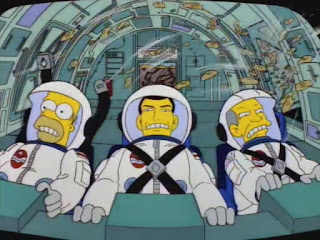
For me, the show started to slip in February '96 with "Scenes from the Class Struggle in Springfield." (Did anyone else notice that the font style of the opening writer-producer credits changed slightly in this episode and has remained different ever since? The letters are a little wider and taller than they were before.) This was around the time when Bill Oakley and Josh Weinstein took over from David Mirkin as executive producers. There's no reason to blame them specifically since the show is such a huge collaborative effort, but it was during their reign that the show became strangely mediocre. It was also around this time that episodes started referencing earlier (and therefore better) episodes, as if to say, "Hey, remember that episode from 1994 where Homer went into space? Yeah, that was a funny one. In fact, keep thinking about that episode while we insert this scene of two characters beating each other up for no apparent reason."
However, there were several wildly funny episodes during this period, like "The Springfield Files" and "Homer's Phobia." I think the show started to rebound in October '97 when Mike Scully took over as the "showrunner." It's a different show now than it used to be, with a bigger emphasis on Homer's wacky adventures rather than the entire family's dysfunctionality (call me a sap, but I miss the tenderness of episodes like "Lisa's Substitute," "When Flanders Failed," and "Sweet Seymour Skinner's Baadasssss Song"), but it's still consistently funny. That's why I don't think the show has jumped the shark yet. If it had stayed mediocre after Scully replaced Oakley and Weinstein, I probably wouldn't be watching anymore.

Many of us have grown up watching The Simpsons in awe and therefore feel very protective of it and defensive about which seasons are best. It's understandable since the show has been so terrific for so many years and has given all of us lasting memories of well-earned laughter. This show has had such a strange history, starting off with a huge merchandising push and media blitz in 1990, which led to some of the first season's episodes landing in the top 10 of the Nielsen ratings. I think most fans would agree that that season doesn't provide many laughs these days, but it's interesting to watch those episodes now and see the blueprint for future greatness.

By the fall of 1990, as The Simpsons entered its first full season opposite The Cosby Show on Thursday nights, the media hype died down and the ratings fell. And then a wonderful thing happened, just like someone mentioned earlier on this site: the show became "a true gem," a work of art. The writers realized that repeating Bart's catchphrases week after week wasn't going to satisfy them creatively, so they opened the show up to the vast realm of comedic and animated possibilities. Even though the show is wackier now than it used to be, it has always operated on dream logic. Unlike King of the Hill, which I also love, The Simpsons has never tried to be realistic. It takes full advantage of its cartoon status, and that's one of the main reasons why it's so rewarding. It also features the greatest running commentary about the love-it-or-hate-it medium of TV that I've ever seen (although SCTV and Late Night With David Letterman came close). And no other show that I've seen has featured so many memorable and endearing supporting characters; we could all rattle off about 50 names. Simply put, The Simpsons is the best TV show any of us will probably ever see in our lifetimes.

... And now, part two of my lecture, in which I attempt to clear up some misconceptions about the show, based on what I read in the comments listed above:

(1) Conan O'Brien was never the head writer of the show. He was never one of the executive producers, either. He was just one great writer out of a dozen great writers during the 1992-1993 season. He's only credited with writing three episodes—"New Kid on the Block," "Marge Vs. the Monorail" and "Homer Goes to College"—and the wraparound segments on "Treehouse of Horror IV," and it's not as if he came up with every joke and sight gag in those episodes. In TV, the writer who comes up with the storyline for an episode gets credited for writing the episode, but this doesn't mean he wrote it all by himself. If Jon Vitti, not O'Brien, had left The Simpsons to host his own late-night talk show, you'd probably be saying, "The show hasn't been the same since Jon Vitti left." I'm not saying O'Brien isn't a talented writer, but some of you are giving him way too much credit for the brilliance of the early episodes. After all, he only wrote for the show for one full season.

(2) As other people on this site have previously stated, Springfield is not actually located in Kentucky. Have you ever noticed the geography of Springfield?It has mountains, it has a volcano, it's next to the ocean, it's very close to Mexico, it's been hit by a hurricane, etc. Sound like Kentucky to you? Springfield is Anytown, U.S.A., and it will always remain that way. It's wherever you want it to be, except it's nowhere at all. However, a previous comment on this site did point out that the Springfield radio station's call letters are KBBL, which would indeed put Springfield west of the Mississippi River on the map.

(3) The first-run episodes of The Simpsons have always gone right into a commercial break after the opening sequence. It's the syndicated episodes that (usually) go straight from the opening sequence into the first block and then put the extra commercial break between the last block and the closing credits. The syndicated episodes also take out a minute of original material so that more local commercials can be added during the breaks. D'oh!

(4) The grocery-store cash register in the opening sequence doesn't really flash the message of "NRA4EVER." That was just a joke on the "138th Episode Spectacular!" If you pause your VCR during the opening sequence, you'll see that the cash register flashes some random shapes that don't spell out anything at all. It doesn't take a "mathematician" to figure that out.

(5) Whoever said the show "will never back down from making fun of all the tight asses out there (and I don't only mean homosexuals)" needs to stop watching The Simpsons. Bigots aren't welcome at this party.

(6) Stop bringing up the "Son of Sam and His Amazing Candlestick" issue, which was resolved long ago. We all know by now that he's the one who shot Mr. Burns, not Maggie. Finally, I want the writers to start showing more of Martin Prince and his raisin roundies! God, I miss that kid.

P.S. Stop making fun of Lisa. She's the conscience of Springfield and the smartest character on the show, which means she doesn't get to say any of the memorable "moron" lines that Homer and Chief Wiggum always say, but she's still a wonderful character. Don't you people realize what a heavy burden it is to be young and highly intelligent? Like Ralph Wiggum, I too love Lisa Simpson.

THE END. (Or is it?!)

Thursday, December 11, 2014

Ain't no stoppin' this sixth man.

In the scene that provides the title of Chris Rock's newest film as writer, director, and star, Top Five, his character defends LL Cool J's talents as an MC—"before the show," that is:


Unless I'm way off-base, "the show" is NCIS: Los Angeles, the CBS drama on which the rapper-actor born James Todd Smith has starred alongside Chris O'Donnell since 2009. But LL's first network series was the family sitcom In the House, which aired from 1995 to '96 on NBC before moving to UPN for three more seasons.

Two years prior to its debut Mr. Smith released his fifth album, 14 Shots to the Dome. On the track "Ain't No Stoppin' This" he grouses, "I guess I need a TV show to get mine / But I don't feel like kissin' no director's behind."


Well, not yet anyway. And if you don't kiss the right behind, you may find yourself on the lowest-rated network at the end of the 20th century.

Tuesday, November 4, 2014

untitled

I thought titles couldn't be copyrighted, which would explain why, for instance, the Replacements could name their 1984 album Let It Be despite the Beatles having used it 14 years earlier. But in The Gross: The Hits, the Flops—The Summer That Ate Hollywood (St. Martin's Press, 1999), author Peter Bart makes it clear that titles can be registered and "coveted":

For a couple of weeks, [director Michael] Bay and [screenwriter Jonathan] Hensleigh met to further refine their ideas before meeting with Joe Roth at Disney. They were twenty minutes into their pitch to Roth when he interrupted to say, "This will be the biggest movie of 1998. I'm making it."

Roth even had a title: Armageddon. The only problem, Roth conceded, was that Joel Silver, a producer at Warner Bros., had registered the title a few years earlier. "I'll do some horse-trading with Joel," he promised, noting that Warner Bros. coveted two titles owned by Disney—Conspiracy Theory and Father's Day.

The Robin Williams-Billy Crystal comedy Fathers' Day (fellow punctuation enthusiasts, note the plural, not singular, possessive) was released by Warner Bros. on May 9, 1997, while the Mel Gibson-Julia Roberts action thriller Conspiracy Theory hit theaters on August 8. The former grossed a disappointing $28.5 million; the latter grossed a less disappointing $75.9 million. Armageddon, on the other hand, made $201.5 million the following year. None of these films will be immortalized in the National Film Registry, but if Paul Westerberg and Tommy Stinson end up recording a new Replacements album titled "Conspiracy Theory Re: Armageddon on Father's Day," I don't think anyone will sue.

Tuesday, October 21, 2014

EBOLA (reference) DISCOVERED IN NEW MEXICO (four years ago)!!!!

I didn't see Breaking Bad during its five-year run on AMC, so I've been catching up on Netflix a few episodes at a time over the past month or so. In the third-season episode titled "Fly," which originally aired on May 23, 2010, Walter White (Bryan Cranston) tells his partner in crime, Jesse Pinkman (Aaron Paul), that there's a contaminant in their underground meth lab. Jesse is unnerved by this revelation until he realizes Walt is talking about a single housefly.

JESSE: When you say it's contamination, I mean, I'm thinking, like, an Ebola leak or something.

WALTER: (condescendingly) Ebola ...

JESSE: Yeah, it's a disease on the Discovery Channel where all your intestines sorta just slip right out of your butt.

WALTER: Thank you, I know what Ebola is.

JESSE: Uh-huh.

WALTER: Now tell me: what would a West African virus be doing in our lab?

Well, you do live one state over from Texas, Mr. White. Do I need to draw you a map?


Saturday, October 11, 2014

food for thought via thoughts on food bags

Chipotle is currently placing snippets of writing (remember, portion control is important) by authors such as Toni Morrison, Malcolm Gladwell, George Saunders, and Michael Lewis — and actor-comedians Sarah Silverman and Bill Hader for good measure — on its carry-out bags and paper cups.


As Saunders says on the Chipotle-sponsored website CultivatingThought.com, "I love the idea of putting something literary in a place we might not expect to find it." At the very least the pull quote above is more upbeat than the song lyrics featured on either side of the decades-old Treasure Island Foods bag I found in the archives at my last job. I'll take humorous optimism with my vegetarian burrito bowl over romantic pessimism with my European cheeses any day of the week.

Sunday, September 14, 2014

From the archives (i.e., piles of newspaper clippings on my dusty studio-apartment floor) ...

Terje, you might find this interesting. It comes from Miriam Di Nunzio's interview with veteran music producer David Foster, published in the Chicago Sun-Times on October 16, 2009.

Q: Is it getting harder for you to make albums today?

DF: I really love the music of today. I love Beyonce, Rihanna, producers like Tricky Stewart, Kanye, Jay-Z, Sean Kingston. I love those records but I have no clue how to make these records; suddenly, you're 60 trying to think like you're a 16-year-old. I know my place. People who complain about the music business as they get older and say they "had to leave it" are full of it. The business leaves them. Nobody leaves the business. I'm still getting [excited] musically, even more so now that I don't have the pressure of radio. Now I just have to make albums.

Saturday, September 6, 2014

signs of the times

They're pointing from fatty to healthy at the intersection of Clark Street and Drummond Place.

Sunday, August 31, 2014

giving credit where credit was due 20 years ago

In today's New York Times Jon Caramanica writes about André "André 3000" Benjamin's reunion with Antwan "Big Boi" Patton to celebrate Outkast's 20th anniversary as recording artists, plus Benjamin's role as Jimi Hendrix in the new film biography Jimi: All Is by My Side, written and directed by John Ridley, who won the Oscar for Best Adapted Screenplay earlier this year, for 12 Years a Slave. A couple of points stand out in Caramanica's article:

For the better part of his career, André 3000 has been a pioneer, sometimes to his detriment. Outkast was a titan of Southern hip-hop when it was still being maligned by coastal rap purists. On the 2003 double album "Speakerboxxx/The Love Below," which has been certified 11 times platinum, he effectively abandoned rapping altogether in favor of tender singing, long before melody had become hip-hop's coin of the realm.

I would argue that P.M. Dawn were far more ahead of their time than André 3000 in that department. By their third album, Jesus Wept (1995), frontman Prince Be had abandoned rapping altogether in favor of singing, but even on their 1991 debut, Of the Heart, of the Soul and of the Cross: The Utopian Experience, Be sang for the duration of the tracks "On a Clear Day" and "In the Presence of Mirrors":


(In a possible nod to the duo's influence, rapper Childish Gambino, a.k.a. actor-comedian Donald Glover, covered their 1992 hit "I'd Die Without You" earlier this year on BBC Radio 1Xtra.)

Here's another point of Caramanica's I disagree with:

His forays into fashion (Benjamin Bixby) and animated television (“Class of 3000”) would have made far more sense — and had a far bigger impact — a couple years down the line. In many ways, André 3000 anticipated the sound and shape of modern hip-hop ambition.

I don't care to argue his point about fashion, though I'm pretty sure Sean "Puff Daddy"/"P. Diddy" Combs's Sean John line of clothing came before André 3000's, but does Caramanica not remember Kid 'n Play's Saturday-morning cartoon on NBC in the fall of 1990?


Or MC Hammer's on ABC the following year?


Hey, nobody said pioneering had to lead anywhere good. Just ask the Donner Party.

Saturday, August 30, 2014

"The future is now!"

"The future is now! Soon every American home will integrate their television, phone, and computer. You'll be able to visit the Louvre on one channel or watch female mud wrestling on another. You can do your shopping at home or play Mortal Kombat with a friend in Vietnam. There's no end to the possibilities!"

—psychotic cable-TV technician Chip Douglas (Jim Carrey) in The Cable Guy (1996)


Eighteen years later, however, I still haven't found that female-mud-wrestling channel. C'est la vie.

Friday, August 15, 2014

fantasy vs. reality

Since 2009 Sofía Vergara has played Ed O'Neill's wife on my favorite current sitcom, Modern Family. And in this summer's Chef she plays the ex-wife of Jon Favreau, who also wrote and directed the film.

No offense to O'Neill or Favreau or any men who look like them who don't make TV and movie money, but the odds are that any woman who looks like Sofía Vergara has her pick of the litter. She doesn't have to settle for a big-bellied bulldog—not when she can have True Blood werewolf Joe Manganiello.

But since most of us don't look anything like him, we'll continue to do the right thing and create movies and TV shows in which Vergara plays the homely hero's wife, ex- or otherwise, so that she can continue to pay her bills. (Is selflessness a turn-on for you, Sofía? Just curious ...)

Saturday, July 26, 2014

Will there ever be peace in the Middle East (on Duck World)?

As you can see in the Topps trading card below, nothing has changed since 1986. But we mustn't duck and cover. We must not quack up or waddle away from the negotiating table. One day we will all break breadcrumbs together. One day we will finally have peace.


Friday, July 25, 2014

No one opens the door for a native New Yorker. (No one?) No one.

How did Odyssey's ready-for-prime-time 1977 hit "Native New Yorker" not find its way into the opening credits of a network sitcom back in the heyday of disco?


It was used to promote The Tonight Show Starring Jimmy Fallon earlier this year, with Fallon roller-boogieing down a New York City sidewalk, but why couldn't Busting Loose, a short-lived CBS comedy starring Adam Arkin as "a young man in New York City who has moved out of his parents' house to live on his own for the first time," according to the show's Wikipedia entry, give it a good home? What, not butch enough for you, Busting Loose?


Okay, I see your point.

To be fair, Busting Loose premiered in January of '77, and "Native New Yorker" didn't become a hit until that summer, apparently. That means the Barney Miller spin-off Fish, which debuted in February, would've been ineligible as well. (When a station in my hometown of Macon, Georgia, aired reruns of Fish in the summer of '83, it used Madness's then-current hit "Our House" in its promos, which is why Abe Vigoda and Suggs will be forever linked in my mind.)


However, the Mary Tyler Moore Show spin-off Rhoda was entering its fourth season in the fall of '77 and could've used some new platform shoes.


ABC's Makin' It didn't live long enough to see its theme song reach number five on the Billboard Top 40. That's because the show was canceled months earlier. (Oh, the humanity.) Besides, Makin' It centered on a native New Jerseyer, not a native New Yorker. (It's worth pointing out that Greg Antonacci, who was scary as hell in the final season of The Sopranos as one of Phil Leotardo's henchmen, was a featured player on both Busting Loose and Makin' It. He also made a couple of memorable appearances in those days on The Rockford Files, on which Sopranos creator David Chase was a writer.)


Welcome Back, Kotter, you could've used a boost in your final season (1978-'79) after John Travolta left for greener pastures on the big screen. On second thought, never mind—John Sebastian's melancholy but ultimately uplifting "Welcome Back" is a perfect TV theme song. No need for a quick fix of something that wasn't broken to begin with.


The same goes for Taxi, which debuted in the fall of '78. I love you just the way you are, Bob James's "Angela."


I guess it wasn't meant to be, "Native New Yorker," but keep your head up—I have a feeling you're gonna make it after all.

Monday, June 30, 2014

"Transformers" transforming without the assistance of one particular human

The fourth Transformers movie, Transformers: Age of Extinction, opened last Friday and is already loudly smashing and stomping its way toward global domination—but without the on-screen services of Shia LaBeouf, the male lead in the first three installments. As he told MTV News in 2011, shortly before the release of Transformers: Dark of the Moon, "I'm not coming back to do another one. I don't think [director Michael Bay] will either. It still is a hot property, I think, especially coming out of the third one. So I imagine they'll reboot it at some point with someone else."

Just three years later, "some point" has arrived, and Michael Bay is at the helm once again. Am I the only one who thinks he told LaBeouf he wasn't interested in making a fourth Transformers just so the actor would say, "Yeah, dude, I feel the same way—a trilogy's the way to go"? LaBeouf hasn't led a quiet life off-screen, to put it mildly, making me wonder if he's a headache on the set who chalks up any and all unprofessional behavior to "performance art."

Bay's continuation of the Transformers series without LaBeouf reminds me of the Ben Folds Five song "Army" (1999), in which the protagonist joins a band after dropping out of college:

Grew a mustache and a mullet
Got a job at Chick-fil-A
Citing artistic differences

The band broke up in May
And in June reformed without me

And they got a different name
I nuked another Grandma's Apple Pie 

And hung my head in shame

If it's any comfort, Shia, apple pie is much more satisfying than any of the Transformers movies I've seen so far.