Showing posts with label Sydney Pollack. Show all posts

Monday, March 9, 2020

the gentleman assassin (R.I.P. Max von Sydow, 1929-2020)

One of my favorite movie moments arrives in the first act of Sydney Pollack's Three Days of the Condor, when Max von Sydow's assassin, Joubert, is leading the massacre of Joe Turner's (Robert Redford) CIA colleagues. The last one still standing, Janice (Tina Chen), is asked, gently, by Joubert to move away from the windows.

"I won't scream," she says.

"I know," he replies, and von Sydow delivers the line in an almost paternal way. Nothing personal—just business.

Joubert is one of the most memorable "bad guys" in any movie I've seen, and although Pollack's go-to script doctor, David Rayfiel, gives him some great dialogue, von Sydow is the reason why Joubert becomes the most three-dimensional character in the film. He steals Three Days of the Condor from his top-billed costars in the most gentlemanly fashion possible.

Wednesday, October 17, 2018

liberals and conservatives (part two)

"[Acting] is a little bit of 'Look at me, look at me,' I suppose, but I don't think that's all of it. A lot of the rest of it is just experiencing all of the other stuff that you're going to experience: What is it like to be a killer, what is it like to be a slave, what is it like to be a prince, what is it like to be Hitler? How do you play that? Where do you find that in yourself? I think it's the reason that most artists tend to be liberal as opposed to conservative. There are more conservative liberals and there are more liberal conservatives, but it's very hard to walk in other people's shoes and not have a little more understanding of what it's like, in a certain way, if you spend your life being other people and trying to see the world through their eyes. In some way all liberal arts teach you compassion—they can't avoid that."

Sydney Pollack, from the documentary Character (2009)

Tuesday, April 26, 2011

My infatuation with Three Days of the Condor is forever (dot dot dot).

Film critic Juliette Small invites her daughter, Erica, and Erica's friend Katherine to join her for an advance screening of a new Robert Redford movie in chapter 14 of Forever..., Judy Blume's controversial 1975 novel about young love, which I'm reading for a grad-school research paper on young-adult fiction.

After the picture Mrs. Small asked me, personally, what I thought of it.

"Well ..." I told her, "I just love Robert Redford."

"Don't we all ..." Mrs. Small said, "but I mean about the story."

"Oh, the story ... I liked it ..."

"But ..."

"I don't think it could happen that way in real life ..."

"Exactly!" she said. "But you wanted it to, didn't you ... you were hoping it would turn out just that way."

"Yes," I told her.

"You see ... that's the whole point."

"It's going to be a smash," Erica said.

"In spite of my review, you mean?"

"In spite of anybody's review."

"I agree with you, completely," Mrs. Small said.

In 1975 Robert Redford starred in two films, The Great Waldo Pepper and Three Days of the Condor. The former was scripted by William Goldman and directed by George Roy Hill, who had previously collaborated with Redford on 1969's Butch Cassidy and the Sundance Kid, while the latter was helmed by Sydney Pollack, who, prior to Condor, had already directed the California native in three films, including the western Jeremiah Johnson (1972) and the romantic drama The Way We Were (1973), costarring Barbra Streisand.

The Great Waldo Pepper is a period piece in which Redford plays a 1920s stunt pilot, but Three Days of the Condor is a contemporary thriller that asks audiences to believe that a guy as handsome as the Sundance Kid is employed by the CIA as a bookworm rather than a dashing James Bond clone. As Katherine says, "I don't think it could happen that way in real life." But you want it to.

Waldo was released in March of '75; Condor came out in September. When Katherine, the protagonist of Forever..., takes a train from Westfield, New Jersey, into New York City with Erica and her mom to see "a preview of a new Robert Redford picture," it's either late March or early April in the book's narrative. Yes, I'm fully aware of the possibility that Blume isn't talking about any Redford movie in particular—for one thing, I don't know when exactly Forever... was published in '75 (spring, summer, etc.), or if she even had a particular year in mind besides "right now, whenever that is" when she wrote the book, or if copyright issues prevented her from using the title of an actual Redford movie—but a boy can still dream, even when he's no longer a young adult.

Monday, November 23, 2009

in between

On the run from government assassins after a botched attempt on his life, and looking for a place to hide, CIA bookworm Joe Turner (Robert Redford) kidnaps a stranger, Kathy Hale (Faye Dunaway), and forces her to drive him back to her place, in Sydney Pollack's 1975 film Three Days of the Condor.

Later, at Kathy's apartment, Joe uses a rare moment of quiet to look at the black-and-white photographs on her walls.

Joe: Lonely pictures.
Kathy:
So?
Joe: You're funny. You take pictures of empty streets, and trees with no leaves on them.
Kathy:
It's winter.
Joe: Not quite winter. They look like ... November. Not autumn, not winter. In between.

Thursday, August 27, 2009

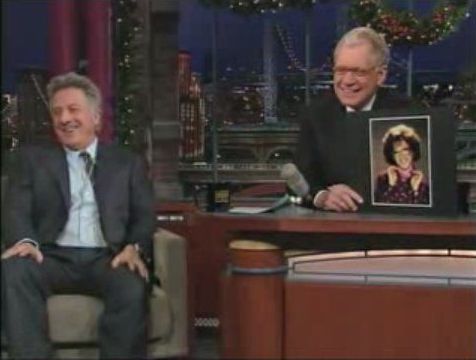
the day Dustin Hoffman met George Clooney's uncle

On Tuesday night I watched
Sydney Pollack's Tootsie (1982) at Butler Field in Chicago's Grant Park. It was the final film in this summer's Chicago Outdoor Film Festival—in July I saw Billy Wilder's Sunset Boulevard—and the first time I'd seen my favorite of Pollack's movies on a big screen. The appreciative audience surrounding me didn't hurt.

Yesterday* I discovered the following Late Show With David Letterman clip, from December 22 of last year, on YouTube:

ACCEPT NO SUBSTITUTES EXCEPT THIS ONE

* Almost 14 years later I discovered that the original clip had been pulled from YouTube. The link above, which I can't embed on Blogger the normal way because of the time stamp, will have to do.

Saturday, June 13, 2009

African fiction

This week's Soundtrack Saturday post at Popdose centers on the 1988 film Coming to America, in which Eddie Murphy plays a prince who lives in the fictional African country of Zamunda.

On the seventh season of 24, which ended last month, some of the bad guys were from the fictional African country of Sangala.

If one were to create a fictional map of "the dark continent," would Zamunda and Sangala be anywhere near Matobo, the fictional African country in Sydney Pollack’s The Interpreter? (Ivory Coast native Isaach de BankolĂ© played the prime minister of Sangala this year on 24. His name? Ule Matobo.) Wikipedia has an entire page devoted to fake African nations, which makes me wonder if the continent's biggest import is intellectual-property lawyers.

My friend Paulina recently moved to Kenya for a contract position with the United Nations. Apparently it's a real country, but the name could use a rewrite. How about Kinjanja? Or even Kwanzaaland? I'm looking forward to your second draft, Paulina.

Speaking of the Democratic Republic of Kareemabduljabbar, the Associated Press reported on April 30 that thousands of Kenyan women had stopped having sex in order to protest the bickering of their country's male leaders. "We have seen that sex is the answer" when it comes to avoiding civil war in Kenya,
said Rukia Subow. It's hard to disagree with that assessment, ladies, but a man's gun, literal or otherwise, is inevitably going to go off, with or without your help.

Wednesday, March 4, 2009

Oscars wrap-up (What, too late?)

First off, Ben Stiller's take on Joaquin Phoenix's odd behavior outstayed its welcome when he presented the Best Cinematography award with Natalie Portman, partly because it was too much of an inside joke. I knew the reference, but I didn't see Phoenix's February appearance on Late Show With David Letterman until a few days ago, and a friend of mine had no idea what Stiller was doing and why people in the audience were laughing.


I hope Phoenix doesn't give up acting, because the YouTube clips of him on Late Show elicit many emotions: sympathy, embarrassment, annoyance with the audience, annoyance with Phoenix, sympathy for Letterman, sympathy for the audience. Back in 2000 when he was promoting Gladiator on The Tonight Show, Jay Leno supposedly ended the interview with "Thanks for coming, Joaquin. Next time bring your brain." I never saw that interview and can't find it on YouTube, but Letterman says something similar here. Joaquin marches to the beat of his own drum machine.

On to the main event—I've waited until now to talk about the Oscar ceremony that took place two weeks ago because I wanted to let it completely sink in before I did a full analysis. And if you believe that, I'd like to offer you an
authentic Oscar statue for only $10,000 cash. I found it in the trash outside Jack Nicholson's place in Malibu. I guess he felt he didn't really deserve that third one for 1997's As Good as It Gets.

Two of the comments under the post I wrote (and actually finished!) the day of the Oscars took the words right out of my mouth. First, this one from Halfhearted Dude:

The TV direction in the In Memoriam segment was criminal — I almost wish that the director will feature in it next year for messing up the best part of the show. Long angle shots of screens on which the writing was too small, and sometimes the image of the late subject. Unlike certain child actors, I couldn't see dead people. And then the camera zoomed in and out and left and right; I nearly got seasick. What pretentious rubbish.

I agree wholeheartedly, Halfhearted! I was especially invested in this year's "In Memoriam" segment because of the 2008 passing of Sydney Pollack, one of my heroes, but as soon as the segment started with Queen Latifah singing whatever she was singing, I had a bad feeling. Since Laurence Mark and Bill Condon had said they wanted this year's ceremony to feel more like a party, I got the impression that they decided the big downer moment would be Heath Ledger's family's acceptance speech if he won (yep, I shed a tear, as I expected), and that the "In Memoriam" segment would be the equivalent of when you're at a party and you get stuck talking to your friend who becomes morose whenever he's drunk and wants to discuss "what it all means." You make a beeline for the cooler, which is what the cameramen seemed to do during the "In Memoriam" segment. I'm sure the producers didn't mean to be disrespectful in their presentation of the segment, but it was executed about as poorly as it possibly could. Next year the names and images need to be visible to the viewers at home the entire time, not just to the audience inside the Kodak Theatre.

Next up is this comment from Jane:

I couldn't stick with the whole Oscar ceremony. I think for me what was missing were the film clips. I've always enjoyed the film clips playing while the nominees are called. The "tribute" from previous winners was a nice idea, but didn't hold the same impact for me.

Again, I agree. The Oscar ceremony is already the most self-congratulatory night of the year in Hollywood, so amplying that aspect with the tributes to the actor nominees made me squirm. "You're great!" "No, you're great!" Enough. I have no doubt it's difficult to pick out solid Oscar clips for the actor nominees each year—a good performance can't be encapsulated in 20 seconds—but for people like me who hadn't seen most of the performances that were nominated, I had no reason to think any of the nominees were better than any other. At least with the Oscar clips you can be "hooked" in those 20 seconds and see a glimpse of lightning in a bottle, even if the clip just shows the actor screaming or crying, which are the "old standby" displays of emotion in Oscar clips. (My roommate during my freshman year of college thought that good acting boiled down to how loud you can yell, or at least that's the impression he gave. Who needs subtlety? Just crank up the volume, and flip over a table while you're at it.)

I think a conspiracy was afoot—yes, afoot!—with the Oscar clips because Robert Downey Jr. was nominated for Tropic Thunder. After he was nominated I wrote my friend Jeremy and said, "Do you think his 'full retard' speech in that movie will be the clip?" If you haven't seen Tropic Thunder, I'll just say that the speech involves the Downey character's take on why certain actors win Oscars for playing mentally handicapped people and others don't. For instance, Dustin Hoffman played a character who was merely autistic in Rain Man, so he won Best Actor in 1989, but Sean Penn "went full retard" in I Am Sam, so he didn't win Best Actor in 2002.

The host of a party who can make fun of himself or take a joke at his own expense is a good host, but maybe the Academy isn't that kind of host. Or maybe Sean Penn is still sore about losing that Oscar for I Am Sam. Or maybe the fact that Downey was the only "black" actor nominated this year in both the lead and supporting categories made the Academy not want to show what he looks like in Tropic Thunder, in case Al Sharpton or Jesse Jackson were nearby with a stack of fresh picket signs waiting to be hoisted. But the "full retard" speech, though it may be offensive to some moviegoers, does a good job of showing the mindset of Downey's five-time-Oscar-winning Method-actor character, who goes to extremes to capture the "truth" in his performances yet is still career-savvy enough to know what Academy members will vote for.

(I also think Downey's Oscar nomination was more of an acknowledgement that he's "back" than anything else. His performance in Tropic Thunder is funny at first, but it wears thin, and the movie is a disappointment overall. Meanwhile, the trailer for The Soloist, also starring Downey—though Jamie Foxx plays the black guy in this one—is on the Tropic Thunder DVD, and when I saw it I thought, "Oh yeah, wasn't this piece of Oscar bait supposed to come out in the fall?" Sure enough, it ends with the date "November 2008"; DreamWorks's decision to push the film's release back to April doesn't bode well for its quality.)

Did you notice what when Jennifer Aniston was presenting the animation awards with Jack Black, the camera cut to Angelina Jolie in the front row looking at Aniston? Reeeal classy, Mr. Director. It wouldn't be a party without icy tension between two gorgeous women who've both been with the same guy!

What else? I think Beyoncé was lip-synching during the big Baz Luhrmann-choreographed musical number. And I liked that Sean Penn acknowledged Mickey Rourke in his acceptance speech for Best Actor, because it reminded me that Rourke had a great cameo in The Pledge, which was directed by Penn and starred Jack Nicholson. I recommend it if you haven't seen it. I had low expectations when I first saw it because it came out in January of '01 but was originally supposed to be released in the fall of 2000 to qualify for awards season. Releasing a film in January is never a good sign, but The Pledge isn't an embarrassment by any means. It stuck with me long after I saw it, and though Rourke only has one scene, it was enough to remind me that he was still a good actor who had something left to prove.

Friday, May 2, 2008

creation

XTC's Andy Partridge on the demo version of "Holly Up on Poppy" (courtesy of the blog Timedoor and, presumably, the liner notes of Partridge's Fuzzy Warbles 3, which is why I'm leaving the punctuation intact):

"When [my daughter] Holly rode her rocking horse 'Poppy', she would say 'Daddy, I like its Poppy song'. That song was the low rhythmic rumble and high un-oiled squeak of its moving parts. I tried to capture that in this demo from 11th of May 1990. Of course I failed but isn't that the curse and motivation of all art? To bottle the unbottleable. I also have a rocking horse fixation, but you knew that."


Frank Gehry on the creative process, from Sydney Pollack's 2006 documentary, Sketches of Frank Gehry:

Pollack: "Is starting hard?"

Gehry: "You know it is. I don't know what you do when you start, but I clean my desk, I make a lot of stupid appointments that I make sound important. Avoidance, delay, denial. I'm always scared that I'm not gonna know what to do. It's a terrifying moment. And then when I start I'm always amazed: 'So ... that wasn't so bad.'"